
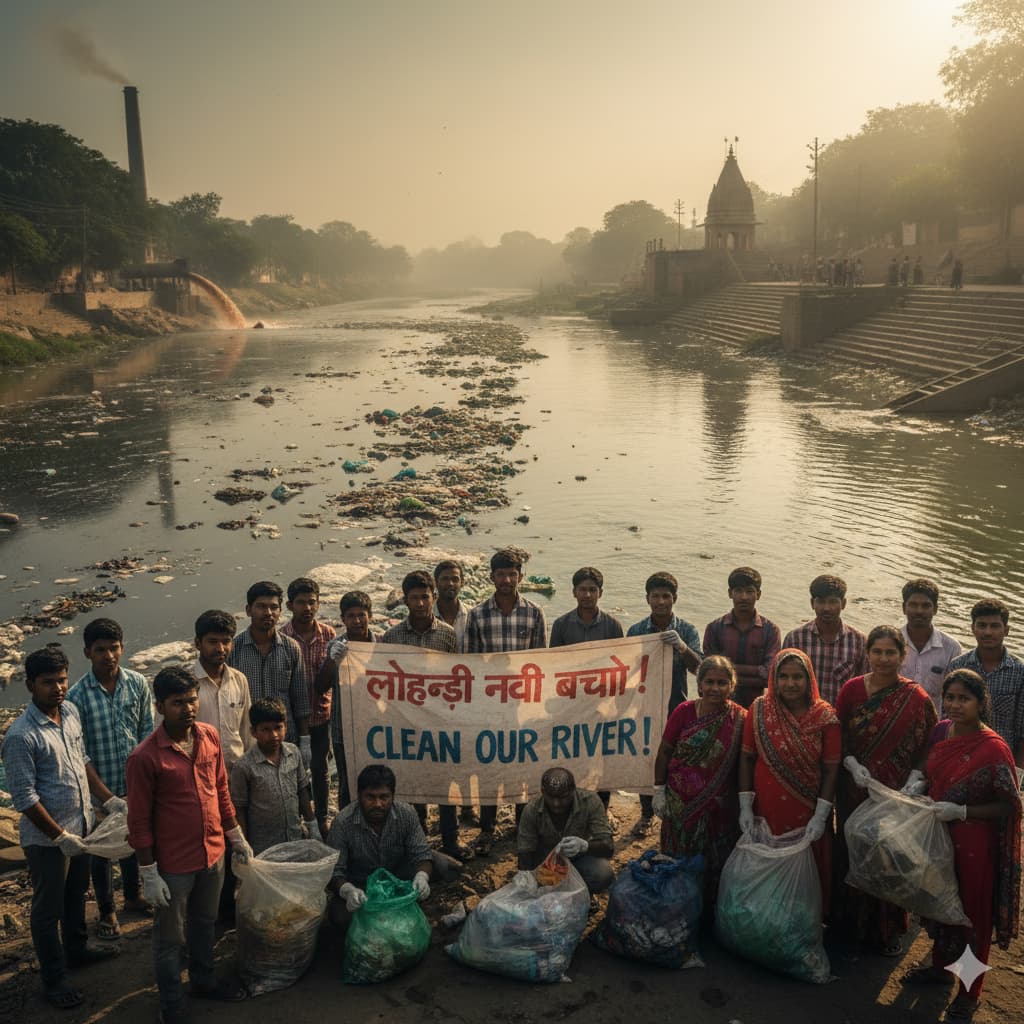
💧 The Saga of Lohandi River: Transparency, Pollution, and the Quest for Accountability
The Lohandi river in Mirzapur is a small river originating from Barkachha Khurd. It merges with the Ganga. It has become a stark symbol of environmental neglect and bureaucratic opaqueness. Despite an allocation of Rs. 10 million (one crore) for its renovation, the river remains severely polluted. This prompted a citizen, Yogi M. P. Singh, to file a Right to Information (RTI) application. He sought details on the expenditure and the efficacy of the cleaning efforts. The documented details from the RTI application and ensuing appeal highlight the environmental crisis. They also reveal a significant challenge in achieving transparency and accountability in public works.
The State of the Lohandi River: Pollution and Neglect
The condition of the Lohandi river, as described in the accompanying text, is dire.
- Garbage and Pollution: The river near the city boundary and Gyaarah Takhwa is reportedly “filled with garbage.” Its water is polluted. It has turned black.
- Sources of Contamination: The primary culprits are identified as:
- Industrial Discharge: “Poisonous water” and “chemical-laden water” from a factory beyond Nakhara.
- Domestic Sewage: Dirty water from nearby settlements.
- Environmental Impact: The pollution is severe. Animals reportedly “die after drinking the river water in summer.” A “foul smell” is making life difficult for nearby residents. Mosquitoes are also breeding in the contaminated water.
- Failed Renovation: Despite the stated expenditure of Rs. 10 million for renovation, the condition near Gandhi Ghat, Sonra Ghat, and Gyaarah Takhwa remains poor. This suggests the funds either were not properly utilized. Alternatively, the pollution sources were not addressed.
Dilip Kumar, PD (Incharge CDO), stated that the condition has improved. He mentioned that cleaning will be done near Gandhi Ghat and Gyaarah Takhwa. This statement contrasts sharply with the described reality. The river is “filled with garbage.” Its water is polluted. These issues raise serious questions about the status of the renovation.
❓ The Information Sought: A Demand for Transparency
To understand how the significant funds were utilized, the applicant sought detailed information through the RTI application. They wanted to know why the river remains polluted. The six key questions were:
- Sanction Details: Name, designation, and posting of officials who sanctioned the Rs. 10 million for the renovation.
- Proposal Copy: A copy of the proposal made to the competent authority for the renovation.
- Technical Oversight: Name, designation, and posting of the technical experts who monitored the renovation.
- Precautionary Measures: Details of precautionary measures taken before renovation to stop further pollution.
- Addressing Company Discharge: Information on measures taken to apprise the Chief Development Officer (CDO) about the factory’s discharge before renovation. They argued that the work was “meaningless if discharge of the excretion of company was continued.”
- Financial Records: Estimates, work booklet, and invoices about the renovation work.
These questions directly target the core issues. They include the financial flow, the planning and technical execution, and the failure to tackle the root cause of pollution. This root cause is the factory discharge, which rendered the renovation ineffective.
🚧 The Battle for Information: The Appeal
The starting RTI application (Registration No. COMRD/R/2025/60052) was filed on 03/02/2025 and disposed of on 21/02/2025. The applicant alleges the application was merely transferred to the Block Development Officer (BDO), City Mirzapur. This was done under Section 6(3) of the RTI Act, 2005. It was then illegally closed.
The appeal (Registration No. COMRD/A/2025/60058), filed on 22/02/2025, raised critical points about this procedure:
- Illegal Closure: The appellant argued that transferring the application to another Public Authority is not permissible. The original PIO (District Development Officer, DDO) can’t dispose of the inquiry in this manner. The original PIO must handle the demand directly.
- Accountability Dodge: The appeal states that the DDO should have collected the information from the concerned authority (BDO). The DDO should have uploaded this information. The appeal suggests the current action is a way of “escaping from the accountability.”
- Erosion of Right to Appeal: The DDO closed the original application. This action effectively “encroached the right of the first appeal” of the appellant. It did so against incomplete or misleading information from the BDO.
The appeal emphasizes that the RTI Act was introduced to promote transparency and accountability. These principles are being undermined by such “cryptic roles” played by the Public Authority to withhold information. This is especially worrying in a “matter of corruption.” The appeal sought a directive. It requested the First Appellate Authority (FAA), the CDO, to give the information as per the law.
The status of the appeal as of 28/06/2025 is “APPEAL DISPOSED OF.” The reply states it was “sambandhit ko antarit” (transferred to the concerned party). This suggests the appellant’s concerns about procedural irregularities were not fully addressed. Additionally, the core information about the Rs. 10 million expenditure and river cleanup is still elusive, keeping the accountability issue alive.
⚖️ The Broader Context: Transparency and Environment
The Lohandi river case encapsulates the challenges facing local governance in India. It demonstrates the critical link between environmental preservation and public accountability. Public funds for environmental projects need transparent disclosure. Effective measures are necessary to enforce anti-pollution regulations. Without these, valuable resources will continue to be wasted. The environment will suffer, which impacts the lives and health of citizens. This is shown by the distress of the residents near the Lohandi river. The persistence of the applicant, Yogi M. P. Singh, highlights the indispensable role of active citizens in demanding good governance.
Would you like me to find out the current status or any recent news about the Lohandi river cleanup project?
Information sought concerning corrupt information board images of G.P. Lohandi Kala
ADO Panchayat city block must upload legible public information board images
ADO Panchayat city block must upload legible public information board images
BDO City Block uploaded illegible information board images to conceal corruption


Facing a similar challenge? Share the details in the box below, and our team of experts will do their best to help.