
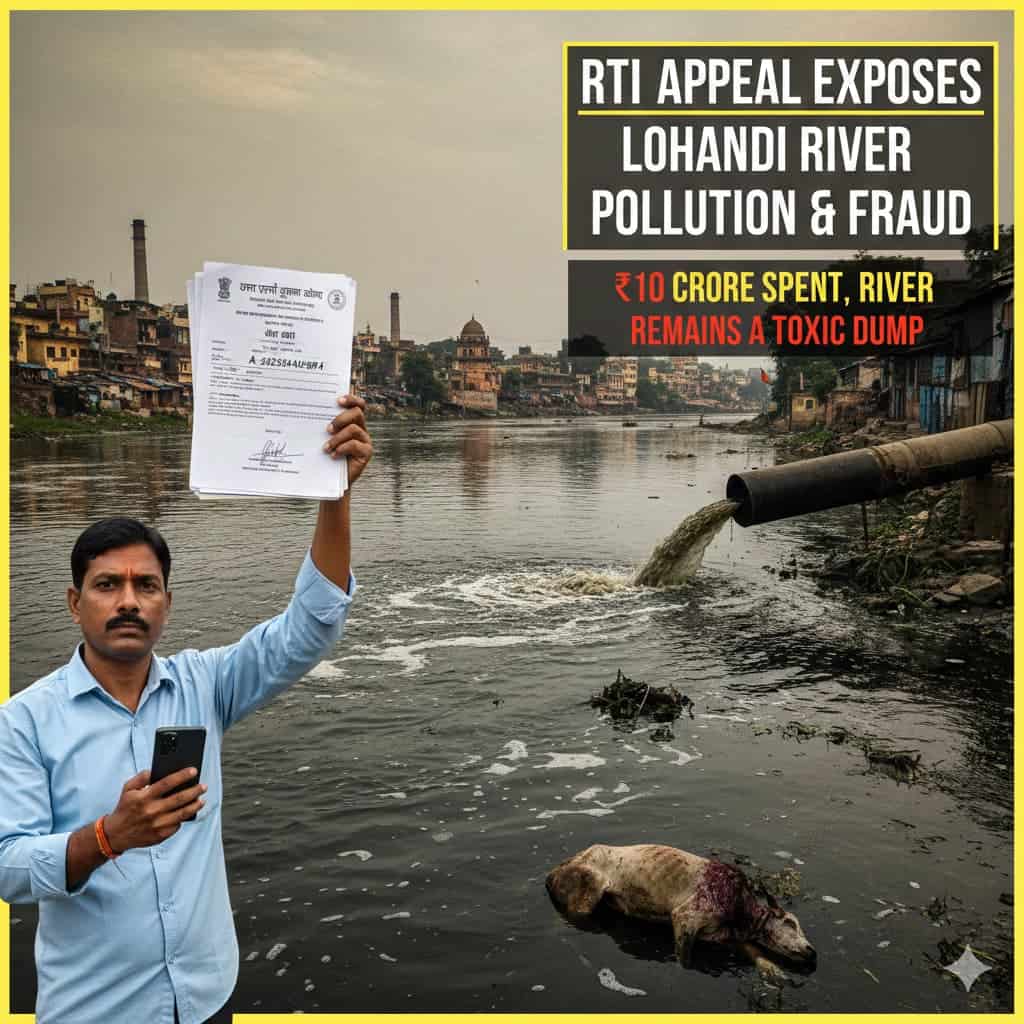
RTI Appeal on Lohandi River Pollution: The pollution of the Lohandi River has emerged as a pressing environmental issue, significantly negatively impacting the local ecosystem and the health of nearby communities. Once a vital source of life and livelihood for many residents, the river now suffers from severe contamination due to both industrial waste and domestic sewage. Consequently, this contamination has led to a notable decline in fish populations and poses serious health risks to those who still rely on the river for drinking water. Through this RTI appeal, we therefore request information on the measures that relevant authorities are currently taking to combat this pollution problem, as well as the effectiveness of these interventions in restoring the river’s condition.
Key Takeaways
- The pollution of the Lohandi River poses serious health risks and impacts local ecosystems, prompting an RTI appeal for information on government actions.
- The appellant argues that, should the CDO confirm renovation projects worth $10 million, it follows that the information cannot be dismissed as merely hypothetical.
- Under the RTI Act, the requested information is not only factual but also should include documents pertaining to spent funds and project completion.
- The PIO incorrectly cited the hypothetical clause and misinterpreted page limits to deny information, undermining transparency and accountability.
- The appellant seeks a penalty against the PIO and disciplinary action for failing to provide crucial public documents related to the environmental issue.
🏗️ RTI Appeal on Lohandi River Pollution: Why Documents Aren’t Speculation
The appellant, Yogi M. P. Singh, presents a compelling argument: if the Chief Development Officer (CDO) Mirzapur publicly acknowledges that the Lohandi River renovation occurred and that they spent $10 million, one cannot logically dismiss the requested information as hypothetical.
The conflict, therefore, centers on a fundamental misunderstanding—or misapplication—of the Right to Information (RTI) Act, 2005, along with the corresponding U.P. Rules, 2015, by the Public Information Officer (PIO).
🚫 What is Not Hypothetical Under RTI?
In the context of RTI, information is hypothetical if it requires the PIO to: (RTI Appeal on Lohandi River Pollution)
- Create an Opinion: e.g., “What is your view on the quality of the river renovation?”
- Answer a “What If” Scenario: e.g., “If the company stopped discharging waste, would the river be cleaner?”
- Perform Calculation or Interpretation: e.g., “Calculate the total environmental impact over the next five years.”
The Information Sought is Factual (RTI Appeal on Lohandi River Pollution)
The appellant’s six-point request seeks specific, document-based, and verifiable facts relating to a completed governmental action.
| Information Point | Nature of Document/Record |
| Sanctioning Authorities | Office order/Sanction letter, records of designation |
| Copy of Proposal | Official project proposal document |
| Technical Experts | Duty/deployment orders, attendance/monitoring logs |
| Precautionary Measures | Official minutes of meeting, project plan document |
| Company Excretion Discharge | Internal correspondence, inspection reports, action memos |
| Estimates, Work Booklet, Invoices | Financial records, Measurement Book (M.B.), bill vouchers |
Since the CDO confirmed the work and expenditure, these records must exist within the public authority’s possession. Documents are never hypothetical; they are the concrete evidence of official action.
🛑 Analyzing the PIO’s Two Faulty Grounds (RTI Appeal on Lohandi River Pollution)
The PIO (via the Block Development Officer) used two primary grounds for denying the information, both of which appear flawed in light of the official confirmation of the work:
1. Misapplication of the Hypothetical Clause
The PIO cited Rule 4(2)(b)(iii) of the UP RTI Rules, 2015, asserting that the request, consequently, involves “answering hypothetical questions.” (RTI Appeal on Lohandi River Pollution)
- The Flaw: By confirming that $10 million was spent on a renovation that took place, the Public Authority (through the CDO) effectively establishes the existence of the factual record. Indeed, you cannot spend public money on a project and then claim that the records associated with that spending are a hypothetical matter. Furthermore, this PIO response clearly utilizes a specific exemption clause to withhold existing, non-exempt information.
2. Misinterpretation of the Word/Page Limit (RTI Appeal on Lohandi River Pollution)
The PIO also claimed the request was “not payable” due to being on “two pages” and containing “more than 500 words” (citing Rule 4(2)(c) of the UP RTI Rules, 2015).
- The Flaw: State RTI rules limit the length or complexity of a single application (often to 500 words or one page for the query text) to prevent excessively complex or voluminous requests that hinder the PIO’s daily duties. However, these rules do not allow the PIO to deny access to crucial public documents related to corruption and environmental protection, especially when the official RTI portal generated and accepted the application itself. The appellant noted that the two pages comprised the official RTI application format.
⚖️ The Relief Sought: Transparency and Accountability
The appellant’s request is not just for documents; it is a direct challenge to the lack of transparency and accountability regarding the $10 million expenditure, especially given the continuous pollution issues from the company’s discharge. (RTI Appeal on Lohandi River Pollution)
The appellant’s prayer to the UP Information Commission is to:
- Impose a Pecuniary Penalty (Section 20): Consequently, this is sought against the PIO (DDO Mirzapur, Shri Shravan Kumar Rai) for what the appellant deems to be a denial of information on “false and flimsy grounds.”
- Initiate Disciplinary Proceedings: This action is sought against the First Appellate Authority (FAA), CDO Mirzapur, Vishal Kumar, for failing to pass an order on the first appeal. Consequently, this oversight constitutes a violation of the statutory duty outlined in Section 19(1) of the RTI Act.
Ultimately, the appellant is asking the Information Commission to not only enforce the spirit of the RTI Act but also to emphasize that where public money is spent on a public work, the records of that spending must consequently be made public. (RTI Appeal on Lohandi River Pollution)
Based on the details provided in your appeal document and supporting search results, here are, subsequently, the requested contact details as well as the registration link for the Uttar Pradesh Information Commission (UPIC):
📞 Key Contact Details (RTI Appeal A-20250400904)
1. Appellant’s Details (Yogi M. P. Singh) (RTI Appeal on Lohandi River Pollution)
| Detail | Information |
| Mobile Number | 7379105911 |
| Email ID | yogimpsingh@gmail.com |
| Alternative Email | yogimpsingh@yogi.systems (Found in public records) |
2. Public Information Officer (PIO) Details (RTI Appeal on Lohandi River Pollution)
| Detail | Information |
| Name/Designation | Shri Shravan Kumar Rai, DDO Mirzapur |
| Mobile Number | 9454465108 |
| Email ID | ddomirzapur123@gmail.com |
3. First Appellate Authority (FAA) Details (RTI Appeal on Lohandi River Pollution)
| Detail | Information |
| Name/Designation | Vishal Kumar (I.A.S.), CDO Mirzapur |
| Mobile Number | 9454465106 |
| Email ID | drda-mir@nic.in |
🔗 UP Information Commission (UPIC) Details (RTI Appeal on Lohandi River Pollution)
The appeal you filed is a Second Appeal under Section 19(3) of the RTI Act, 2005, with the Uttar Pradesh Information Commission (UPIC).
| Detail | Information |
| Appeal Registration Number | A-20250400904 |
| Commission Address | 7/7A, RTI Bhawan, Vibhuti Khand, Gomti Nagar Lucknow, UP, PIN Code-226010 |
UPIC Online Services Link (RTI Appeal on Lohandi River Pollution)
You can check the status of your appeal, and furthermore, view the cause list, as well as find details about online hearings on the official UPIC website.
- UPIC Portal Link (Online Case Information):
- To check the status of your case (using the registration number) or view the cause list for hearing dates, you should visit the Uttar Pradesh Suchna Ayog (UPIC) website.
- A direct link to the case search/weekly cause list is the appropriate official channel for tracking the appeal.
Would you like me to look up the current hearing status for your Appeal Registration Number, A-20250400904, on the UPIC website?
Uttar Pradesh Information Commission (UPIC) Links (RTI Appeal on Lohandi River Pollution)
| Purpose | Link |
| Official UPIC Website | https://upsic.up.gov.in/ |
| Track Application/Appeal Status | https://upsic.up.gov.in/cispu/trackstatus |
| Weekly Cause List (Hearing Dates) | https://upsic.up.gov.in/cispu/view_weekly_cause_list |


Facing a similar challenge? Share the details in the box below, and our team of experts will do their best to help.