
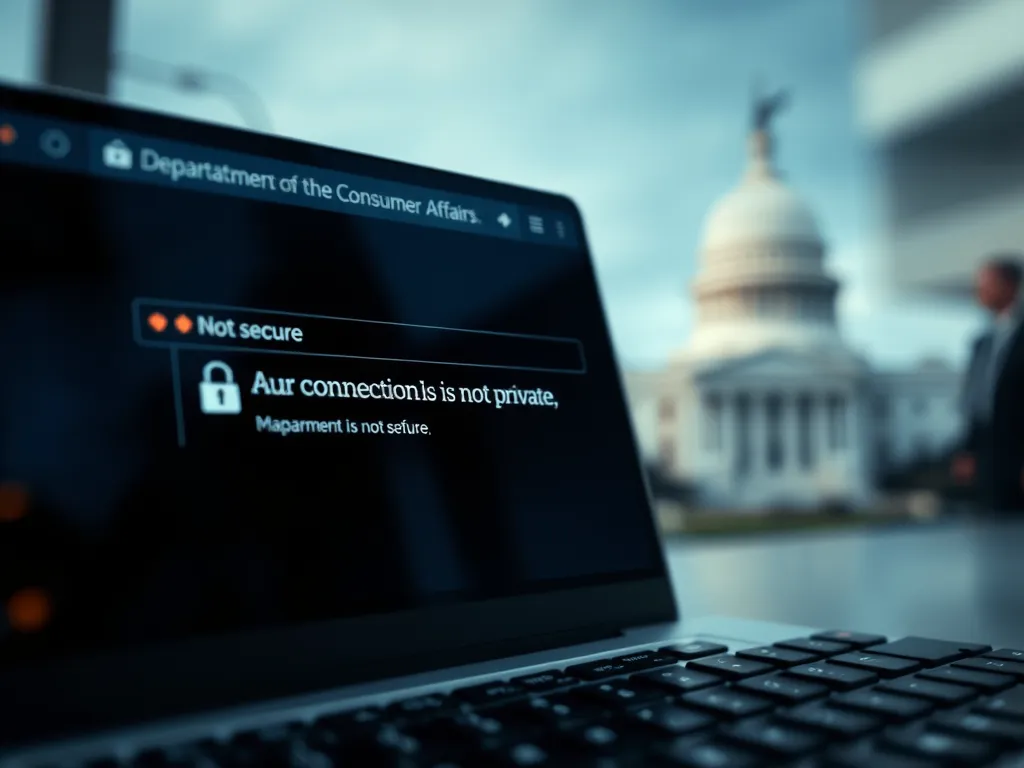
Here are the key takeaways from the blog post regarding the issues with the National Consumer Helpline (NCH):
- Critical Technical Negligence: The NCH website suffers from severe security vulnerabilities, including invalid SSL certificates and HSTS errors. This marks the site as “Not Secure,” potentially exposing citizens’ sensitive data to attackers and undermining the “Digital India” mission.
- Systemic Administrative Apathy: There is a recurring pattern of “perfunctory disposal” of grievances. Instead of addressing technical complaints, officials provide scripted, irrelevant responses (like directing users back to a toll-free number), effectively ignoring the root cause of the problem.
- Failure of the Appellate Mechanism: The Appellate Authority failed to exercise its duty of “perusal.” By rubber-stamping an arbitrary report without providing a reasoned order, the authority violated the “Right to Reason,” which is a fundamental pillar of a sound administrative system.
- Erosion of Accountability: The lack of a cogent approach by the Director of the NCH suggests a breakdown in transparency. Closing an appeal without addressing the “pros and cons” indicates that the grievance portal is currently functioning as a data-entry exercise rather than a genuine redressal tool.
- Dignity and Governance: Such “blunders” (as opposed to simple mistakes) lower the dignity of the government and contradict the principles of good governance. A dysfunctional helpline benefits errant service providers by making it harder for consumers to seek justice.
Would you like me to help you draft a specific “Rejoinder” or a fresh grievance to the PMO highlighting this failure of the Appellate Authority?
This blog post explores the systemic failures within the National Consumer Helpline (NCH) grievance redressal mechanism, specifically focusing on the recent experience of Yogi M. P. Singh. It highlights the lack of transparency, the technical failures of the NCH website, and the perfunctory nature of administrative responses.
Digital Deficits and Administrative Apathy: The Crisis at the National Consumer Helpline
In an era where “Digital India” is a cornerstone of national policy, the tools intended to empower citizens must be beyond reproach. However, recent developments surrounding the National Consumer Helpline (NCH)—the very apex of consumer protection—suggest a troubling disconnect between high-level vision and ground-level execution. When the gatekeepers of consumer rights present a “not secure” gateway and respond to valid technical critiques with automated apathy, the democratic fabric of accountability begins to fray.
The Core Issue: A Website in Distress
The primary grievance raised by citizens like Yogi M. P. Singh is not merely a minor glitch but a fundamental failure of digital security infrastructure. Users attempting to access consumerhelpline.gov.in have been met with severe security warnings: “Your connection is not private” and “net::ERR_CERT_COMMON_NAME_INVALID.”
For a government website dealing with sensitive personal data, passwords, and consumer complaints, an invalid SSL certificate is a “blunder,” not a “mistake.” It signals to the browser (and the user) that the site’s credentials do not match its identity, potentially exposing users to “man-in-the-middle” attacks.
The Illusion of Redressal: The “Copy-Paste” Culture
The technical failure is only the first half of the problem. The second, more systemic issue lies in the grievance redressal process itself. When a citizen reports that a government portal is insecure, the expectation is a technical investigation and a timeline for a fix.
Instead, the response provided by the PG (Public Grievance) officer was a terse, repetitive instruction:
“You may contact to the NCH Toll Free Number 1800114000 or 1915.”
This response ignores the substance of the complaint. The complainant wasn’t asking how to file a new grievance; they were reporting that the system itself was broken. Using a toll-free number does not fix a compromised website. This “disposal” of a case without addressing the technical root cause is a hallmark of administrative avoidance.
The Failure of the Appellate Authority
The Department of Administrative Reforms and Public Grievances (DARPG) provides an appeal mechanism precisely to catch these instances of poor quality disposal. However, in the case of Appeal No. DOCAF/E/A/25/0000205, the Appellate Authority seemingly failed to exercise “perusal of the contents.”
By simply echoing the PG officer’s initial response and declaring the appeal “disposed off,” the authority violated the Right to Reason. In a sound administrative system, an order must be “speaking”—meaning it must provide reasons for its conclusion. To ignore the “pros and cons” of an appeal is to render the entire CPGRAMS (Centralized Public Grievance Redress and Monitoring System) portal a mere data-entry exercise rather than a justice-delivery mechanism.
Security Risks and Public Trust
The implications of a “Not Secure” NCH website are grave:
- Data Vulnerability: Sensitive information regarding consumer disputes, which often includes invoices and identity proofs, could be intercepted.
- Erosion of Dignity: As noted in the grievance, such technical negligence lowers the dignity of the government. When the Prime Minister’s Office (PMO) forwards a grievance, the responding department’s failure to act with gravity reflects poorly on the entire administration.
- Exclusion: Users who are not tech-savvy may ignore the warning and get hacked, while tech-literate users are forced to stay away, effectively shutting the doors of the NCH to a large section of the public.
The Absence of Transparency and Accountability
Transparency is not just about publishing reports; it is about acknowledging when a system fails. The refusal of the Director of the National Consumer Helpline to address why the website uses HSTS incorrectly or has invalid credentials suggests a lack of accountability.
If the staff responsible for maintaining the digital infrastructure are not held to a standard of “good governance,” the citizens are the ones who pay the price. The question remains: Who reaps the benefits of a dysfunctional helpline? A broken helpline effectively shields errant corporations and departments from consumer scrutiny.
A Call for Reform
To restore faith in the National Consumer Helpline, several steps are non-negotiable:
- Immediate Technical Audit: The Department of Consumer Affairs must rectify the SSL/TLS certificate issues and ensure the website complies with modern cybersecurity standards.
- Meaningful Disposal: PG officers must be trained to provide substantive replies. Closing a grievance with a toll-free number when the website is the issue should be flagged as an “unsatisfactory disposal.
- Active Oversight: Appellate authorities must be mandated to write at least a two-sentence justification explaining why they agree with the lower officer, rather than copy-pasting previous remarks.
Conclusion
The case of Yogi M. P. Singh is a microcosm of a larger struggle for administrative justice in India. When a citizen takes the time to document a systemic flaw—backed by error codes and screenshots—the state’s response should be one of gratitude and corrective action, not dismissal. Until the NCH treats its own digital security and grievance protocols with the seriousness they deserve, “Consumer Protection” will remain a promise unfulfilled.
To help you escalate this matter or maintain your records, here are the structured details for the concerned public authorities and the specific identifiers for your case.
I. Case Identifiers
| Detail Type | Value |
| Grievance Number | PMOPG/E/2025/0011446 |
| Appeal Number | DOCAF/E/A/25/0000205 |
| Complainant | Yogi M. P. Singh |
| Appeal Closed Date | 28/03/2025 |
II. Concerned Public Authorities (Contact Directory)
1. Primary Officer (NCH)
- Name: Director, National Consumer Helpline (NCH)
- Email Address: abs.shalini@gov.in
- Contact Number: 011-23381120
- Organization: Department of Consumer Affairs (DoCA)
2. Higher Oversight (Department of Consumer Affairs)
If you wish to escalate the failure of the appellate authority, you should contact the Secretary’s Office:
- Designation: Secretary (Consumer Affairs)
- Current Incumbent (2026): Smt. Nidhi Khare, IAS
- Address: Room No. 49, Krishi Bhawan, New Delhi – 110001
- Phone No: 011-23782807 / 011-23070121
- Email: secy-ca@nic.in
3. Public Grievance (PG) Division
- Department Address: Public Grievance Division, Room No. 456-C, Krishi Bhawan, New Delhi – 110001
- General Department Phone: 011-23386189
- Support Email: nch-ca@gov.in / consaff@gmail.com
III. Important Web Links
- National Consumer Helpline (NCH): consumerhelpline.gov.in
- Central Public Grievance Portal (CPGRAMS): pgportal.gov.in
- Department of Consumer Affairs (Official): doca.gov.in
IV. Redressal Hierarchy for Your Case
The following diagram illustrates the proper flow your grievance should have taken and where the current “loophole” occurred in your appeal:
Note: In your specific case, the process failed at Step 5, as the authority did not conduct an “independent perusal” but simply mirrored the PG officer’s reply.
Would you like me to prepare a “Demand for Justice” notice or a formal email to the Secretary (secy-ca@nic.in) pointing out the breach of Administrative Law in your specific appeal?


Facing a similar challenge? Share the details in the box below, and our team of experts will do their best to help.