
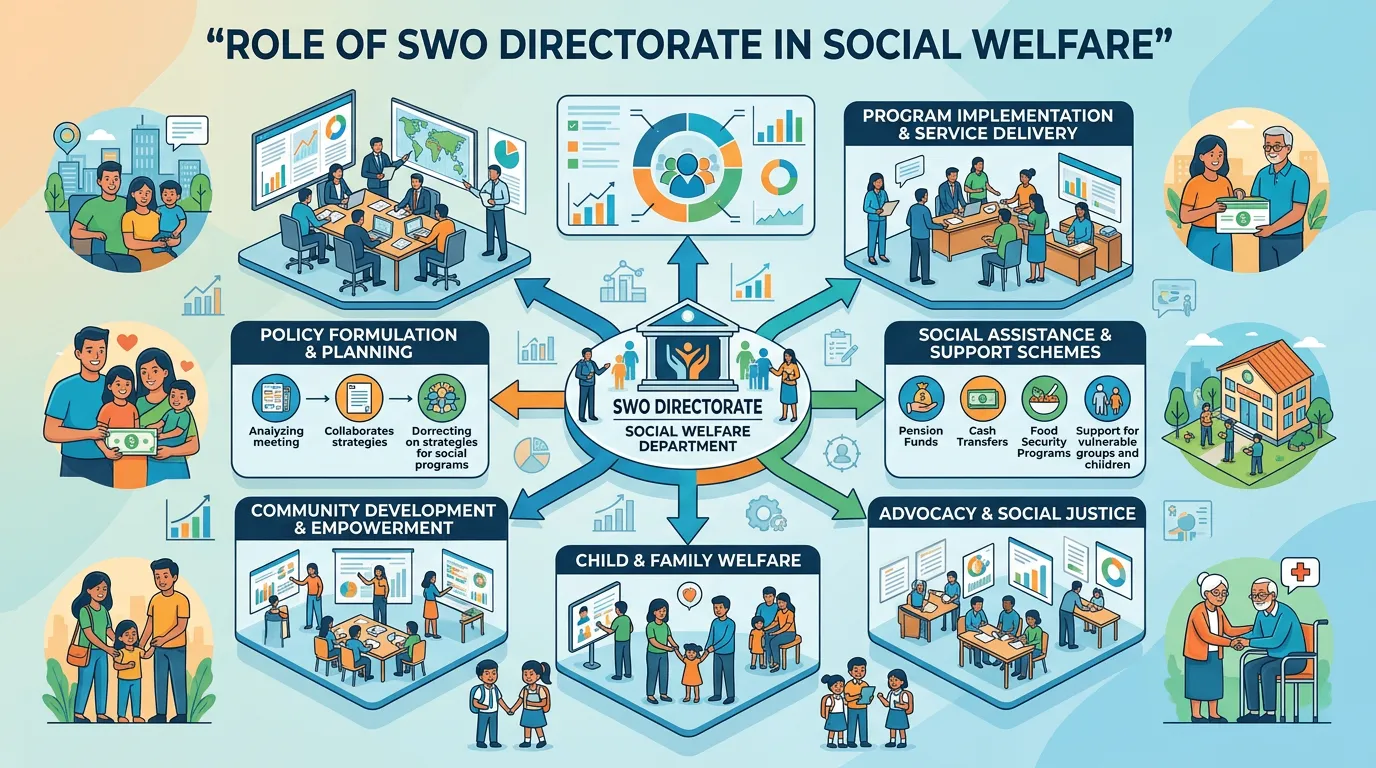
The Role of SWO Directorate in Social Welfare comes under scrutiny in this RTI case study. It exposes transparency and accountability failures in Uttar Pradesh. The findings reveal significant discrepancies in the implementation of various social welfare schemes, which were meant to uplift disadvantaged communities. Investigations showed that funds allocated for these initiatives were often mismanaged or not disbursed at all. This led to widespread public disenchantment. Additionally, the lack of proper monitoring and evaluation mechanisms has further exacerbated these issues. Many beneficiaries were left without the necessary support. This case highlights the urgent need for reforms within the SWO Directorate to ensure effective governance and service delivery. Improved oversight and a commitment to transparency are essential for restoring public trust and achieving the intended outcomes of social welfare programs.
Key Takeaways
- The case study highlights a lack of transparency and accountability within the Role of SWO Directorate, as RTI requests faced numerous obstacles.
- Yogi M. P. Singh’s RTI application sought crucial information about the scholarship system, exposing failures by the PIO and FAA.
- The PIO deflected responsibility and failed to provide necessary information, violating RTI principles of transparency.
- The FAA’s inaction on the appeal forced the applicant to escalate to a second appeal, underscoring the need for accountability.
- The article stresses the importance of strong Information Commissions to ensure responsive government and uphold the Role of SWO Directorate effectively.
🚨 Role of SWO Directorate in Social Welfare: A Case Study in RTI Non-Compliance
Understanding the Role of SWO Directorate in Social Welfare starts with the RTI Act itself. Specifically, the Right to Information (RTI) Act, 2005, forms a cornerstone of India’s democracy. Lawmakers intentionally designed it to foster transparency; moreover, they aimed to hold public authorities accountable. Nevertheless, in practice, the path to obtaining information is often riddled with obstacles. For instance, Yogi M. P. Singh, a resident of Mirzapur, Uttar Pradesh, learned this firsthand. Consequently, he eventually had to file a Second Appeal with the Uttar Pradesh Information Commission (UPIC). Ultimately, he simply wanted answers to basic questions about how the Directorate functions.
Officials registered this case as UPICR20240000149. It clearly highlights a failure on two separate fronts. Both the Public Information Officer (PIO) and the First Appellate Authority (FAA) fell short of their statutory duties. As a result, an ordinary citizen had to navigate a lengthy, multi-stage appeals process. He needed this process just to access information the law should have made readily available. In many ways, this case illustrates the broader role of SWO Directorate in social welfare administration across Uttar Pradesh.
1. The Initial Information Request 📜
On November 22, 2024, the appellant filed RTI Application No. DIRSW/R/2024/60158. In this application, he sought crucial details about the Scholarship and Fee Reimbursement Online System. This system sits at the heart of the SWO Directorate’s role in social welfare delivery.
He asked for the following:
- Public Staff Monitoring: the name and designation of personnel who check the website’s functionality and monitor the scholarship scheme (Queries 1 & 4)
- Reason for Technical Failure: why the persistent “Status not received from NPCI server” error kept students, including Bhoomika Singh, from completing their applications (Query 2)
- Government Action: minutes of proceedings and any action taken for students who couldn’t print their applications due to the website or NPCI server failure (Query 3)
- Expenditure: funds spent maintaining and updating the scholarship website across fiscal years 2021-22 through 2024-25 (Query 5)
These five queries were narrowly tailored. They fell squarely within the scope of what a public authority should readily disclose under the RTI Act. Transparency, after all, should sit at the center of the SWO Directorate’s role in social welfare governance.thin the scope of what a public authority should readily disclose under the RTI Act. Therefore, there was little reason to expect resistance, especially given that transparency is meant to be central to the role of the SWO Directorate in social welfare governance.
2. PIO’s Failure to Furnish Information ❌
On December 10, 2024, the PIO, Shashikant Singh (APIO HQ), issued a reply. However, the reply fell well short of expectations. The appellant categorized it as “Answer incomplete/unsatisfactory/false/misleading.”
The PIO’s reply simply stated that the U.P. IT and Electronics Department operates the scholarship portal. It also stated that this same department issues budget-related details. However, the PIO never actually addressed the specific, critical queries. He didn’t name the monitoring staff. Moreover, He didn’t explain the NPCI server error. He didn’t describe any action taken for affected students. Instead, he deflected responsibility onto another department. He should have provided the information the Department already held, or transferred the request correctly under Section 6(3) of the RTI Act.
This failure directly violates the transparency principle in the RTI Act. It also raises a deeper question about the actual role of the SWO Directorate in social welfare oversight. If the Directorate cannot answer basic questions about a scheme it administers, its capacity to monitor and safeguard welfare delivery comes into serious doubt. Procedural compliance without genuine disclosure defeats the very purpose the law was designed to serve.
3. The Lack of Action by the First Appellate Authority (FAA) 🛑 (Role of SWO Directorate in Social Welfare)
Given that the initial response proved unsatisfactory, the appellant then filed a First Appeal under Section 19(1) of the RTI Act on December 14, 2024 (Registration No. DIRSW/A/2024/60167). At this stage, one would reasonably expect a higher level of scrutiny and, ultimately, a resolution.
Yet, surprisingly, the FAA, Mr. Arun Kumar Pandey, completely failed to adjudicate the appeal. In fact, the status still reads “RTI APPEAL RECEIVED,” and to date, no formal answer exists on record. Clearly, this non-action represents a grave lapse in accountability, particularly because the FAA’s role is crucial for maintaining internal checks and balances within the system. After all, the First Appellate Authority exists precisely to catch and correct failures at the PIO level before a matter needs to escalate further — and this internal check is itself part of the broader role of the SWO Directorate in social welfare accountability.
Ultimately, however, this inaction forced the information seeker to escalate the matter to the next level. In this sense, the FAA’s silence did not resolve the dispute — instead, it merely delayed resolution and added an extra burden onto the appellant, who then had no choice but to pursue a Second Appeal.
4. The Second Appeal and Prayer for Action 🙏 (Role of SWO Directorate in Social Welfare)
Therefore, given the FAA’s failure to act, the appellant filed a Second Appeal under Section 19(3) with the Uttar Pradesh Information Commission. Notably, the relief he sought went well beyond simply obtaining the requested information. Instead, he also sought punitive action against the non-compliant officials, in the hope of deterring similar conduct in the future:
- Action Against PIO: specifically, an order for action under Section 20 of the RTI Act, 2005, on the grounds that the PIO provided misleading and incomplete information (notably, Section 20 allows for a penalty of up to $25,000)
- Disciplinary Action Against FAA: additionally, an order for disciplinary action against the FAA for procrastination and for failing to entertain the First Appeal altogether
In short, the appellant’s prayer for relief reflects a broader concern: that without real consequences, officials have little incentive to fulfil the role of the SWO Directorate in social welfare with the diligence citizens deserve.
Conclusion: The Need for Strong Information Commissions 🏛️
Ultimately, this case serves as a stark reminder that a law, on its own, is not enough. Rather, the true spirit of the RTI Act — namely, ensuring a responsive, responsible, and transparent government — depends entirely on effective, consistent implementation. Otherwise, even a well-drafted law can become little more than words on paper, and the role of SWO Directorate in social welfare administration risks becoming symbolic rather than substantive.
In this instance, the actions of both the PIO and the FAA demonstrate a troubling disregard for citizens’ right to public services, free from arbitrary hurdles. Meanwhile, the Uttar Pradesh Information Commission now faces an important task. Not only must it direct the release of the requested information, but it must also set a meaningful precedent. Specifically, by enforcing penalties and disciplinary action where warranted, the Commission can reinforce accountability and, in turn, discourage officials from making a mockery of the law of the land.
Furthermore, cases like this one illustrate why strong, independent Information Commissions matter so much across India — and why the role of the SWO Directorate in social welfare must be backed by genuine enforcement, not just policy on paper. Without robust enforcement mechanisms, RTI applicants — many of whom are ordinary citizens without legal training or resources — are left to shoulder the burden of pursuing justice through repeated appeals. As a result, delays and non-compliance effectively punish the very people the law was meant to empower.
Based on the details in the Second Appeal, along with publicly available information, below are the contact and email details for the relevant authorities and the appellant.
🏛️ Uttar Pradesh Information Commission (UPIC)
The UPIC is the body where the appellant filed the Second Appeal, and it will hear the case going forward. (Role of SWO Directorate in Social Welfare)
| Contact Detail | Particulars |
|---|---|
| Address | 7/7A, RTI Bhawan, Vibhuti Khand, Gomti Nagar, Lucknow, Uttar Pradesh, PIN Code-226010 |
| Office Phone No. | 0522-2724930 |
| Official Website | upic.gov.in or upsic.up.gov.in |
| Webmaster Email | webmaster-upic[at]up[dot]gov[dot]in |
👨💻 Public Information Officer (PIO) & First Appellate Authority (FAA) (Role of SWO Directorate in Social Welfare)
These officials, who work within the Directorate of UP Social Welfare Department, are the respondents in this case.
| Role | Name | Designation | Mobile Number | Email ID |
|---|---|---|---|---|
| PIO | Shashikant Singh | APIO HQ (S.O. HQ APIO Siksha (A)) | 9151935126 | director.sw@dirsamajkalyan.in |
| FAA | Arun Kumar Pandey | Appellate Authority | 8081989398 | director.sw@dirsamajkalyan.in |
Public Authority Address: Directorate UP Social Welfare Department, Lucknow, PIN Code-226001.
🙋♂️ Appellant’s Details
| Contact Detail | Particulars |
|---|---|
| Name | Yogi M. P. Singh |
| Address (Role of SWO Directorate in Social Welfare) | सुरेकापुरम कॉलोनी जबलपुर रोड मिर्जापुर सिटी (Surekapuram Colony, Jabalpur Road, Mirzapur City) |
| Pincode | 231001 |
| Mobile Number | 7379105911 (Also for Online Hearing) |
| Email ID | yogimpsingh@gmail.com (Also for Online Hearing) |
ℹ️ Note on RTI Online Filing
Finally, if you would like to file RTI applications or First Appeals online with departments under the Government of Uttar Pradesh, you can use the state’s official RTI Online portal:
- UP RTI Online Portal: rtionline.up.gov.in
Suggested image alt text: “Role of SWO Directorate in Social Welfare — RTI case documents and appeal notice”


Facing a similar challenge? Share the details in the box below, and our team of experts will do their best to help.