
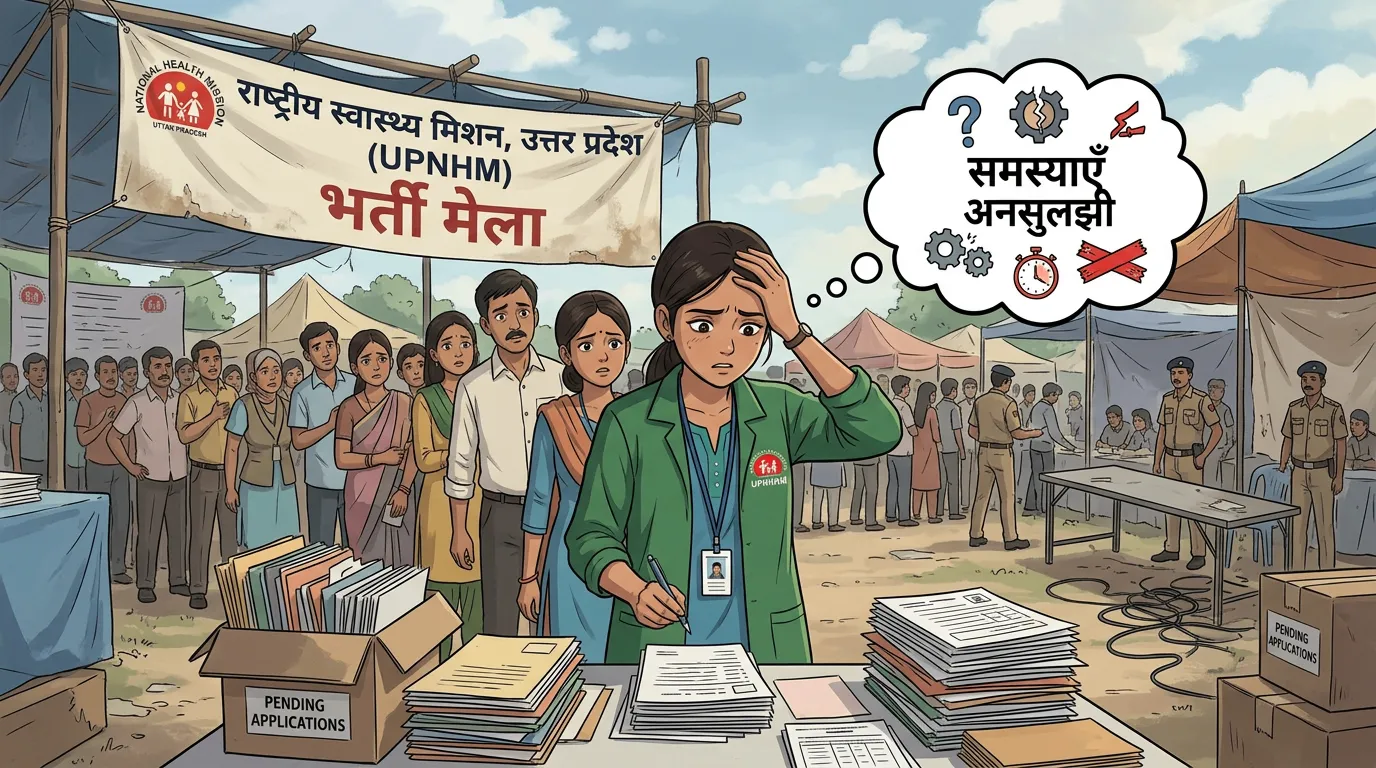
The Unresolved UPNHM Recruitment Drive has left 9,500+ posts in limbo, creating uncertainty for countless job seekers in the health sector. The protracted delays have raised significant concerns about the recruitment process and its implications for public health services. Recent investigations reveal that the situation has been further complicated by a lack of transparency in the hiring policies of NHM UP. See how RTI appeals and a High Court order expose NHM UP’s transparency failures, highlighting the need for accountability and clarity in government recruitment initiatives. The ramifications of these shortcomings extend beyond the immediate hiring crisis, threatening to undermine public trust in state health programs and potentially affecting the delivery of essential services to the community. With so many lives at stake, the resolution of these issues is imperative for both stakeholders and the public at large.
Key Takeaways
- The Unresolved UPNHM Recruitment Drive has left over 9,500 posts vacant, raising concerns about transparency and accountability in the hiring process.
- Initially, the recruitment aimed to fill 17,291 posts but ran into issues such as non-compliance with a High Court order and lack of data disclosure.
- As a result, candidates remain uncertain about their status on the waiting list, prompting calls for legal action against officials involved.
- Recent RTI appeals highlight ongoing non-compliance, showing the continued challenges faced by aspirants in securing jobs in the health sector.
- Legal remedies may include filing a contempt petition in the High Court to address judicial disobedience and push for transparency.
🏥 The Unresolved UPNHM Recruitment Drive: A Crisis of Transparency and Compliance
In late 2022, the National Health Mission, Uttar Pradesh (UPNHM) launched what has since become the Unresolved UPNHM Recruitment Drive. Specifically, the drive aimed to fill 17,291 contractual posts for ANM, Staff Nurse, Lab Technician, and Pharmacist-Allopathic roles. Initially, the goal was simple: strengthen the state’s healthcare system. However, the process quickly ran into trouble. Indeed, officials have failed to disclose key data, mishandled the waiting list, and, according to multiple RTI applications, ignored a High Court order — leaving the entire recruitment drive unresolved to this day.
Recruitment Status and Key Issues Behind the Stalled Unresolved UPNHM Recruitment Drive
At the center of the Unresolved UPNHM Recruitment Drive sits a simple question: what happened to the gap between the original targets and the final appointments? In particular, aspirants want to know the fate of candidates still on the waiting list.
- Total vacancies: 17,291 contractual posts.
- Selected candidates: By January 2024, the exam process had selected 7,706 candidates.
- The waiting list dispute: According to the official notification, dated 13.12.2022, the waitlist would stay valid for six months, filling new vacancies or replacing no-shows. Yet no public data shows how many candidates the waitlist actually filled. Furthermore, aspirants allege that many selected candidates held multiple offers, so positions stayed vacant instead of going to the next name on the list.
- Recruitment closure: Eventually, UPNHM formally closed the drive. Nevertheless, closing it didn’t resolve the waitlist candidates’ grievances; instead, those grievances remain unaddressed — which is exactly why aspirants and observers now refer to it as the Unresolved UPNHM Recruitment Drive.
Non-Compliance with Judicial and Transparency Orders in the Unresolved UPNHM Recruitment Drive
Allegedly, UPNHM officials ignored both a High Court directive and repeated RTI requests. Consequently, this failure sits at the heart of the Unresolved UPNHM Recruitment Drive.
High Court Order (21 October 2024)
Initially, the Allahabad High Court directed UPNHM to act on the recruitment and waiting-list grievances. Specifically, the Court gave the Mission Director two months to decide on the petitioners’ representations. Despite this deadline, however, no public record — whether on the UPNHM website or through any RTI response — shows compliance.
Compliance status: consequently, unresolved.
RTI Non-Compliance and Appeals
First, the applicant, Yogi M. P. Singh, filed an RTI application on 09-11-2024, seeking details on filled vacancies, waitlist appointments, and the High Court order’s compliance status. Then, the Public Information Officer (PIO), Dr. Amresh Bahadur Singh, DGM (NCD & RTI), did not respond within the required time. As a result, Singh escalated the case.
Subsequently, he filed a Second Appeal with the Uttar Pradesh Information Commission (UPIC). In this appeal, he demands two things: first, action against the PIO under Section 20 of the RTI Act, 2005, and second, disciplinary action against the First Appellate Authority (FAA), Mission Director Dr. Pinky Jowel, IAS, for refusing to entertain the First Appeal.
Accountability and Legal Remedies for the Stalled NHM UP Recruitment Drive
Overall, this case highlights a clear conflict. On one hand, public authorities owe citizens transparent governance under the Right to Information Act, 2005; on the other hand, administrative inaction keeps blocking that duty — and keeps the Unresolved UPNHM Recruitment Drive exactly that: unresolved.
| Official/Authority | Role and Responsibility |
|---|---|
| Dr. Pinky Jowel, IAS | Mission Director, NHM, UP (FAA for RTI). Responsible for judicial compliance and RTI obligations. |
| Shri Partha Sarthi Sen Sharma, IAS | Principal Secretary, Medical Health and Family Welfare Department. Responsible for oversight. |
| Dr. Amresh Bahadur Singh | DGM (NCD & RTI) and PIO, NHM, UP. Allegedly failed to provide RTI information. |
Potential legal remedies for aggrieved aspirants:
- Contempt petition: For instance, file under the Contempt of Courts Act, 1971, against officials for willfully disobeying the High Court’s order.
- State Information Commission (UPIC): Alternatively, pursue the Second Appeal with the Uttar Pradesh Information Commission for penal action against the PIO and FAA under the RTI Act.
- Judicial review: Finally, seek a Public Interest Litigation (PIL) or writ petition to force transparency and compliance.
🔎 Update: The Unresolved UPNHM Recruitment Drive and the Waiting List Controversy
Overall, further research confirms these core issues. In addition, it adds new detail on both the missing waitlist data and the alleged non-compliance with the High Court order.
I. Vacancy Breakdown (Initial Advertisement)
To begin with, the original advertisement (Ref. No: 642/SPMU/NHM/2022-23/6200, dated 26.11.2022) listed 17,291 vacancies across several health programs:
| Post Category | Major Program-Wise Vacancy Totals |
|---|---|
| ANM | 807 (NUHM) + 3634 (Maternal Health) + 401 (RBSK) + 847 (15th Finance Commission) = 5,689+ |
| Staff Nurse | 684 (NUHM) + 913 (DHS) + 376 (HDU) + 431 (Trauma) + 226 (DHS) + 185 (Maternal Health) + 1737 (Community) + 17 (RBSK) + 1847 (Child Health) + 847 (15th Finance Commission) + 295 (NPHCE) + 48 (NPPC) + 290 (NPCDCS) + 28 (Blood Bank) = 7,921+ |
| Lab Technician | 282 (NUHM) + 52 (Trauma) + 20 (DHS) + 96 (Maternal Health) + 1109 (Community) + 5 (RBSK) + 274 (PM-ABHIM) + 1305 (15th Finance Commission) + 10 (National) + 4 (National) + 65 (Blood Bank) + 11 (Training) = 3,233+ |
| Pharmacist-Allopathic | 209 (NUHM) + 46 (DHS) + 186 (RBSK) + 4 (National) = 445+ |
| Total Vacancies | 17,291 |
Note: overall, the official 2023 result named 7,706 selected candidates. Therefore, over 9,500 posts — including waitlist positions — remain unaccounted for within the Unresolved UPNHM Recruitment Drive. Essentially, that’s the core problem: the PIO refused to disclose the number of vacancies filled from the recruitment, or from the waiting list.
II. High Court Order and Compliance Status
- The order: Specifically, in WRIT-A No. 14572 of 2024 (Kanhaiya Lal and 6 Others vs. State of U.P. and Another), the Allahabad High Court ordered Respondent No. 2 (the Mission Director) on October 21, 2024 to decide on the waitlist petitioners’ representations within two months.
- The alleged breach: Ultimately, that two-month window expired in late December 2024. Yet, the subsequent grievances and RTI appeals, filed in January 2025, allege that the Mission Director never issued a decision, either within the deadline or after.
- The closure notification: Meanwhile, officials reportedly issued a notification on January 17, 2025 that closed waitlist appointments entirely. According to the complainant, this move violated the Court’s implicit directive to resolve the waitlist grievances first — deepening the Unresolved UPNHM Recruitment Drive rather than settling it.
III. Status of RTI Appeals in the NHM UP Recruitment Crisis (Yogi M. P. Singh’s Case)
So far, Singh has pursued this case through every stage of the RTI framework:
| Step | Action Taken | Date/Status | Issue |
|---|---|---|---|
| RTI application | Filed with the PIO; sought vacancy status, waitlist data, and High Court compliance details | 09-11-2024 | PIO missed the 30-day statutory deadline (violation of Section 7(1)). |
| First appeal | Filed with the FAA (Mission Director, NHM, UP) | 17-12-2024 | FAA neither entertained the appeal nor issued a ruling. |
| Second appeal | Filed with the State Information Commission (UPIC) | 26-01-2025 | Seeks penal action against the PIO (Section 20) and disciplinary action against the FAA. |
Overall, taken together, these failures, both on vacancy disclosure and on the High Court order, point to a deeper accountability problem behind the Unresolved UPNHM Recruitment Drive.
⚖️ Legal Grounds for a Contempt Petition Over the Unresolved UPNHM Recruitment Drive
Altogether, the facts above build a strong case for a Contempt Petition arising from the Unresolved UPNHM Recruitment Drive. Specifically, the likely targets are the Mission Director (Dr. Pinky Jowel, IAS) and any other officials tied to the compliance failure.
Fundamentally, the legal foundation rests on the Contempt of Courts Act, 1971, and, more specifically, the alleged willful disobedience of the Allahabad High Court’s directive.
I. Legal Framework: Civil Contempt
- Definition: According to Section 2(b), “civil contempt” means willful disobedience of a court’s judgment, decree, direction, order, or writ, or, alternatively, willful breach of an undertaking given to a court.
- The offense here: In this case, officials allegedly disobeyed a clear judicial direction issued by the High Court.
II. Specific Grounds for the Petition
1. Willful disobedience of a time-bound order
To begin with, the High Court’s October 21, 2024 order gave the Mission Director two months to decide the waitlist candidates’ representations. However, that deadline passed in late December 2024 without a ruling. Because this order targeted a senior official directly, and because it came with a fixed deadline, the failure to comply looks deliberate rather than accidental. Worse still, officials allegedly closed the waitlist on January 17, 2025, without ever addressing the Court’s directive. Therefore, petitioners could frame that closure as a calculated move to sidestep the order entirely.
2. Undermining the judicial process
By ignoring the order, officials arguably obstructed justice and, in turn, undermined the High Court’s authority. Moreover, since the case affects thousands of citizens’ employment rights, this disregard could draw the Contempt Court’s quasi-criminal jurisdiction.
3. Evasive tactics (a possible additional ground)
Often, courts act when an agency dodges an order through technicalities; for instance, by issuing a new order that skirts the real issue instead of resolving it. Similarly, if the waitlist closure came after the deadline and never addressed the underlying grievance, that pattern strengthens the case for willful disobedience.
III. Procedure for Filing in the Allahabad High Court
- Draft the petition. First, state the facts clearly. Then, attach a certified copy of the Court’s original order (dated 21 October 2024). Finally, name the officials responsible.
- Name the contemnors. Specifically, list each defaulting official by name and designation — for example, Dr. Pinky Jowel, IAS, Mission Director, NHM, UP.
- File the petition. Next, submit it to the Allahabad High Court, which will then assess whether a prima facie case of willful disobedience exists. Petitioners can track the matter afterward through the Court’s online case status portal.
- Await the notice. If the Court is satisfied, it issues a “Rule” — in other words, a show-cause notice requiring the officials to explain themselves, often through a Compliance Affidavit.
- Face the outcome. If the explanation falls short, the Court can then frame charges. Under Section 12 of the Act, civil contempt carries a penalty of up to six months’ imprisonment, a fine of up to ₹2,000, or both. However, an unconditional apology may lead to discharge.
Given all this, the next step for the Unresolved UPNHM Recruitment Drive is clear: aggrieved aspirants should consult a lawyer who specializes in service and writ matters at the Allahabad High Court. From there, they can move forward with a Contempt Petition, the Second Appeal at UPIC, or both — and finally push this long-unresolved case toward resolution.e toward resolution. by Yogi M. P. Singh (A-20250102157) at the UPIC?


Facing a similar challenge? Share the details in the box below, and our team of experts will do their best to help.