
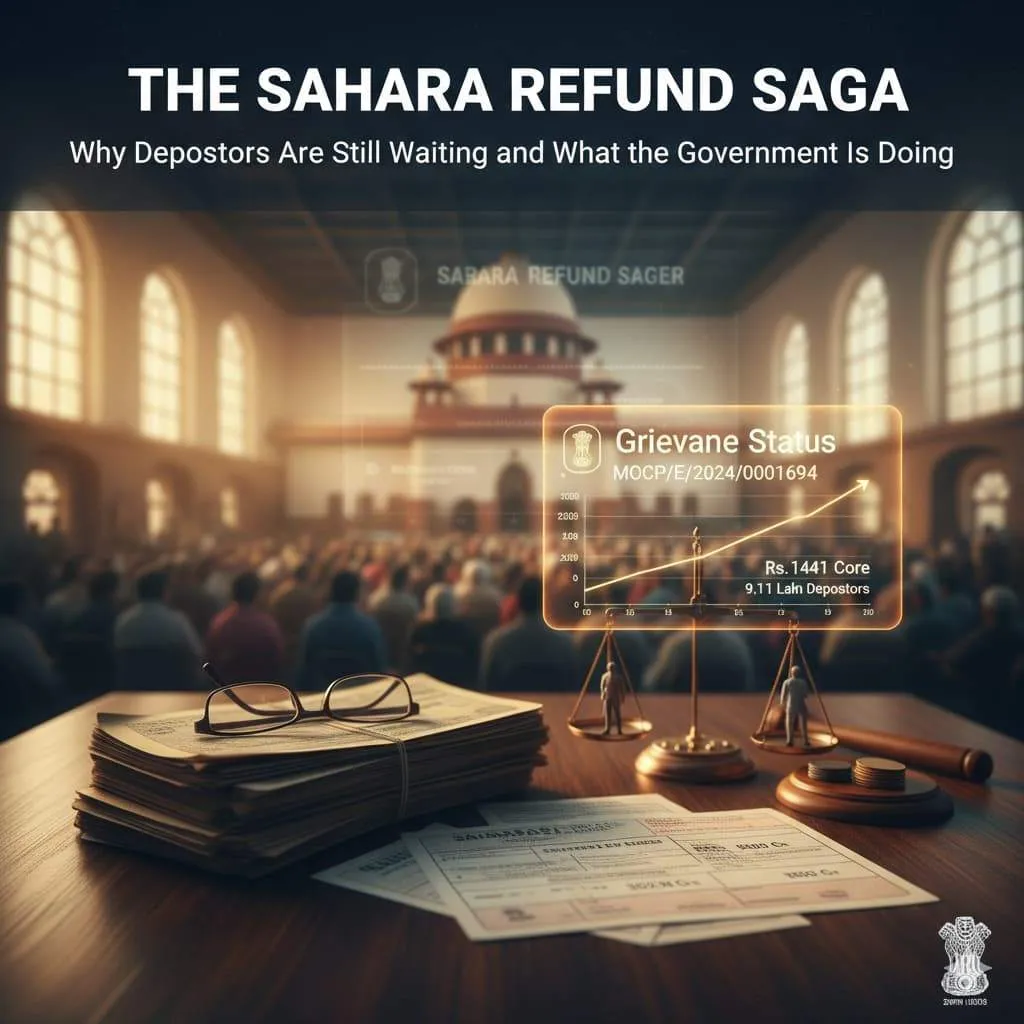
This is a demand for an update on the disbursement status of funds to Sahara Group of Cooperative Societies depositors. The Sahara Refund Saga requires clarification, so please give a reason for the slow progress. We also need an explanation of the government’s role in the process, based on the provided grievance details.
The grievance data shows a date of December 8, 2024. The latest disbursement status indicates April 30, 2024 (Amount Released: ₹302.96 Cr., Total depositors: 3,24,581). I need to search for more current information about the disbursement of the ₹5,000 crore fund to Sahara depositors. This will help to explain the reasons for the slow progress. This reflects the true picture of the Sahara Refund Saga.
The Sahara Refund Saga: Why Depositors Are Still Waiting and What the Government is Doing
The ongoing refund process for the Sahara Group of Cooperative Societies deposits is significant for millions of small savers. It represents a long-fought battle for their hard-earned money. Despite a Supreme Court mandate, the disbursement of the initial ₹5,000 crore is slow. It is also a complex process, even with the launch of a dedicated online portal. See progress and update of Sahara Refund Saga.
1. Current Status of Fund Disbursement (Updated Data)
The latest official data available indicates significantly more progress. These figures are greater than those mentioned in your April 2024 grievance status. Still, it shows a fraction of the total claims.
| Metric | Grievance Status (as of 30.04.2024) | Latest Public Data (as of Dec 2024 / Jan-Feb 2025) | Latest Public Data (as of Sept 2025) |
| Amount Released | ₹302.96 Crore | ~₹1,441 Crore (As of Dec 11, 2024) | ~₹5,053.01 Crore (As of Sep 2025) |
| Total Depositors Paid | 3,24,581 | ~9,11,043 (As of Dec 11, 2024) | ~26,25,090 (As of Sep 2025) |
| Current Disbursement Limit | Initial (Trial) Phase | Up to ₹50,000 per depositor | Up to ₹50,000 per depositor |
| Total Claims Filed (Approx.) | Not stated | Over 1.35 Crore claims | Over 5.43 Crore claims |
| Original Deadline | 9 months from March 29, 2023 | Extended to December 31, 2026 | Extended to December 31, 2026 |
The Supreme Court has acknowledged the immense scale and complexity. It has granted an extension for the full disbursement process until December 31, 2026.
2. Reasons for Slow Progress (Sahara Refund Saga)
Your observation about the slow pace is a common concern among depositors. The key reasons for the protracted process, as shown by government and court records, are multifaceted and relate to the scale, complexity, and verification required:
- Massive Volume of Claims: An estimated 5.43 crore investors have claimed a staggering ₹1,13,504 crore. The authorities plan to allocate the initial ₹5,000 crore solely for genuine depositors of four specific cooperative societies. They must tackle the Herculean administrative task of processing and verifying this massive volume of records for authenticity. (True picture of Sahara Refund Saga)
- Documentation and Deficiency: Many claims filed on the CRCS-Sahara Refund Portal flag deficiencies. These issues often arise from mismatches between the data that depositors submit and the records provided by the Sahara societies. Discrepancies also occur in the required documentation (Aadhar seeding, PAN linking, proof of deposit). This situation necessitates a cumbersome “re-submission” process, which significantly adds to the time.
- Judicial Oversight and Transparency: A former Supreme Court judge, Justice R. Subhash Reddy, and an Amicus Curiae actively watch and supervise the entire disbursement. While this ensures a transparent and fair process, it inherently adds scrutiny and procedure. This slows down the disbursement pace compared to an ordinary bank deal. The focus remains on preventing fraudulent claims to make certain that the limited funds reach only the genuine small depositors.
- Fund Availability and Phased Release: The authorities are currently distributing the refund in phases. They are prioritizing small depositors up to ₹10,000. Now they are extending the limit to ₹50,000. This distribution comes from the initial ₹5,000 crore allocated by the Supreme Court from the SEBI-Sahara Refund Account. The significant gap between the ₹1.13 lakh crore claimed and the available ₹5,000 crore necessitates a cautious, phase-wise approach.
3. The Government’s Role: A Logistic and Regulatory Approach
The question of whether the delay constitutes “corruption” is a serious accusation reflecting the immense hardship faced by depositors. The government plays the role of a facilitator from a policy standpoint. Legally, it regulates under the direction of the Supreme Court. The apex court actively monitors the Sahara Refund Saga.
The Government as a Facilitator
The Ministry of Cooperation (MoC) handles the refund process primarily. They do this through the Central Registrar of Cooperative Societies (CRCS). Their role involves:
- Setting up the Digital Infrastructure: Launching the CRCS-Sahara Refund Portal for a paperless, transparent, and digital claim submission process.
- Legal Intervention: The petitioners are filing the Interlocutory Application in the Supreme Court. They seek to transfer the ₹5,000 crore from the SEBI-Sahara account. This transfer specifically benefits the cooperative society depositors.
- Monitoring and Supervision: Working under the strict monitoring of a Supreme Court-appointed committee to ensure due process.
The Government as a Regulator
The nature of the fraud occurred under private cooperative societies. The Multi-State Cooperative Societies (MSCS) Act, 2002 does not provide a government guarantee for the repayment of deposits to members.
- No Direct Guarantee: The government is legally not responsible for guaranteeing the repayment of deposits in cooperative societies.
- Intervention for Justice: The Supreme Court transfers ₹5,000 crore as an extraordinary, one-time intervention. This money, deposited by the Sahara Group with SEBI, aims to provide partial relief to the most vulnerable depositors.
- People-Friendly Aspect of Sahara Refund Saga: The government has launched the portal. They have increased the refund limit to ₹50,000. Additionally, they sought a time extension. They officially show these actions as measures to focus and speed up payments. They aim to help genuine, small depositors who feel helpless against the cooperative societies.
The government’s current action is both a logistic and humanitarian effort. It aims to recover funds from a defunct private entity. The government will distribute these funds under judicial oversight. This action does not involve a direct payment from the national exchequer. Officials face slow progress as they struggle to reconcile massive, often deficient, records. A strict court-mandated process for verification requires them to make sure that the limited funds are, disbursed correctly and transparently. (Sahara Refund Saga)


Facing a similar challenge? Share the details in the box below, and our team of experts will do their best to help.