
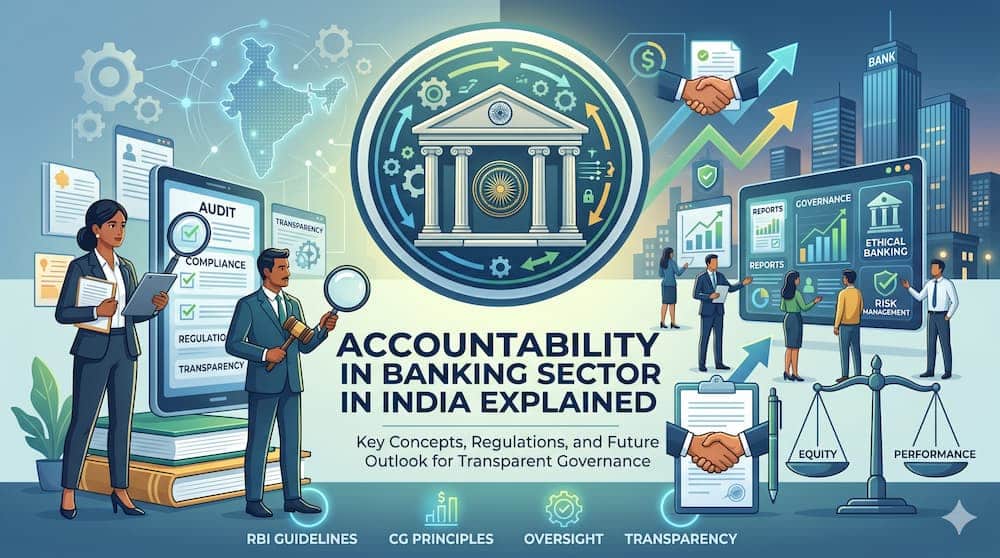
Accountability in the banking sector in India is critical to upholding the integrity and trust placed in financial institutions. It involves transparent practices, stringent regulatory compliance, and a commitment to ethical standards. As the sector evolves with the introduction of digital banking and fintech innovations, stakeholders increasingly need robust oversight mechanisms that prioritise customer interests. Effective accountability measures can help mitigate risks associated with fraud, enhance customer confidence, and promote sustainable financial growth. Stakeholders, including banks, regulators, and customers, must work collaboratively to foster a culture of accountability that supports long-term stability in the industry.
Key Takeaways
- Accountability in the banking sector in India is vital for trust and requires transparent practices and regulatory compliance.
- A case involving a ₹2,400 refund highlights systemic flaws in grievance redressal and accountability mechanisms.
- The bank’s ‘Promise and Close’ approach leads to unresolved grievances that it marks as ‘Closed’ too early.
- An RTI response reveals evasive guidance and contradictions, raising concerns about accountability protocols in banking.
- There’s an urgent need for improved measures to ensure that grievances stay open until resolved, upholding integrity in the banking sector.
Accountability in Banking: When “Suitable Communication” Replaces Actual Results
In the digital age, banking relies on trust and the assurance that automated systems—and the humans managing them—will promptly resolve errors. For anyone examining the present-day situation, accountability in the banking sector in India is a key topic of conversation. However, a recent RTI inquiry involving the State Bank of India (SBI) reveals a troubling trend: employees close grievances based on “future promises” rather than providing financial resolution.
The Missing Refund: A ₹2,400 Deadlock
The issue began on January 27, 2026, when a merchant initiated a refund of ₹2,400 via an Acquirer Reference Number (ARN: 82305096028500012763392). Despite the merchant (AIOSEO) confirming a successful transaction, the funds failed to reach the customer’s account at the SBI City Branch, Mirzapur. On a wider level, situations like this case highlight how accountability operates within India’s banking sector.
The “Promise and Close” Tactic
A formal grievance (DEABD/E/2026/0021712) was filed via the CPGRAMS portal on February 13, 2026. It is essential to discuss accountability frameworks, especially regarding the banking sector in India, as what followed highlights a systemic flaw in grievance redressal:
- February 17, 2026: A Chief Manager (Operations) sends an email promising the amount will be credited within 7 days.
- February 18, 2026: Less than 24 hours later, and well before the 7-day deadline, the bank marked the case as “Closed” on the portal. +3
- The Result: The grievance was disposed of based on a promise of action, not the verification of funds. When the 7-day window expired on February 24, the money was still missing. +1
The RTI Response: Transparency or Evasion?
Seeking clarity on RBI guidelines and the bank’s internal protocols, the customer filed an RTI request (SBIND/R/T/26/00426). In the context of accountability in the banking sector, particularly in India, the response from the Central Public Information Officer (CPIO) raised more questions than it answered: +1
- Evasive Guidance: Instead of providing specific internal Turnaround Time (TAT) guidelines, the CPIO directed the applicant to the general RBI website.
- Factual Inconsistency: The CPIO claimed there were “Nil” complaints regarding “Delay in service” for the Mirzapur branch in the past 12 months. This directly contradicts the applicant’s own documented and active grievance history. +2
- Absence of Protocol: The bank officially stated that there is “no regulatory protocol” when an institution fails to honour a written timeline provided by its own senior officials.
The Core Issue: Mechanical Disposal
The appellant has noted that the bank is handling grievances in a “mechanical manner” simply to improve its disposal statistics. In fact, the banking sector in India increasingly sees problems with mechanical grievance resolutions as symptoms of failures in accountability. By marking a case “Closed” the moment an email is sent, the bank effectively pauses its performance metrics, but it does not actually solve the customer’s problem.
Next Steps: Holding the Institution Accountable
Dissatisfied with these evasive answers, a First Appeal (SBILW/A/E/26/00135) was filed on May 12, 2026. The appeal challenges the bank on the following:
- Providing misleading or false information regarding complaint statistics undermines the standards for accountability in the whole banking sector in India.
- The bank failed to provide specific regulatory guidelines.
- There is a lack of accountability for the broken commitments made by bank management.
This case serves as a reminder that “suitable communication” is not a substitute for financial resolution. Ultimately, the events described here expose how urgent the call for robust accountability in India’s banking sector has become. For the banking system to remain credible, grievances must remain open until the money is back in the customer’s hands.
The State Bank of India (SBI) does have an official Citizen’s Charter, despite the CPIO’s dismissive RTI reply, which states that there is “no regulatory protocol.” This document acts as a voluntary commitment to provide service standards, transparency, and accountability to its customers.
1. Does SBI have a Citizen’s Charter? (Accountability in Banking Sector in India)
Yes. SBI maintains a comprehensive Citizen’s Charter that outlines the bank’s commitments, customer rights, and service delivery timelines.
- Availability: The charter is publicly accessible on the official SBI website under the “Customer Care” section.
- Purpose: It ensures fair banking practices and specifies the standards a customer can anticipate, including how the bank should respond if it does not conform to those standards.
2. Relevant Commitments in the Charter
Based on your specific issue regarding the missing refund and the broken 7-day promise, the following sections of the Charter and related policies are critical:
- Grievance Redressal Timeline: SBI’s policy generally establishes a maximum resolution time of 3 weeks (21 days) for domestic complaints.
- Escalation Matrix: If a complaint is not resolved within 10 days at the branch level, it is automatically escalated to the Local Head Office (LHO).
- Right to Information: The charter aims to ensure transparency and the right to information regarding all banking procedures and grievance statuses.
3. Why the CPIO’s Reply Contradicts the Charter (Accountability in Banking Sector in India)
The CPIO’s statement that “there is no regulatory protocol” for failing to honour a written commitment directly conflicts with the spirit of the Citizens’ Charter.
- Accountability: The Charter is meant to hold the organisation accountable for its promises.
- Service Standards: When a senior official (like a Chief Manager) provides a written timeline, that timeline becomes a service standard under the Charter’s framework. Failure to meet it should trigger the bank’s internal “Compensation Policy” or “Grievance Escalation” protocols.
4. How to Use the Charter in Your Appeal
In your filed appeal (SBILW/A/E/26/00135), you can specifically cite the existence of the SBI Citizen’s Charter to challenge the CPIO’s “no protocol” claim (Accountability in Banking Sector in India)
- Argue that the Chief Manager’s written commitment of 7 days constitutes a specific service standard under the Charter.
- Highlight that the “Mechanical Disposal” (closing the case based on a promise rather than a resolution) violates the Charter’s commitment to “fair and reasonable” dealings.
- Point out that the CPIO’s refusal to provide internal TAT guidelines is a breach of the Charter’s core mission of Transparency and Excellence in Customer Service.
While the Citizen’s Charter is not a legally enforceable contract in a civil court, it is a regulatory requirement monitored by the RBI and the Banking Ombudsman. Any violation of the Charter’s standards is a valid ground for a complaint to the Ombudsman.
Based on your RTI application and the documents provided, here are the structured contact details for the concerned public authorities.
1. Key Application Identifiers (Accountability in Banking Sector in India)
| Type | Registration Number | Date Filed/Actioned |
| Original RTI Application | SBIND/R/T/26/00426 | 13/03/2026 |
| Transferred RTI (Lucknow) | SBILW/R/T/26/00051 | 18/03/2026 |
| First RTI Appeal | SBILW/A/E/26/00135 | 12/05/2026 |
| CPGRAMS Grievance | DEABD/E/2026/0021712 | 13/02/2026 |
| CPGRAMS Appeal | DEABD/E/A/26/0002688 | 19/02/2026 |
2. Concerned Public Information Officers (CPIOs) (Accountability in Banking Sector in India)
Regional Business Office (RBO-7), Robertsganj
This is the office that provided the specific pointwise reply to your RTI on April 2, 2026.
- Designation: CPIO & Regional Manager
- Address: Regional Business Office-7, Robertsganj, Chapka, Sonbhadra (U.P.) – 231216
- Phone: 8795824306
- Email: rmvns.fimmluc@sbi.co.in / agmr7.zovar@sbi.co.in
Corporate Centre, Mumbai (Nodal Officer) (Accountability in Banking Sector in India)
The original office that received your request is the one that transferred it.
- Designation: CPIO & Deputy General Manager (Customer Service)
- Address: 16th Floor, State Bank Bhavan, Madame Cama Road, Mumbai – 400021
- Phone: 022-22740689 / 022-22029456
- Email: dgmrti.cc@sbi.co.in / dgm.customer@sbi.co.in
3. First Appellate Authority (FAA) (Accountability in Banking Sector in India)
Local Head Office (LHO), Lucknow
This office is the authority you have appealed to regarding the “evasive” RTI reply.
- Designation: General Manager (Network-3)
- Address: State Bank of India, Local Head Office, Moti Mahal Marg, Hazratganj, Lucknow, U.P. – 226001
- Phone: 0522-2295133
- Email: gm3.lholuc@sbi.co.in
4. Technical & Grievance Officials (Accountability in Banking Sector in India)
Chief Manager (Operations), Robertsganj
The official who provided the 7-day promise on February 17, 2026.
- Name: Binod Prasad
- Mobile: 9672148295
- Email: CMCOMP7.ZOVAR@sbi.co.in
5. Important Web Links (Accountability in Banking Sector in India)
- RTI Online Portal: rtionline.gov.in (For filing and tracking appeals).
- CPGRAMS Portal: pgportal.gov.in (For tracking your grievance status).
- SBI Official Website: bank.sbi (For the Citizen’s Charter and internal policies).
- RBI Official Website: rbi.org.in (For Master Circulars and the Banking Ombudsman scheme).
Does this list cover all the specific officials you need to contact for your follow-up?


Facing a similar challenge? Share the details in the box below, and our team of experts will do their best to help.