
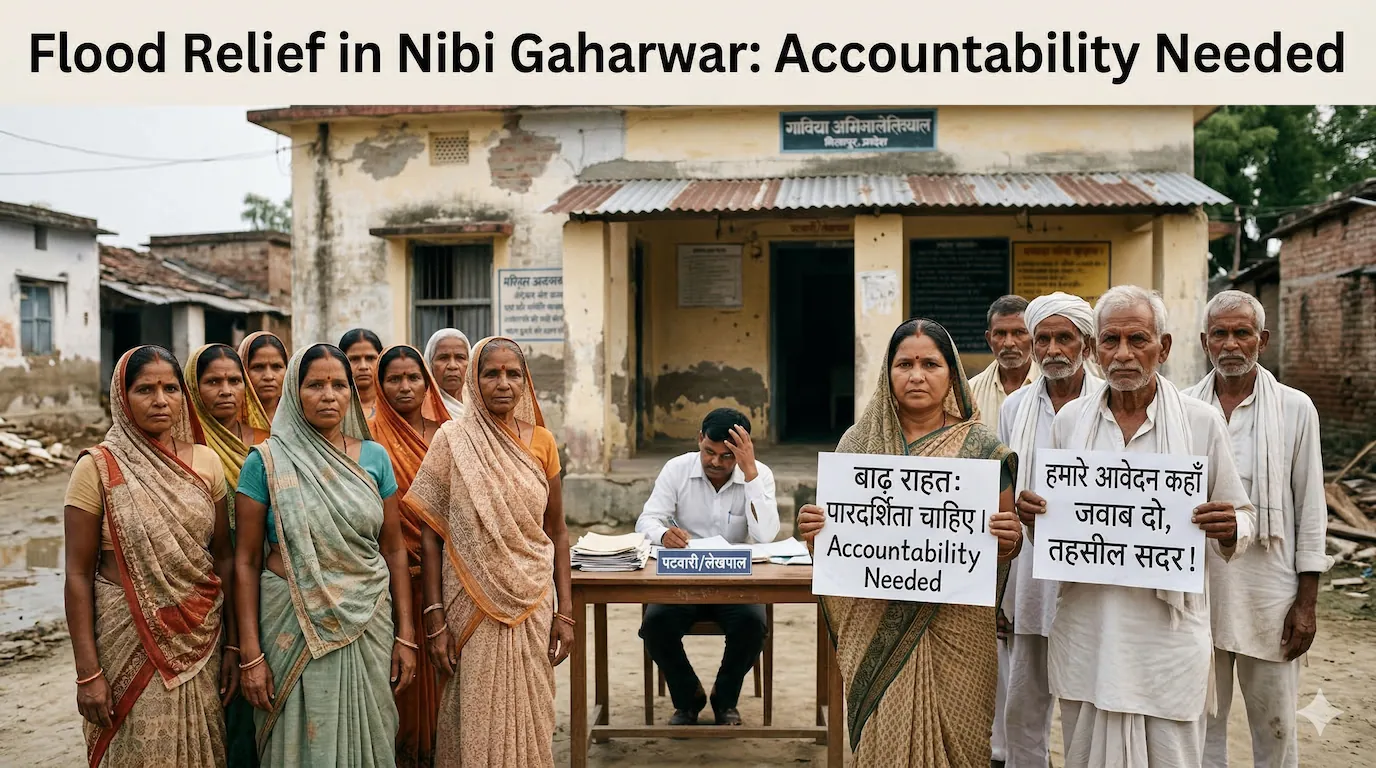
Flood relief efforts in Nibi Gaharwar have gained momentum in recent weeks, as the community comes together to support those affected by the devastating floods. Local authorities, along with various non-profit organizations, are providing essential supplies such as food, clean water, and medical assistance to the displaced families. Volunteers from nearby towns have also joined in, helping to distribute aid and rebuild damaged homes. Community meetings are being held to assess the ongoing needs and develop long-term recovery plans. The resilience and solidarity shown by residents during this crisis is truly inspiring and reflects the strength of the human spirit.
🔑 Key Takeaways from the Blog Post
1. Transparency Issues in Flood Relief
- The distribution of Flood Relief in Nibi Gaharwar suffers from serious transparency gaps.
- Citizens reported that relief applications submitted to local officials were not entered into the system, blocking genuine beneficiaries.
2. RTI Filed to Expose Irregularities
- On 8 January 2026, an RTI application was filed to seek complete information on flood‑relief applications, beneficiaries, staff, and government orders.
- The RTI targeted key records that should already be available under Section 4(1)(b) of the RTI Act.
3. PIO Failed to Respond Within Legal Time
- Despite the RTI Act’s 30‑day time limit, the Public Information Officer did not provide any information.
- The non‑response led to a deemed refusal, violating Section 7 of the Act.
4. First Appeal Submitted for Accountability
- Since the PIO ignored the RTI, a First Appeal (DMOMR/A/2026/60040) was filed on 18 March 2026 before the SDM Sadar.
- The appeal demands:
- Immediate disclosure of all records
- Explanation for the delay
- Possible action under Section 20 for negligence
5. Allegations of Middlemen and Bias
- Villagers alleged that intermediaries influenced relief distribution.
- These complaints suggest potential corruption and selective favoritism in distributing Flood Relief in Nibi Gaharwar.
6. Lack of Proactive Disclosure Worsens the Problem
- Important information—such as beneficiary lists, government orders, and staff details—is not published online, though legally required.
- This absence of proactive disclosure increases mistrust.
7. Broader Administrative Failures Highlighted
- Issues such as poor record‑keeping, non‑entry of documents, and unprofessional handling by local revenue staff indicate systemic weaknesses.
- These failures affect not only individual applicants but the entire village.
8. RTI Act Remains a Powerful Tool for Citizens (Flood Relief in Nibi Gaharwar)
- The case shows how the RTI Act can expose irregularities in welfare programs.
- Citizen persistence plays a critical role in ensuring accountability and fair distribution.
9. The Need for Timely Action by the Appellate Authority
- The SDM Sadar must now dispose of the First Appeal within the statutory period.
- A transparent, reasoned order is essential to restore trust in the administration of Flood Relief in Nibi Gaharwar.
Flood Relief in Nibi Gaharwar: A Citizen’s Fight for Transparency and Accountability
Introduction
The distribution of Flood Relief in Nibi Gaharwar has raised serious concerns about transparency and administrative accountability. Flood‑relief schemes aim to support families during natural disasters. However, the process often becomes complicated. This happens when officials ignore basic transparency requirements. Consequently, many genuine victims face unnecessary delays. This blog highlights the issues, based on a recent RTI and First Appeal filed to uncover the truth.
Background of the RTI Application
RTI Filed to Examine Flood Relief in Nibi Gaharwar
On 8 January 2026, citizen activist Yogi M P Singh submitted an RTI application (DMOMR/R/2026/60008). He wanted to examine the distribution of Flood Relief in Nibi Gaharwar. He requested crucial details, including:
- Number of applications submitted for flood relief
- Total beneficiaries
- Certified beneficiary list
- Government orders guiding relief distribution
- Officials responsible for processing relief claims
- The official web link for mandatory disclosures
Since these details form the backbone of an accountable system, the RTI sought complete transparency.
Concerns That Triggered the RTI
Residents of Nibi Gaharwar reported an issue. They submitted the required documents to the Lekhpal. However, these documents never reached the online system. Because of this gap, legitimate beneficiaries did not receive their due share of Flood Relief in Nibi Gaharwar. Moreover, villagers alleged the involvement of intermediaries who influenced the process. Therefore, the need for official verification became essential.
Failure of the PIO to Respond
Violation of Section 7(1)
The PIO must respond to an RTI within 30 days. However, despite this legal requirement, the PIO did not reply. Consequently, the applicant faced unnecessary delays. This lack of response directly affects the transparency of Flood Relief in Nibi Gaharwar. It is a clear violation of the RTI Act.
Implications of Non‑Response
When authorities ignore RTI deadlines, transparency suffers. As a result:
- Villagers cannot confirm whether relief reached genuine victims
- Suspicions of bias strengthen
- Public trust in governance declines
Moreover, during a disaster, timely information is extremely important.
Filing the First Appeal (Flood Relief in Nibi Gaharwar)
First Appeal Submitted on 18 March 2026
Since the PIO failed to respond, the applicant filed a First Appeal (DMOMR/A/2026/60040) before Asha Ram Verma, SDM Sadar. He cited “No Response Within the Time Limit” as the primary reason.
Core Issues Raised in the Appeal
The First Appeal highlighted several serious concerns:
- The PIO ignored Section 7(1)
- Beneficiary information related to Flood Relief in Nibi Gaharwar remained undisclosed
- Authorities failed to update mandatory information under Section 4(1)(b)
- Certified copies of documents were not provided
- Action under Section 20 may be necessary
Because these issues affect an entire village, the appeal demands timely and transparent action.
Broader Issues Connected to Flood Relief in Nibi Gaharwar
Absence of Proactive Disclosure
Government departments must publish key information online. In the case of Flood Relief in Nibi Gaharwar, beneficiary lists are unavailable. Government orders remain undisclosed as well. Consequently, citizens cannot verify how relief funds are used.
Administrative Irregularities and Complaints
Villagers reported troubling issues, including:
- Non‑entry of submitted documents
- Influence of middlemen
- Poor record‑keeping by revenue staff
- Delays in processing legitimate claims
These problems indicate systemic negligence, and therefore stronger oversight is crucial.
Citizen Action and the Role of RTI
The RTI Act empowers citizens to question administrative decisions. Although the process sometimes becomes challenging, it ensures transparency, especially in cases like the Flood Relief in Nibi Gaharwar. The applicant’s persistence demonstrates how public participation strengthens democracy.
Conclusion (Flood Relief in Nibi Gaharwar)
The situation surrounding Flood Relief in Nibi Gaharwar reveals significant administrative gaps. Since the PIO ignored a lawful RTI request, the applicant was forced to escalate the matter through a First Appeal. Now, the responsibility lies with the First Appellate Authority to ensure justice and transparency.
Ultimately, only a transparent system can guarantee that relief funds reach those who truly need them. Citizens can ensure fair and accountable flood‑relief distribution with consistent follow‑up. Public awareness is also crucial. A strong use of the RTI Act will make it corruption‑free.
RTI Application & Appeal Details (Flood Relief in Nibi Gaharwar)
RTI Application
- RTI Registration Number: DMOMR/R/2026/60008
- Date of Filing: 08/01/2026
First Appeal
- Appeal Registration Number: DMOMR/A/2026/60040
- Date of Filing: 18/03/2026
✅ Public Information Officer (PIO) – Tehsildar Sadar
| Detail | Information |
|---|---|
| Name | Vishal Kumar Sharma |
| Designation | Tehsildar, Sadar, Mirzapur |
| Mobile | 9454416823 |
| teh-sadar.mi@up.gov.in |
First Appellate Authority (FAA) – SDM Sadar
| Detail | Information |
|---|---|
| Name | Asha Ram Verma |
| Designation | SDM Sadar, Mirzapur |
| Mobile | 9454416810 |
| sdm-sadar.mi@up.gov.in |
✅ Nodal Officer – District Magistrate Office, Mirzapur
| Detail | Information |
|---|---|
| Name | Ajay Kumar Singh |
| Mobile | 8756844195 |
| shakti.3916@up.gov.in |
Applicant Details (You) (Flood Relief in Nibi Gaharwar)
| Detail | Information |
|---|---|
| Name | Yogi M P Singh |
| Mobile | 7379105911 |
| yogimpsingh@gmail.com |
✅ Web Link Details
These are the standard RTI portals where your application and appeal are recorded:
1. Uttar Pradesh Online RTI Portal
(Used for filing your RTI & First Appeal)
🔗 https://rtionline.up.gov.in
2. View RTI Status Page
(Used to check your application/appeal status)
🔗 https://rtionline.up.gov.in/status


Facing a similar challenge? Share the details in the box below, and our team of experts will do their best to help.