
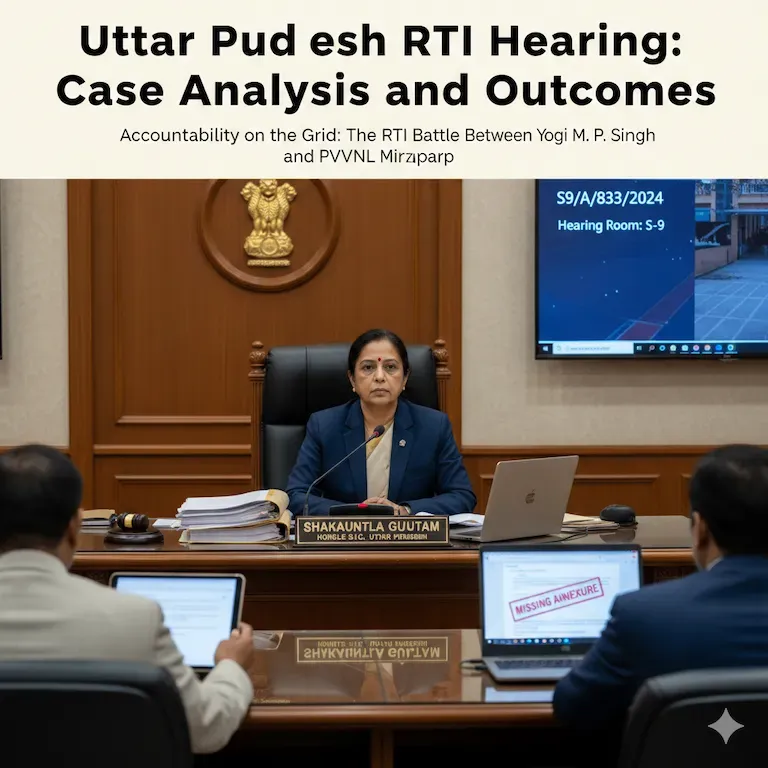
This blog post examines a critical case of administrative accountability. It focuses on the Right to Information (RTI) framework of Uttar Pradesh. The case involves the Purvanchal Vidyut Vitran Nigam Ltd. (PVVNL) and the State Information Commission, and centres around an Uttar Pradesh RTI Hearing.
Accountability in Uttar Pradesh RTI Hearing: The RTI Battle Between Yogi M. P. Singh and PVVNL Mirzapur
The Right to Information Act, 2005, envisions a sunshine law that illuminates the inner workings of public authorities. It empowers the “common man” to avoid being, left in the dark. However, recent proceedings before the Honourable State Information Commissioner, Shakuntala Gautam reveal that administrative lethargy and technical evasions often block the path to transparency. Notably, these obstacles came to the forefront during an official hearing related to the Uttar Pradesh RTI process.
The case of Shri Yogi M. P. Singh vs. PIO, Office of Purvanchal Vidyut Vitran Nigam Ltd. (Appeal No: S9/A/833/2024) serves as a stark reminder. Digital portals are only as effective as the officials who manage them, and this is never more evident than when an Uttar Pradesh hearing under the RTI framework exposes such pitfalls.
The Core Conflict of Uttar Pradesh RTI Hearing: Transparency vs. Technicality
At the heart of this dispute is a fundamental failure of the Electricity Distribution Division (Second), District Mirzapur, to maintain updated records on the RTI portal. Mr Singh, a persistent advocate for transparency, sought five specific points of information—underscoring the vital role such enquiries play in the overall process of an Uttar Pradesh RTI Hearing.
- The “Why”: Reasons for failing to update the PIO’s name and contact details (Email/Mobile) on the portal.
- The “Who”: Names and designations of staff responsible for portal updates.
- The Directory: A list of PIOs and First Appellate Authorities (FAA) within the Mirzapur Division.
The response from the Public Information Officer (PIO) was a classic example of “procedural stonewalling.” Rather than providing the specific reasons or data, the PIO offered vague references to internal correspondence. Furthermore, the PIO claimed that information was “annexed”—annexures that the appellant claims were entirely missing from the digital file, a concern often raised in the context of Uttar Pradesh RTI Hearing responses.
The Commission’s Intervention: A “Last Opportunity”
During the hearing on April 23, 2025, a glaring issue came to light: neither party appeared. More concerning was a letter from the Executive Engineer. The letter claimed they hadn’t received notice and couldn’t identify which of Mr Singh’s many applications this appeal referred to. This confusion is unfortunately not uncommon in cases of Uttar Pradesh RTI Hearings.
Commissioner Shakuntala Gautam’s order was firm. Recognizing the potential for administrative chaos to swallow the citizen’s right to know, the Commission:
- Consolidated the Records: Ordered the attachment of all previous orders and the original 6(1) application to a new notice to eliminate “confusion.”
- Issued a Mandate: Directed the PIO to dispose of the application strictly under the RTI Act 2005 and UP RTI Rules 2015, illustrating the increased scrutiny typical of a high-profile Uttar Pradesh RTI Hearing.
- Required Personal Appearance: Invoked Rule 9(2), requiring the PIO to appear in person on May 28, 2025, with a disposal report, or face further legal consequences.
The Appellant’s Rebuttal in Uttar Pradesh RTI Hearing: Deconstructing the “Arbitrary Reply”
In his subsequent submissions dated July 16, 2025, Yogi M. P. Singh did not mince words. He characterised the PIO’s responses as “arbitrary” and “misleading.” Such dissatisfaction in the appellant’s rebuttal is typical in contentious RTI Hearings across Uttar Pradesh, indicating an ongoing struggle for effective information disclosure.
1. The Missing “Right to Reason”
Under administrative law, the “Right to Reason” is an essential safeguard against the misuse of power. When Mr Singh asked why the portal wasn’t updated, the PIO replied that a letter had been sent to a Nodal Officer months prior. As Singh correctly points out, this does not explain the delay or the failure. Instead, it merely points to a different cog in the machine—highlighting how some Uttar Pradesh RTI Hearing processes can get mired in bureaucracy.
2. The Ghost Annexures in Uttar Pradesh RTI Hearing
Perhaps the most frustrating aspect of modern RTI practice is the “missing attachment” syndrome. The PIO claimed that names, designations, and contact details were “annexed.” Yet, Mr. Singh’s digital download from the portal showed no such documents. This raises a critical question: Is the PIO providing information, or simply checking a box to clear the ticket? Issues such as these have become a recurring theme across multiple Uttar Pradesh RTI Hearing appeals.
Who will compensate the detriments suffered by the information seekers due to non-availability of information on the RTI portal because of the dereliction of duty?” — Yogi M. P. Singh
Why This Case Matters for Every Citizen
This case is not just about one electricity division in Mirzapur. Additionally, it highlights three systemic issues in the Indian RTI ecosystem, frequently exposed during Uttar Pradesh RTI Hearings:
- Digital Negligence: If official emails and mobile numbers are not available on the RTI portal, the portal becomes a dead end. Moreover, this violates guidelines set by the Apex Court and the Department of Administrative Reform. Experience from Uttar Pradesh RTI Hearing disputes consistently demonstrates this problem.
- The Burden of Persistence: It took over a year (from the applied date of May 2024 to the hearings in 2025) for the case to reach this level of scrutiny. Most citizens would have given up.
- Accountability for Misinformation: Providing an “arbitrary reply” is often worse than providing no reply. It misleads the Commission and wastes public resources.
Conclusion: Waiting for May 28th
The State Information Commission has set a clear boundary. By demanding the personal appearance of the Executive Engineer, the Commission is signalling that “lost emails” and “unclear applications” are no longer valid excuses. What happens next in this Uttar Pradesh RTI Hearing will set an important precedent for future appeals.
The resolution of Appeal S9/A/833/2024 will be a litmus test for the UP RTI Rules of 2015. Will the PIO finally provide the “reason” and the “directory” sought, or will the system continue to protect its own at the expense of transparency? For the residents of Mirzapur, the answer remains buffered in a digital queue, awaiting the final outcome of this crucial Uttar Pradesh RTI Hearing.
Key Takeaways
- The article discusses a significant case of administrative accountability within the Uttar Pradesh RTI Hearing framework involving Yogi M. P. Singh and PVVNL.
- Singh faced bureaucratic obstacles in obtaining vital information due to lack of updated records on the RTI portal.
- The State Information Commission intervened, demanding clarity and personal appearances to enforce transparency.
- Key issues highlighted include digital negligence, the time-consuming nature of inquiries, and the complications of arbitrary replies.
- This case serves as a crucial test for accountability and transparency within the Uttar Pradesh RTI Hearing process.
Based on the legal proceedings and your specific requirements for Mirzapur’s electricity distribution division, here are the official application details, contact information, and digital access points for the concerned public authorities.
1. Primary Public Authority: PVVNL Mirzapur
As per your submission, the key office is Electricity Distribution Division (EDD-II), Mirzapur.
| Authority / Office | Concerned Officer (Designation) | Official Mobile | Official Email |
| PIO (EDD-II Mirzapur) | Manish Kumar Srivastava (Executive Engineer) | 9450963598 | ee.2mirzapur@puvvnl.in |
| PIO (EDD-I Mirzapur) | Yogesh Kumar (Executive Engineer) | 9450963597 | ee.1mirzapur@puvvnl.in |
| Superintending Engineer | Ram Das (SE – EDC Mirzapur) | 9415304000 | se.mirzapur@puvvnl.in |
| Chief Engineer (Zone) | Jayanti Prasad Narayan Singh | 9450963509 | ce.mirzapur@puvvnl.in |
2. Higher Administrative Contacts (HQ Varanasi)
If the local office fails to respond, these are the nodal officers for Purvanchal Vidyut Vitran Nigam Ltd (PuVVNL):
- Managing Director (PuVVNL): Shri Shambhu Kumar, IAS
- Email:
md@puvvnl.in| Phone: 0542-2318437
- Email:
- Director (Technical): Sri Jitendra Nalwaya
- Email:
dirtech@puvvnl.in
- Email:
- Customer Care (24/7): 1912
- Email for Complaints:
1912@puvvnl.in
- Email for Complaints:
3. Official Web Links & Portal IDs
To track your appeal or file new applications electronically, use the following portals:
- UP RTI Online Portal:rtionline.up.gov.in
- Note: Use this to track Appeal Registration Number: A-20240502857
- Official PVVNL Directory: puvvnl.in/en/page/officers-staff
- UP State Information Commission (UPSIC):upsic.gov.in
- Hearing Room S-9 Email:
hearingcourts9.upic@up.gov.in(For Hon’ble Commissioner Shakuntala Gautam)
- Hearing Room S-9 Email:
4. Specific Application Identifiers (From your Case)
- Appeal Number: S9/A/833/2024
- CATS Registration Number: A-20240502857
- Applied Date: 30/05/2024
- Next Hearing Date: 28/05/2025
Important Note: In your next submission to the Commission, you should explicitly state that while the Executive Engineer (EDD-II) claims “notice not received,” the contact information above is publicly listed. This proves there is no technical barrier to them receiving communications if their digital infrastructure is maintained as per the RTI Act Section 4(1)(b).
Would you like me to help you draft a formal notice to the Chief Engineer highlighting the specific dereliction of duty regarding these non-updated contact details?


Facing a similar challenge? Share the details in the box below, and our team of experts will do their best to help.