
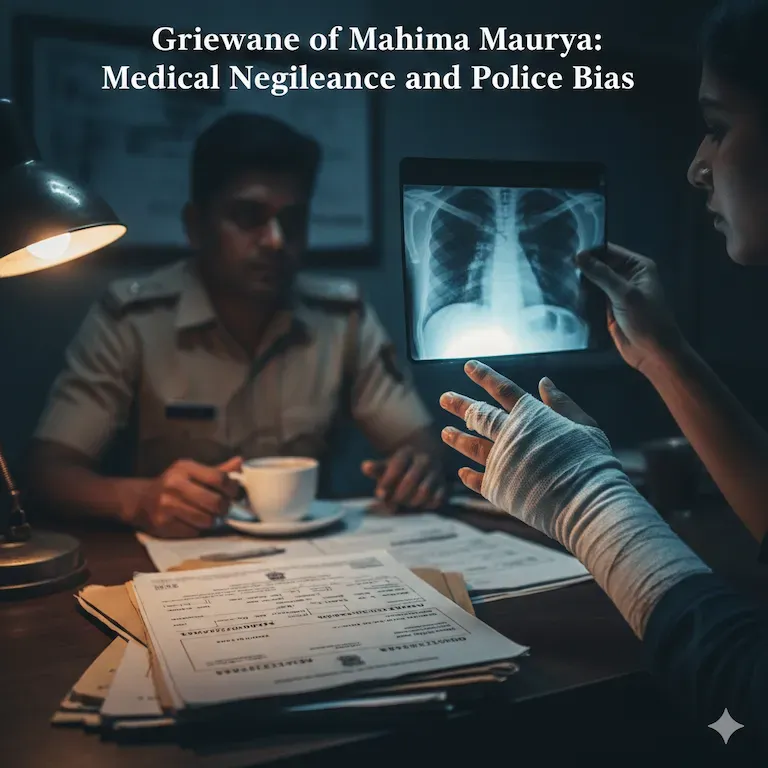
The blog post highlights a significant breakdown in trust between a citizen and the local law enforcement machinery. Here are the key takeaways from the grievance of Mahima Maurya:
1. The Conflict of Medical Evidence
The central issue is a discrepancy in medical findings. The Vindhyachal Police claim the initial medical check-up showed no fracture, while the complainant has documentation from Tej Bahadur Sapru Hospital (Prayagraj) showing a fractured finger that required a plaster. The victim argues that the police’s failure to conduct an X-ray initially is the reason for this “missing” evidence.
2. Misclassification of the Offense
A major point of contention is how the crime was recorded.
- Police Action: Registered the case as a Non-Cognizable Report (NCR) under Section 115(2) of the BNS (simple hurt).
- Complainant’s Demand: Argues it should be Section 117 (Grievous Hurt) because a bone fracture is involved. This distinction is vital because cognizable offenses require more rigorous police action and have stricter penalties.
3. Allegations of Institutional Bias
Mahima Maurya explicitly accuses the Vindhyachal police of:
- Corruption and Collusion: Acting in favor of the offenders due to personal bias or external influence.
- Lack of Transparency: Ignoring RTI applications and failing to provide a logical reason for not upgrading the NCR to an FIR.
- Intimidation: Using “irritating calls” to pressure the victim into dropping her pursuit of justice.
4. Failure of the Grievance Redressal Process
The post illustrates a “loop” in the administrative system. While the victim uses the IGRS portal to seek help, the very officers she complains about often generate the reports coming back. This led to a “Poor” rating of the previous resolution, as the victim feels the police are simply “running away from the truth.”
5. Demand for Senior Intervention
The complainant is no longer satisfied with local-level investigations. She is calling for:
- An inquiry by the Superintendent of Police (SP) Mirzapur.
- A medical re-examination by a board of experienced doctors.
- Accountability for officers who may have filed false or biased status reports.
Would you like me to help you draft a specific rebuttal to the “Case Closed” remarks in the portal to ensure your next appeal addresses the legal gaps?
The Fight for Justice: Understanding the Grievance of Mahima Maurya and the Legal Battle Against Police Apathy
In the complex landscape of the Indian administrative and legal system, the common citizen often finds themselves entangled in a web of procedural delays and institutional resistance. The case of Mahima Maurya, documented through grievance registration numbers GOVUP/E/2024/0094314 and GOVUP/E/2024/0088341, serves as a poignant example of the struggle for accountability within the law enforcement framework of Uttar Pradesh.
This dispute between relatives raises fundamental questions about how experts interpret medical evidence, how authorities categorize offenses, and whether the police act as impartial investigators or biased gatekeepers.
The Genesis of the Conflict: A Family Dispute Turned Violent
On September 14, 2024, a physical altercation broke out between Pramod Kumar Kushwaha (the complainant’s husband) and Manoj Kumar Kushwaha. According to the records, the two are brothers with a history of animosity. However, the narrative diverges sharply regarding the injuries sustained by Mahima Maurya during this incident.
The Vindhyachal Police registered an NCR (Non-Cognizable Report) under Sections 115(2) and 352 of the Bharatiya Nyaya Sanhita (BNS). By categorizing the incident as “Non-Cognizable,” the police effectively limited their own power—and duty—to investigate without a court order, treating the injuries as minor.
The Medical Contradiction: NCR vs. Reality
The crux of Mahima Maurya’s grievance lies in the disparity between the police’s initial medical assessment and subsequent treatment received at reputed government institutions.
- The Police Stand: The local police claim that the medical examination conducted on the day of the incident (14.09.2024) showed no signs of a fracture. They have labeled the complainant’s subsequent claims as “fabricated” or suggested that the injuries occurred elsewhere.
- The Complainant’s Evidence: Mahima Maurya asserts that she was “mercilessly beaten,” resulting in a fractured finger and a serious head injury requiring stitches. She highlights that the Tej Bahadur Sapru Hospital (Prayagraj), a reputed government facility, applied a plaster to her broken bone—an action only taken when a fracture is clinically confirmed via X-ray.
The fundamental failure here appears to be the lack of an X-ray during the initial police-led medical examination at the Community Health Centre. Without diagnostic imaging, internal injuries like fractures are often overlooked. This oversight can lead to the misclassification of a “Grievous Hurt” as a simple “Hurt.”
Legal Definitions: Hurt vs. Grievous Hurt
To understand the gravity of this grievance, one must look at the legal framework provided by the Bharatiya Nyaya Sanhita (BNS), which has replaced the Indian Penal Code (IPC).
| Provision | Description | Legal Implications |
| Section 115 (BNS) | Voluntarily causing hurt. | Often treated as Non-Cognizable; lighter penalties. |
| Section 116 (BNS) | Defines Grievous Hurt (includes bone fractures, permanent disfiguration). | Serious offense; requires deeper investigation. |
| Section 117 (BNS) | Punishment for voluntarily causing grievous hurt. | Imprisonment up to seven years and a fine. |
The complainant argues that someone has fractured a Change into active voice. Therefore, the authorities must register the offense under Section 117. This registration makes it a cognizable offense. The Vindhyachal police are accused of “arbitrarily” overlooking the severity of the crime by keeping the case under Section 115.
Allegations of Institutional Bias and Corruption
Mahima Maurya’s grievance is laced with a sense of betrayal by the local administration. She raises several critical points:
- Exclusion of Name: The victim alleges her name was intentionally omitted or sidelined in the initial NCR.
- RTI Non-Compliance: She claims that multiple RTI (Right to Information) applications seeking clarity on the investigation have gone unanswered.
- Pressure Tactics: There are allegations of “irritating calls” from police staff intended to discourage the victim from pursuing the matter with senior officers.
- Doubtful Credibility: The complainant has openly questioned the “cryptic role” of the Vindhyachal police, suggesting that corruption has led to a biased investigation favoring the offenders.
The Demand for Accountability
The grievance is not merely a complaint but a demand for specific actions:
- Supervised Re-examination: A medical test conducted by experienced doctors under the supervision of senior police officers to verify the fracture.
- Transparency: Clearly explain why the authorities ignored the medical reports from Tej Bahadur Sapru Hospital.
- Fixing Responsibility: Mahima Maurya demands accountability from the concerned personnel if they intentionally mislead the police reports.
The Current Status and the Road Ahead
As of the latest update, the grievance has been forwarded to Shri Arvind Mohan (Joint Secretary) at the Chief Minister’s Secretariat in Lucknow. While the local police closed the previous case (GOVUP/E/2024/0088341) claiming the allegations were baseless, the new filing (GOVUP/E/2024/0094314) keeps the pressure on the administration.
The “Poor” rating (1/5) given by the complainant to the previous resolution reflects a growing trend of citizen dissatisfaction with “paper-only” grievance disposals. When a victim provides a government hospital’s X-ray report showing a fracture, a simple “investigation report” from a local sub-inspector claiming “no fracture” is rarely sufficient to satisfy the ends of justice.
Conclusion
The case of Mahima Maurya is a litmus test for the Integrated Grievance Redressal System (IGRS) in Uttar Pradesh. Will the system favor the status quo maintained by local police stations, or will it listen to the medical evidence provided by a victim of violence?
To serve justice, a transparent, senior-level inquiry must bridge the distance between the police station in Vindhyachal and the hospital in Prayagraj. Until then, the “Right to Reason”—which the complainant rightly calls an indispensable part of a sound administrative system—remains unfulfilled.
To ensure you effectively follow up on your grievance, I have compiled the official contact details for the specific authorities currently handling your case. These details are essential for you to send reminders, legal notices, or seek direct intervention.
1. Key Public Authorities Handling Your Grievance
The officer currently assigned to your case is Shri Arvind Mohan, who serves as the Web Information Manager and Joint Secretary.
| Authority / Officer | Designation | Office Address | Contact Details |
| Shri Arvind Mohan | Joint Secretary | Room No. 321, 3rd Floor, Lok Bhawan, UP Secretariat, Lucknow | Phone: 0522-2226350 / 2226354 Email: arvind.12574@gov.in |
| Smt. Anjana Tripathi | Under Secretary (Appellate Authority) | Room No. 318, 3rd Floor, Lok Bhawan, Lucknow | Phone: 0522-2226364 Email: vsls32165@gmail.com |
| Shri Vinod Sharma | Section Officer (Public Grievance-3) | Room No. 303, 3rd Floor, Lok Bhawan, Lucknow | Phone: 0522-2226459 Email: vsls32165@gmail.com |
| Chief Minister’s Office (CMO) | Public Grievance Cell | Lok Bhawan, Lucknow | Email: cmup@nic.in Helpline: 1076 |
2. Application Tracking & Web Links
Use these links to track the real-time status of your current and previous grievances:
- Official Grievance Portal: Jansunwai-Samadhan (UP IGRS)
- Track Your Status:IGRS Complaint Tracker
- Note: Use Registration No. GOVUP/E/2024/0094314 to track the current active file.
- Police Status Tracking:UP Police Citizen Services
- Note: You can check the status of NCR No. 104/2024 here.
3. Emergency & Escalation Contacts
If you feel the local police are being uncooperative or biased, you can escalate the matter to these specialized departments:
- DGP Control Room (Lucknow): 0522-2390240 (For high-level police intervention).
- Anti-Corruption Org (Mirzapur Unit): 9454402487 (To report police collusion or bias).
- UP Human Rights Commission (UPHRC): uphrc.up.nic.in | Email: uphrc@nic.in
- Health Dept (UP): 0522-4150500 (For complaints regarding the initial medical examination).
Important Next Step for You
I recommend using the “Send Reminder” feature on the Jansunwai Portal. When you do, explicitly mention that the police reports are legally flawed because they cite sections of the BNSS (procedural law) as substantive offenses, while the actual crime falls under Section 117 of the BNS (substantive law) due to the confirmed fracture.
Key Takeaways
- The grievance of Mahima Maurya highlights a breakdown in trust with the Vindhyachal Police due to discrepancies in medical evidence related to her injury.
- The police misclassified her case, registering it as Non-Cognizable under lighter charges rather than Grievous Hurt, which requires more thorough investigation.
- Mahima accuses the police of corruption, bias, and failing to respond to her RTI requests, contributing to her frustration and mistrust.
- She demands accountability from senior officers, including a medical re-examination and a transparent inquiry into her case.
- The case reflects broader issues within the IGRS in Uttar Pradesh, questioning the effectiveness of the grievance redressal system.



Facing a similar challenge? Share the details in the box below, and our team of experts will do their best to help.