
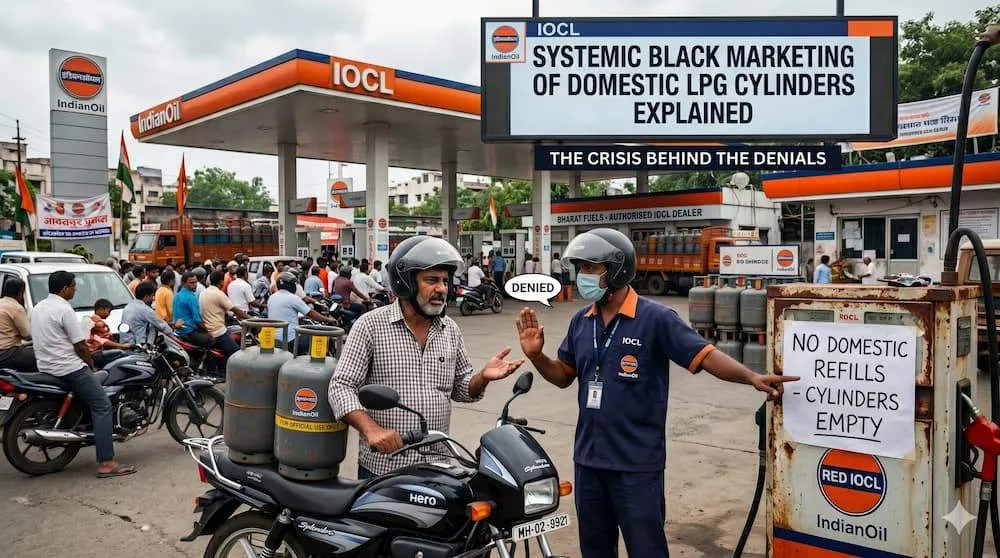
Systemic Corruption and Service Denial within the Indian Oil Corporation Limited (IOCL) represent a pervasive issue that significantly undermines the integrity of energy distribution systems. This corruption not only affects the availability of subsidised cooking fuel for households but also perpetuates a cycle of exploitation and injustice. Consumers, particularly in marginalised communities, face bureaucratic hurdles and denial of service, leading to a thriving black market. The systemic failures call attention to accountability and reform to ensure that every citizen has access to their rightful entitlements without interference from corrupt practices.
Key Takeaways
- Systemic corruption & service denial in IOCL hinder access to subsidised cooking fuel, affecting vulnerable communities and fostering a black market.
- Distributors exploit digital systems, denying delivery despite valid records, leading to significant consumer frustrations and injustices.
- The grievance redressal mechanism fails, with complaints marked as ‘Resolved’ without genuine resolutions, perpetuating the cycle of corruption.
- Sadhana Tiwari’s fight for justice illustrates the bureaucratic hurdles citizens face in securing their entitlements and demands urgent reforms.
- A physical audit is essential to address inconsistencies between local distribution and IOCL records, restoring accountability and fairness.
Systemic Corruption & Service Denial in IOCL: The LPG Black Market Exposed
Systemic corruption and service denial in IOCL undermine the promise of subsidised energy. This promise should guarantee that every household has clean cooking fuel. For residents of Surekapuram Colony in Mirzapur, this promise has become a bureaucratic trap. Local distributors exploit digital systems for black marketing. They deny genuine consumers their rights, as seen in Sadhana Tiwari’s case. These actions reveal a broader pattern of abuse within the system.
The Ghost in the Machine: When Records “Disappear”
The core of this grievance lies in a paradoxical situation. Digital systems confirm a consumer’s existence. However, the physical distributor denies it. On March 26, 2026, the system generated an invoice for Ram Lakhan/Kaniti Devi (consumer ID: 722412107991) amounting to ₹976.5. The official IOCL records document this invoice. At the same time, the system issued Delivery Authentication Codes (DACs), which serve as unique verification numbers needed to confirm delivery upon receipt.
A DAC acts as the ultimate confirmation of a transaction. When the consumer approached the distributor, they received a blunt response: “No records exist.”
This “record denial” is not a technical glitch. Instead, it is a calculated tactic. Distributors assert that a consumer is absent from their local database. This occurs despite the consumer being active in the centralised Indian Oil Corporation (IOCL) system.
As a result, they can “orphan” the stock intended for that consumer. The system generates an invoice, but the distributor fails to deliver the cylinder to its rightful owner.
The high-demand commodity often ends up in the commercial black market.
This scenario occurs at inflated prices.
Consequently, the cycle of corruption continues unchecked.
Multiple Victims, One Pattern
The Mirzapur case clearly shows how systemic corruption and denial of service in IOCL render Digital India’s efforts ineffective. Local actors openly undermine the robust tracking system established by the Ministry of Petroleum and Natural Gas through corrupt denial-of-service tactics, causing severe service delivery delays. Sadhana Tiwari fights for justice at every level.
She makes local complaints, approaches the DGM of Indian Oil, and even reaches out to the ministry itself. Her relentless pursuit highlights how far citizens must go to secure their legal entitlements. Such behaviour is intolerable, and we must demand immediate reform.
Looking ahead, the outcome will set a meaningful precedent. This situation requires urgent attention from authorities.
- Case 1: Ram Lakhan/Kaniti Devi: Despite a valid subscription voucher and active DACs, delivery was withheld.
- Case 2: Shiv Lakhan Tiwari: Under Consumer ID AGS11423, this household has faced persistent denial of service. Even after completing the required KYC (Know Your Customer) procedures with Asmita Gas Service, the distributor still refused to fulfil the refill request. (Systemic Corruption & Service Denial in IOCL)
Both consumers come from Surekapuram Colony. By targeting this specific geographic cluster, the corrupt distributor deliberately diverts stock, exploiting the assumption that individual voices cannot challenge a state-backed entity. This calculated targeting must stop immediately.
The grievance redressal mechanism has failed catastrophically. The system refused to correct itself. Sadhana Tiwari filed her initial complaint (MPANG/E/2026/0014995) in March 2026. Still, on April 23, 2026, the system had the audacity to mark the case “resolved”—an insult to the complainant.
But what does “Resolved” mean in the eyes of the bureaucracy?
Here, the term “Resolved” serves as a bureaucratic dodge, as it merely acknowledges the complaint while ignoring it, compelling the complainant to escalate through an appeal and a secondary grievance. (Systemic Corruption & Service Denial in IOCL)
When oversight bodies close cases without verifying physical delivery, they inadvertently embolden the perpetrators. This action creates a feedback loop. The distributor quickly learns they can wait out the initial complaint cycle. Eventually, the “Resolved” status is triggered by a timer or a perfunctory response. As a result, systemic corruption persists.
Distributors clearly deny even a single cylinder because they are motivated by profit. The price gap between subsidised domestic LPG and much more expensive commercial LPG drives diversion to the black market at hefty premiums.
- Distributors pocket government subsidies while charging black-market buyers the full commercial rate. By manufacturing scarcity through these practices, they coerce domestic users into paying illegal service charges. This exploitation must end; only immediate action can restore fairness.
A Call for Accountability: The Demand for a Physical Audit
Sadhana Tiwari’s latest representation to Mr Manik Biswas (DGM, LPG Sales, IOCL) is resolute and uncompromising. She demands a systemic audit, not just delivery of a single cylinder. (Systemic Corruption & Service Denial in IOCL)
A digital invoice is a financial footprint. If the IOCL system indicates that it generated an invoice and issued a DAC (Delivery Authentication Code), the situation becomes concerning. When a consumer reports non-delivery, it indicates a gap in the chain of custody.
A physical audit of Distributor SAP-155283’s stock logs against their digital delivery confirmations would immediately reveal the discrepancy.
Key Demands for the Nodal Office:
We request the immediate fulfilment of pending refills for Shiv Lakhan Tiwari and Ram Lakhan. No further delay is acceptable.
Order a rigorous technical probe. Investigate why discrepancies persist between the distributor’s local terminal and the IOCL central database. The local terminal is the software or device at the distributor’s location that manages inventory and delivery information. The IOCL central database is the main computerised system where all official records are kept. (Systemic Corruption & Service Denial in IOCL)
Enforce suspension of any distributor found to have deliberately suppressed the domestic supply.
Conclusion: Combating Systemic Corruption & Service Denial in IOCL
The Mirzapur case clearly shows how systemic corruption and denial of service in IOCL render Digital India’s efforts ineffective. The Ministry of Petroleum and Natural Gas has established a robust tracking system. However, local actors openly undermine it through corrupt denial-of-service tactics. This causes severe service delivery delays. Sadhana Tiwari has fought for justice at every level. She has made local complaints, approached the DGM of Indian Oil, and even reached out to the ministry itself.
Her fight shows how far citizens must go to secure their legal entitlements. Such behaviour is intolerable. Demand immediate reforms.
Looking ahead, the outcome will set a meaningful precedent.
Based on your request, here is a structured directory of the public authorities and registration details mentioned in your grievance documents.
1. Active Grievance & Appeal Identifiers (Systemic Corruption & Service Denial in IOCL)
Use these numbers for all future correspondence to ensure your history is tracked.
- Primary Grievance No (Ongoing):
MPANG/E/2026/0028400 - Previous Grievance No (Closed/Disputed):
MPANG/E/2026/0014995 - Active Appeal Number:
MPANG/C/A/26/0001382(Filed 28/04/2026)
2. Concerned Public Authorities (Systemic Corruption & Service Denial in IOCL)
These are the officers directly responsible for overseeing your case at various levels of the Indian government and Indian Oil Corporation.
| Authority Level | Officer Name | Designation | Contact Details |
| Corporation (IOCL) | Manik Biswas | DGM (LPG-Sales), UP State Office-1 | Phone: 0522-2305713 Email: manikbiswas@indianoil.in |
| Ministry (MoPNG) | Shri Ravi Pande | Deputy Secretary | Phone: 011-24011216 Email: pande.ravi04@gov.in |
| Local (Mirzapur) | Nodal Officer | District Supply Officer (DSO) | DM Office: 05442-257400 Email: dmmir@nic.in |
3. Essential Digital Links & Portals (Systemic Corruption & Service Denial in IOCL)
You can monitor the real-time status of your appeal and file further evidence through these official channels.
- Central Grievance Portal (CPGRAMS):
- Action: Use the “View Status” tab with your registration number.
- MoPNG e-Seva (Alternative Support)
- Email Support: support@mopnge-seva.in
- Indian Oil Transparency Portal
- Purpose: To monitor the distributor’s daily stock and delivery logs.
4. Key Reference Data for your Follow-ups (Systemic Corruption & Service Denial in IOCL)
When writing to these authorities, ensure you consistently cite these specific IDs to prove the digital footprint exists:
- Distributor Code: SAP-155283 (Asmita Gas Service)
- Consumer IDs in Question: *
722412107991(Ram Lakhan / Kaniti Devi)519936137338/AGS11423(Shiv Lakhan Tiwari)
- Unused Delivery Codes (DACs)
427897(Generated 26/03/2026)
Important Note: Since your appeal is now with the ministry level (Shri Ravi Pande), you should focus your next communication there if the DGM (LPG-Sales) in Lucknow does not provide a physical delivery confirmation within 48 hours.


Facing a similar challenge? Share the details in the box below, and our team of experts will do their best to help.