
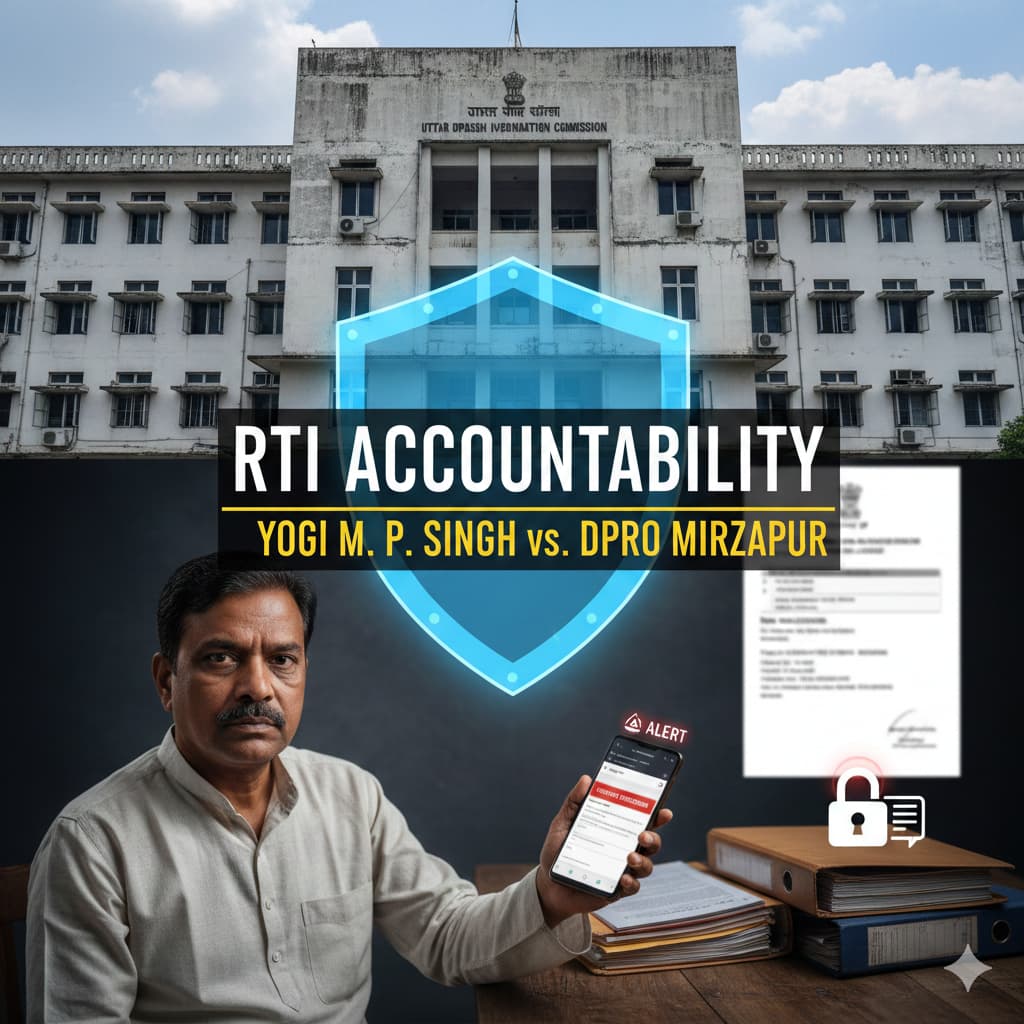
Key Takeaways (RTI Accountability)
- This case study highlights RTI Accountability failure due to non-compliance by the DPRO in Mirzapur, Uttar Pradesh.
- The appellant, Yogi M. P. Singh, filed an RTI application. He sought information about the failure of 85 Gram Panchayats to upload Public Information Board images.
- The PIO misdirected the inquiry by providing irrelevant information from a different RTI application, further complicating accountability efforts.
- Persistent non-compliance has led to a second appeal before the UP Information Commission. This emphasizes the need for transparency in rural governance.
- The appellant requests action against the PIO for sustained denial of information and seeks to uphold the RTI Act’s spirit.
📢 RTI Accountability Failure: A Case Study in Non-Compliance at UP Information Commission
Appeal Highlight: Yogi M. P. Singh vs. DPRO, Mirzapur (A-20241200030)
This case study examines a significant lapse in public accountability. It investigates the deliberate non-compliance with the Right to Information (RTI) Act, 2005. This non-compliance is a clear example of RTI Accountability issues. This non-compliance is exhibited by the District Panchayat Raj Officer (DPRO) in Mirzapur, Uttar Pradesh. The case is currently before the Uttar Pradesh Information Commission (UPIC). It highlights systemic challenges that citizens face when exercising their fundamental right to information.
The Core Issue: Transparency in Rural Governance
The matter originates from an RTI application (Registration No. DIRPR/R/2024/60593) filed by the Appellant, Shri Yogi M. P. Singh, on October 12, 2024. (RTI Accountability)
The application sought crucial details regarding transparency and accountability at the grass roots level:
- Subject: Mandatory Public Information Board images have not been uploaded. 85 Gram Panchayats in the Development Block Chhanbey are responsible for this on the GPDP portal for the year 2023–2024.
- Information Sought: Reasons for non-compliance, names of officials responsible for monitoring, and details of fund disbursement to these non-compliant Panchayats.
This information is vital to ensure public funds are utilised responsibly. It also ensures that mandated transparency norms are followed in rural development projects.
The PIO’s Response: Misdirection and Obstruction (RTI Accountability)
Instead of addressing the specific queries, the Public Information Officer (PIO) / DPRO, Mirzapur, committed a grave error that escalated the matter to a Second Appeal.
Irrelevant Information Furnished
The PIO provided information related to a completely different RTI application (No. 60644) filed by an unrelated individual (Shri Ashok KumarSingh) on an entirely different subject. This action raises serious concerns:(RTI Accountability)
- Violation of Section 7(1): The failure to provide the correct information within the stipulated time.
- Gross Negligence: The misdirection suggests a profound lack of procedural integrity or, worse, deliberate obfuscation to evade transparency.
Contempt for the Commission’s Directives (RTI Accountability)
The case, registered under File No. S09/A/0002/2025, has reached the hearing stage. The Appellant’s submission for the hearing on November 28, 2025, highlighted the PIO’s sustained non-compliance. This occurred even after the UPIC took cognizance of the matter.
The Appellant identified three critical points of violation:
- Fundamental Failure: The PIO has never provided the correct information related to the non-compliance of the 85 Gram Panchayats.
- Attempt to Mislead: The initial action was providing irrelevant information. This was a clear attempt to mislead the Appellant. It also wasted public resources.
- Disregard for Procedure: The most recent communication from the DPRO’s office (dated 22/11/2025) was merely an internal administrative instruction. It was sent to a subordinate officer. It directed them to attend the hearing. This was not the requested information itself. This demonstrates a conscious disregard for the Commission’s authority.
The Appeal for Justice and Accountability
The Appellant has earnestly requested the Hon’ble Commission to take stringent action to uphold the RTI Act’s spirit. The requested relief includes: (RTI Accountability)
- Immediate Direction to the PIO to furnish the complete and correct information.
- Initiation of Enquiry into the conduct of the DPRO, Mirzapur, and related officials.
- Imposition of Maximum Penalty under Section 20 of the RTI Act for the sustained denial and misleading conduct.
This case serves as a crucial reminder. The arbitrary denial of information and procedural lapses not only violate the law. They also actively erode public trust. These actions undermine democratic governance at the local level. The outcome of this case will be significant. It will set a precedent for accountability in the Panchayat Raj Department across Uttar Pradesh.
📢 RTI Accountability Failure: A Case Study in Non-Compliance at UP Information Commission
Appeal Highlight: Yogi M. P. Singh vs. DPRO, Mirzapur (A-20241200030)
This case study examines a significant lapse in public accountability. It also addresses the deliberate non-compliance with the Right to Information (RTI) Act, 2005. This non-compliance is by the District Panchayat Raj Officer (DPRO) in Mirzapur, Uttar Pradesh. The case is currently before the Uttar Pradesh Information Commission (UPIC). It highlights systemic challenges citizens face when exercising their fundamental right to information. (RTI Accountability)
The Core Issue: Transparency in Rural Governance and Financial Mandates
The matter originates from an RTI application (Registration No. DIRPR/R/2024/60593) filed by the Appellant, Shri Yogi M. P. Singh, on October 12, 2024. (RTI Accountability)
The application sought crucial details regarding transparency and accountability at the grass roots level:
- Subject: 85 Gram Panchayats in Development Block Chhanbey did not upload the mandatory Public Information Board images. This non-uploading occurred on the GPDP portal for the year 2023–2024.
- Information Sought: Reasons for non-compliance, names of officials responsible for monitoring, and details of fund disbursement to these non-compliant Panchayats.
This information is vital for ensuring public funds are utilised responsibly. It also ensures that mandated transparency norms are followed in rural development projects.
🚨 Critical Escalation: The Link Between Transparency and Budget
The failure of the PIO/DPRO to provide the requested information takes on a far more severe dimension due to a direct financial mandate: (RTI Accountability)
Violation of a Financial Accountability Mandate (RTI Accountability)
- The District Panchayat Raj Officer (DPRO) is the designated monitoring head for this compliance at the district level.
- The issuance of the next financial year’s budget depends on the Public Information Board images. They must be successfully uploaded to the GPDP Portal.
- The PIO (DPRO Mirzapur) himself accepted and confirmed this crucial condition to the Appellant during a telephonic conversation.
The refusal to provide information now equates to a direct obstruction. It conceals details about a financial mandate breach and accountability failure within the DPRO’s jurisdiction.
The PIO’s Response: Misdirection and Obstruction (RTI Accountability)
Instead of addressing the specific queries related to this financial and transparency breach, the PIO committed a grave error. This mistake escalated the matter to a Second Appeal.
Irrelevant Information Furnished
The PIO provided information related to a completely different RTI application (No. 60644) filed by an unrelated individual (Shri Ashok KumarSingh) on an entirely different subject. This action raises serious concerns: (RTI Accountability)
- Violation of Section 7(1): The failure to provide the correct information within the stipulated time.
- Deliberate Misdirection: The misdirection is viewed as an act of obstruction and an attempt to evade transparency.
Contempt for the Commission’s Directives (RTI Accountability)
The Appellant’s submission for the hearing on November 28, 2025, highlighted the persistent non-compliance by the PIO. This occurred even after the UPIC took cognisance of the matter. The critical points emphasised were:
- Fundamental Failure: The PIO has never provided the correct information related to the non-compliance of the 85 Gram Panchayats.
- Attempt to Mislead: Providing irrelevant information was a clear attempt to mislead.
- Disregard for Procedure: The latest departmental communication (dated 22/11/2025) was merely an internal administrative instruction to a subordinate officer. It was to attend, not the requested information.
The Appeal for Justice and Accountability
The Appellant has earnestly requested the Hon’ble Commission to take stringent action to uphold the RTI Act’s spirit. The requested relief includes:
- Immediate Direction to the PIO to furnish the complete and correct information, specifically addressing the failure regarding the financial mandate.
- Imposition of Maximum Penalty under Section 20 of the RTI Act on the responsible PIO. This is for the sustained denial. It also addresses misleading conduct and obstruction of information regarding a critical financial compliance failure.
This case serves as a crucial reminder. Arbitrarily denying information, especially when tied to financial oversight, violates the law. Such actions actively erode public trust and undermine democratic governance at the local level. The outcome of this case will be significant. It will set a precedent for accountability in the Panchayat Raj Department across Uttar Pradesh.
Here are the requested items in a short, summarised format:
📜 Case Description and Key Dates (RTI Accountability)
| Detail | Description |
| Case Title | Yogi M. P. Singh vs. DPRO, Mirzapur |
| Appeal No. (RTI Accountability) | A-20241200030 / S09/A/0002/2025 |
| Core Issue | DPRO’s failure to provide information regarding 85 Gram Panchayats’ failure to upload Public Information Board images on the GPDP portal. |
| Key Admission | The DPRO confirmed that the image upload is necessary for the next year’s budget issuance. This makes it a financial accountability issue. |
| PIO Action | PIO responded with irrelevant information from a different RTI (No. 60644) by another person, Shri Ashok Kumar Singh. |
| Current Status | Second Appeal (For further hearing) before the UP Information Commission (UPIC). |
📅 Key Events in Short (RTI Accountability)
| Date | Event Summary |
| 12/10/2024 | Original RTI Filed. (DIRPR/R/2024/60593). |
| 2025 (Initial) | PIO gave irrelevant response; First Appeal likely failed. |
| 02/09/2025 | Initial Second Appeal Hearing Date. Appellant filed detailed submission. |
| 22/11/2025 | DPRO sent provided. |
| 28/11/2025 (Today) | Final Representation & Urgent Addendum submitted to UPIC detailing non-compliance and budget-link admission. |
| 28/11/2025 | Online Hearing Scheduled (12:30 PM – 02:00 PM). |
🔗 Portal URL (RTI Accountability)
The URL for the online hearing is:
$$\text{[https://upsic.up.gov.in/cispu/onlinehearing/c81e9b](https://upsic.up.gov.in/cispu/onlinehearing/c81e9b)}$$


Facing a similar challenge? Share the details in the box below, and our team of experts will do their best to help.