
Key Takeaways
- CMO Prayagraj faces scrutiny for providing misleading reports and protecting illegal practices at Chhote Lal Bind Hospital.
- An RTI appeal reveals administrative misconduct, demanding greater transparency and accountability from CMO Prayagraj.
- Dr. Pradeep Kumar Yadav was found guilty of private practice, yet CMO Prayagraj allegedly shields him and the hospital.
- The CMO neglected to respond promptly to the RTI inquiry. This action violated Section 7(1) of the RTI Act, 2005. It also attracted penalties under Section 20.
- This case emphasizes the need for digital governance and public engagement to restore trust in health administration.
CMO Prayagraj took under teeth order of UPIC by providing a misleading and concocted story to the appellant. This action raises significant concerns about the report’s integrity. It seems to try to manipulate the facts, aiming to mislead the authorities. Evidently, ACMO & Deputy CMOs of Prayagraj, along with SDM Handia, supplied inconsistent reports. This further complicates the situation. It suggests a coordinated effort to achieve ulterior motives. These discrepancies undermine public trust in the health administration. They also raise questions about the accountability of these officials. Their reports lack consistency and transparency. This hinders any legitimate investigation. It also obscures the truth of the matter at hand.
Dr Pradeep Kumar Yadav found guilty of private practice in Chhote Lal Bind hospital. Team of Doctors under direction of CMO Bhadohi carried out this enquiry. After appeal, then, A.D. Mirzapur carried out enquiry itself and upheld earlier findings.
In the light of fact, the Government took action against the guilty doctor. But CMO Prayagraj is protecting guilty Chhote Lal Bind hospital, Baraut, Prayagraj ipso facto. Lal Bind hospital is guilty of allowing private practice by government doctors. As a result, CMO Prayagraj is misleading not only the appellant but also the most respected commission.
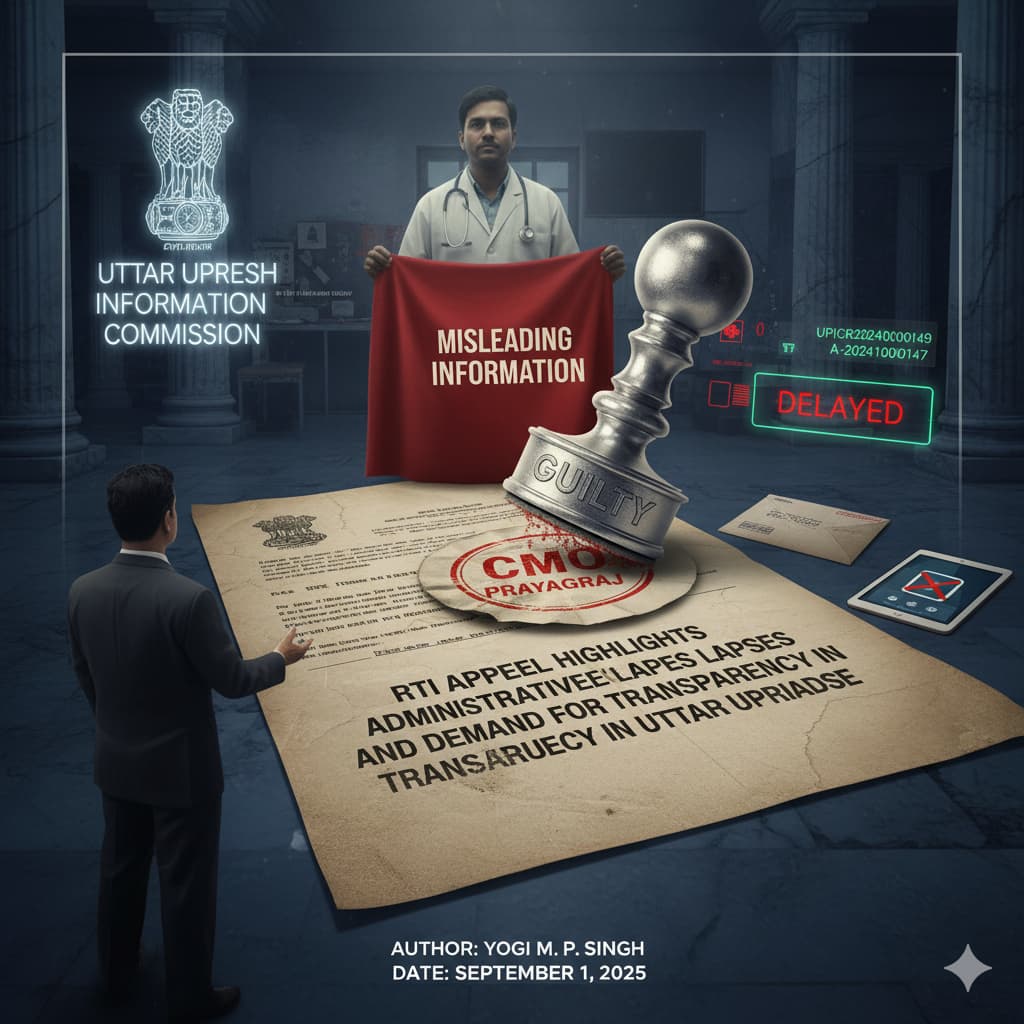
RTI Appeal Highlights Administrative Lapses and Demand for Transparency in working of CMO Prayagraj in Uttar Pradesh
Author: Yogi M. P. Singh
Date: September 1, 2025
Keywords: RTI Act 2005, Uttar Pradesh Information Commission, CMO Prayagraj, private practice by government doctors, Section 20 penalty, digital governance, transparency in administration
Introduction in working of CMO Prayagraj
This blog post presents a detailed account of an RTI appeal filed by Yogi M. P. Singh against the Chief Medical Officer (CMO) Prayagraj. It highlights violations of the RTI Act, 2005. The appeal draws attention to administrative misconduct. It also emphasizes the need for digital governance and transparency in administration.
Case Background of CMO Prayagraj
The appeal, registered under UPICR20240000149 and A-20241000147, concerns the shielding of Dr. Pradeep Kumar Yadav by CMO Prayagraj. This is despite findings from CMO Bhadohi. These findings confirm private practice by the government doctor at Chhote Lal Bind Hospital. The appellant alleges that the hospital facilitated this illegal practice and that the CMO Prayagraj misled the commission.
Violation of RTI Act 2005
The RTI application was filed on 24/06/2024. It was received on 25/06/2024. However, the response was delayed until August 2025, violating Section 7(1) of the RTI Act. This delay attracts penal provisions under Section 20(1) for non-compliance.
Misleading Information and Legal Provisions
The response from CMO Prayagraj neglected to tackle specific queries. It provided irrelevant inspection reports. This left many concerns unresolved. It also prompted further frustration among stakeholders. Under Section 20(1), misleading information warrants a penalty of ₹250 per day. The penalty can go up to a limit of ₹25,000. This emphasizes the importance of transparency and accountability in public health communications. Additionally, the U.P. Government Doctors (Allopathic) Restriction on Private Practice Rules, 1983 clearly prohibits private practice for doctors in the region. This rule was evidently violated by Dr. Yadav as per the compelling evidence submitted. This raises serious ethical questions about his adherence to regulatory frameworks and the consequences that follow such violations. As such, it is crucial to hold all medical practitioners to the highest standards. This helps protect public health and keep trust within the community.
Supreme Court Guidelines and Digital Governance
The Supreme Court in Writ Petition (Civil) No. 360/2021 directed implementation of hybrid hearings and e-filing systems. Despite this, CMO Prayagraj dispatched a hard copy via registered post, violating digital governance norms and incurring unnecessary expenditure.
Administrative Lapses and Prayer for Relief
The RTI sought legal provisions, reasons for inaction, and actions taken, none of which were addressed. This forms administrative misconduct, as failing to give these crucial details undermines the transparency and accountability expected from governmental bodies. The appellant requests the commission to thoroughly investigate this lack of response. Appropriate measures should be taken to rectify this situation. This will restore public confidence and uphold the principles of good governance. Without a comprehensive review, such negligence perpetuates a culture of disregard for legal obligations and civic rights. The appellant firmly urges the commission to resolve these issues decisively and transparently.
- Impose penalties under Section 20
- Recommend disciplinary action
- Ensure compliance with digital governance directives
Conclusion
This case highlights the importance of transparency in administration and following the RTI Act 2005. It calls for accountability from public officials and the use of digital governance to protect citizens’ rights. In a democratic society, it is essential to ensure that government actions are visible. Public scrutiny of these actions builds trust and integrity within institutions. Officials must adhere to legislative frameworks like the RTI Act. They should also engage with citizens. This engagement encourages participation and feedback. Furthermore, integrating digital governance can make access to information easier. It simplifies procedures and ultimately empowers citizens in decision-making processes. This improvement boosts civic engagement and holds public authorities accountable, which is vital in a rapidly changing digital landscape.


Facing a similar challenge? Share the details in the box below, and our team of experts will do their best to help.