
Key Takeaways
- The closure of a grievance about illegal encroachment on government land raises concerns about accountability and transparency.
- Officials arbitrarily dismissed the case based on a missed call, undermining the legal framework for addressing such grievances.
- This incident highlights systemic issues, including violations of natural justice and erosion of public trust in grievance redressal mechanisms.
- The complainant has requested to reopen the case, conduct a field inspection, and take disciplinary action against involved officials.
- Restoring integrity to public service requires collective efforts to uphold laws and demand proper procedures for grievance closure.
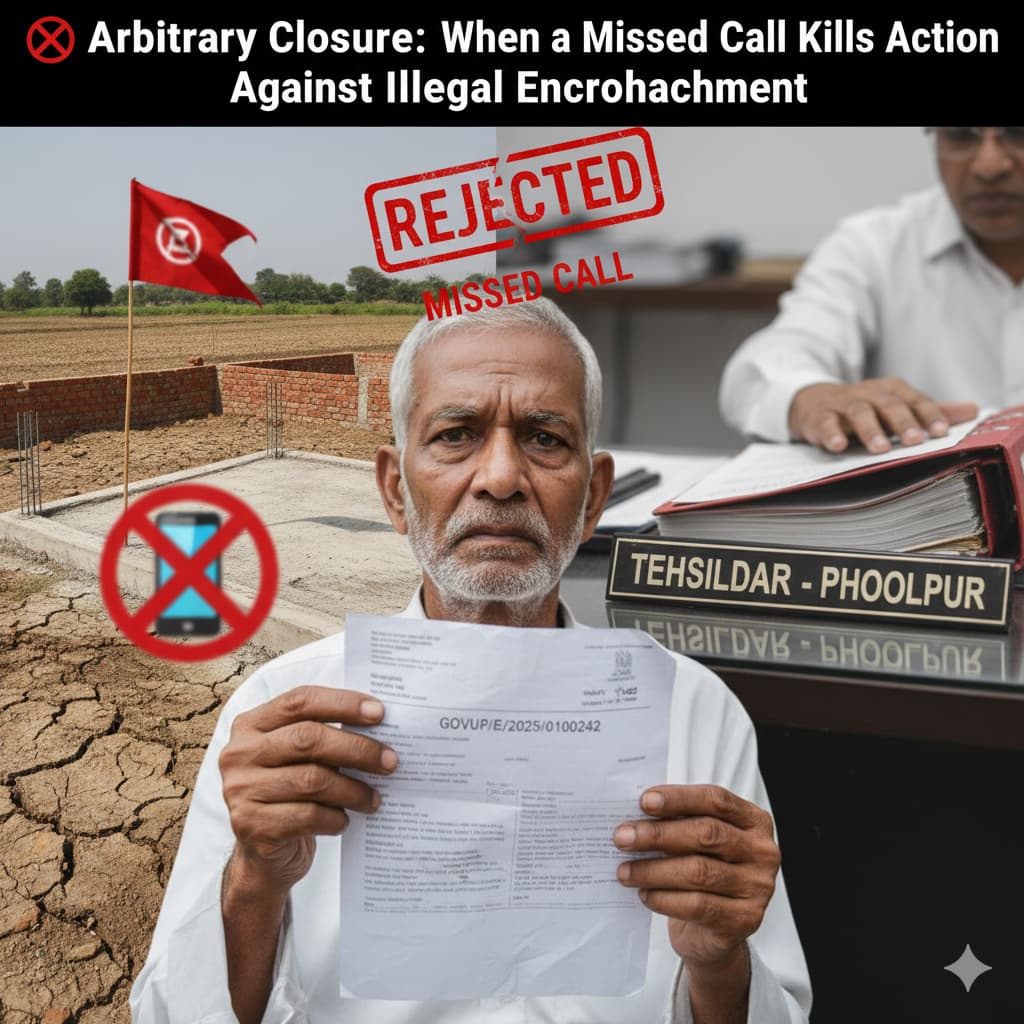
🚫 Arbitrary Grievance closure: When a Missed Call Kills Action Against Illegal Encroachment
The integrity of public service rests on transparency and accountability. A recent incident in Phoolpur, Prayagraj, involved the closure of a critical grievance. This raises serious questions about how seriously some officials take their duty to protect government land. It also questions their commitment to upholding the rule of law.
This post examines a grievance case (Ref: GOVUP/E/2025/0100242) about illegal construction on public land. The reason cited for its arbitrary grievance closure is disturbing.
The Core Issue is arbitrary Grievance closure: Government Land Under Threat
The original complaint was filed by Tej Bahadur Singh. It detailed the illegal construction of residential structures by Balendra Singh, Baleshwar Singh, and Nirmala Singh. These structures were in Village Saraijeet Rai Urf Pure Bhawa, Tehsil Phoolpur.
This is not a minor dispute; it is a clear violation of Section 122B of the U.P. Zamindari Abolition and Land Reforms Act, 1950. This section mandates that the Assistant Collector start proceedings to evict occupants. They must also recover damages when land vested in the Gaon Sabha is improperly occupied. The law provides a clear, non-negotiable legal path for eviction and land recovery to prevent grievance closure without action.
The Flawed Redressal: Closed on a “Flimsy Excuse”
The encroachment was serious. There was a clear legal framework for action. Despite this, the Tehsildar of Phoolpur arbitrarily closed the matter. The official reason cited was astonishingly inadequate: the complainant did not respond to a phone call from the Lekhpal.
Closing a serious land encroachment case is problematic. This case requires a mandatory site inspection, documentation, and formal proceedings. Ending the case because a phone call was missed is a significant issue. It undermines the Jansunwai Portal’s purpose. It highlights problems with grievance closure practices.
Key Concern: The grievance closure report submitted is vague. It seems to be a deliberate effort to avoid initiating proceedings under Section 122B. This suggests a possible intent to suppress action against the illegal construction. The law demands a show cause notice, a 15-day waiting period, and a hearing, not just a phone call.
Why This Arbitrary Action is Unacceptable
This incident highlights a systemic failure in accountability:
- Violation of Natural Justice: Grievances involving public property and illegal activities demand proper investigation, field verification, and documented proceedings. Closing a case based on a single missed call violates the principles of natural justice. It also undermines fairness. This is particularly true with regard to proper closure of grievances.
- Contradiction of Legal Duties: The Tehsildar arbitrarily closed the matter. They failed in their mandatory duty to guarantee the protection of government property under Section 122B.
- Erosion of Public Trust: The Jansunwai Portal aims to guarantee transparent and prompt resolutions. Nonetheless, arbitrary closures erode the public’s trust in the government’s mechanism for grievance redressal.
The Uttar Pradesh Government’s 2025 guidelines for demolishing unauthorized constructions specifically mandate transparency. They also demand documentation. There is strict action against officials who fail to comply. This closure appears to be in direct contradiction to these directives.
The Path Ahead: A Call for Upholding the Law
The complainant has now formally requested the District Magistrate, Prayagraj, to intervene. The primary prayers include:
- Reopening of the grievance and mandatory initiation of proceedings under Section 122B.
- A field inspection conducted by a neutral officer.
- Disciplinary action against the officials who submitted a misleading and vague closure report.
Land management system integrity demands that officers follow procedures and uphold the specific laws enacted to protect community assets. They can’t allow a missed phone call to supersede the processes required for grievance closure.
Conclusion: A Collective Responsibility for Accountability
The issues surrounding the arbitrary closure of grievances related to illegal encroachments are worrying. They underscore a critical need for reform in the grievance redressal system. Protecting public assets is not only a matter of legal obligation. It is also a moral imperative to preserve public trust in governmental processes.
As citizens, we must hold officials accountable for their actions and demand transparency in bureaucratic practices. Resolving such cases should go beyond mere procedural formalities. It requires our commitment to uphold the law. We should not disregard any grievance due to insufficient reasoning. They must strictly adhere to the guidelines established by the Uttar Pradesh Government. We need to scrutinize and address any delay or negligence.
The Constitution guarantees that our collective voice heard by insisting on due process. We also demand rigorous inspections and advocate for proper documentation. Only our joint efforts can reverse the tide of arbitrary grievance closures. Together, we restore integrity to public service. We foster a culture of accountability that genuinely serves the interests of the community. Let’s rally together to uphold these principles for a just and fair society.
What steps do you believe are most effective? How can we guarantee an arbitrary grievance closure is reversed? What proper actions should be taken?
S.D.M. Phoolpur did not finish the process of inheritance in two years
S.D.M. Phoolpur did not execute a 3-year-old inheritance while the campaign for the inheritance of Yogi Adityanath ended on 15 Feb 2021


Facing a similar challenge? Share the details in the box below, and our team of experts will do their best to help.