
Key Takeaways (Non-Availability of UPHRC on UP RTI Portal)
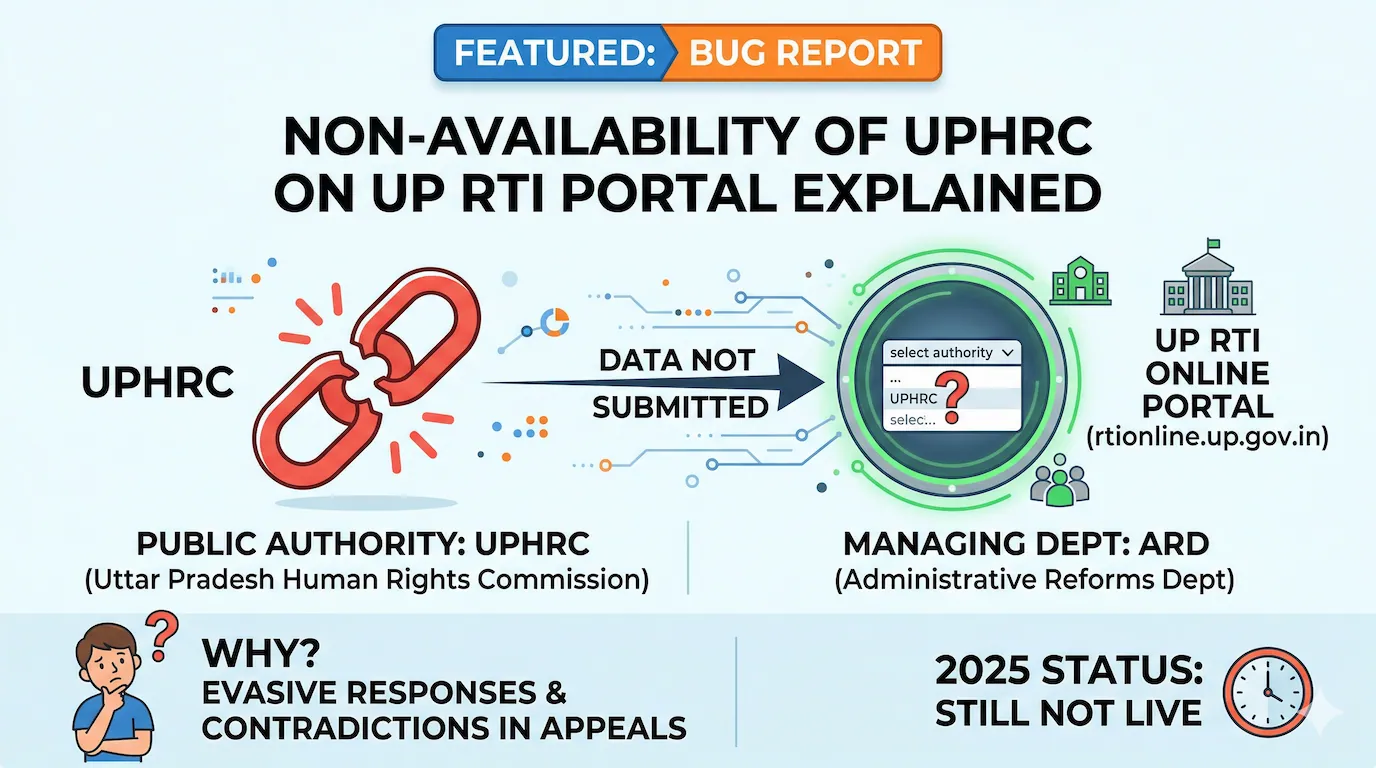
- The Uttar Pradesh Human Rights Commission (UPHRC) is not available on the UP RTI Portal. This is because the necessary information has not been submitted.
- The Administrative Reforms Department claims the responsibility lies with UPHRC to provide the required data for inclusion.
- The applicant has raised concerns about evasive and contradictory responses from the Administrative Reforms Department regarding the situation.
- No official public notice confirms UPHRC’s inclusion on the portal as of 2025, indicating ongoing issues.
- To include UPHRC, mandatory submission of prescribed information must occur, which has yet to be fulfilled.
🏛️ The Non-Availability of UPHRC on the UP RTI Portal: An Analysis
The core issue is the non-availability of the Uttar Pradesh Human Rights Commission (UPHRC) on the RTI Online UP Portal (rtionline.up.gov.in). Despite the official process, public authorities remain excluded. The Administrative Reforms Department manages the portal. They have stated that their replies regarding the issue are “appropriate.” This response has led to an appeal by the applicant.
Core Problem and Official Explanation
The applicant filed an RTI application (DPTAR/R/2024/60109). They also filed a subsequent First Appeal (DPTAR/A/2024/60026). They sought answers to several questions. The primary question was the reason for the UPHRC’s exclusion from the portal. (Non-Availability of UPHRC on UP RTI Portal)
Reason for Non-Availability (as per Administrative Reforms Dept.)
The official response provided by the Administrative Reforms Department (DPTAR) states that:
- Public Authority’s Responsibility: The Public Authority, in this case, UPHRC and NIC UP, must provide the necessary information. The Administrative Reforms Department, serving as the Nodal Department, should prescribe this information. They need it for inclusion in the RTI Online system.
- Process: After receiving the information, the Administrative Reforms Department forwards it to the National Informatics Centre, Lucknow (NIC). They request the portal to make the concerned Public Authority available.
The Department of Administrative Reforms states that the UPHRC has not submitted the required information. Therefore, the online system cannot onboard them.
Disputed Points and Contradictions (Non-Availability of UPHRC on UP RTI Portal)
The applicant, Yogi M P Singh, noted several “Misleading information” submissions in the appeal, highlighting key contradictions and seeking further clarity:
Misleading information” submissions in the appeal
| Applicant’s Query/Ground for Appeal | Administrative Reforms Dept.’s Reply | Contradiction/Commentary |
| User ID & Password Communication: Details of sending login credentials to UPHRC Nodal Officers. | Content is on the RTI Online UP Portal. (Non-responsive to the specific request for communication proof). | The applicant suggests the Nodal Officers for UPHRC and NIC must have been created. This assumption is because DPTAR sends the credentials. However, no proof was provided. |
| Reason for Non-Availability: Why are UPHRC and NIC UP not on the portal when the DPTAR provides the content? (Non-Availability of UPHRC on UP RTI Portal) | Public Authorities are periodically informed to submit prescribed information to the DPTAR to be made “Live.” | The DPTAR shifts the responsibility to UPHRC for not submitting the data. It avoids a direct answer as to whether a request from UPHRC was ever received. The statement also questions why the DPTAR, as the content provider, hasn’t included key bodies. |
| Staff Dealing with Site Management: Name and designation of the staff managing the feeding of information. | NIC UP develops the portal, and the Nodal Department (DPTAR) provides the necessary “Feeding Content.” | The reply avoids naming the specific official responsible for the management of feeding information as requested. |
| Right to Reason: There is a need for a reason for non-availability of UPHRC. The right to reason is essential. It is an indispensable part of the sound administrative system. | The Public Authority must provide the prescribed information to the DPTAR. The DPTAR then transmits it to NIC for inclusion. The Public Authority must provide the prescribed information to the DPTAR. | The DPTAR did not provide the specific reason (e.g., “UPHRC has not submitted the form”) but repeated the general process, which the applicant deemed insufficient. |
Key Contact Details and Next Steps (Non-Availability of UPHRC on UP RTI Portal)
For the UPHRC to be listed, communication and coordination are required between the two bodies. The available contact details are:
| Entity | Role | Contact Person/Detail |
| Administrative Reforms Department | Managing Department for RTI Portal | Phone: 0522-7118629, Email: onlinertihelpline@up.gov.in |
| UP Human Rights Commission (UPHRC) | Public Authority to be listed | Secretary: Smt. Dhanlakshmi K., IAS, Email: uphrclko@yahoo.co.in, Phone: 0522-2728104 |
| First Appellate Authority (FAA) | Disposed of the Appeal | DR SHEEL ASTHANA, Joint Director cum Deputy Secretary, Phone: 7007383997, Email: ard092156@gmail.com |
Conclusion of the Appeal: The FAA, DR SHEEL ASTHANA, reviewed the appeal and the PIO’s reply. He found the PIO’s answer to be “appropriate.” The appeal was disposed of on 21/01/2025. This shows that the Administrative Reforms Department views the responsibility as belonging to UPHRC. UPHRC must provide the requisite information. (Non-Availability of UPHRC on UP RTI Portal)
📰 Status Update: UPHRC on UP RTI Portal (2025)
Based on the information available and the context of the disposed appeal, there is no official public notice. There is no recent news that confirms the inclusion of the Uttar Pradesh Human Rights Commission (UPHRC) on the RTI Online UP Portal in 2025. Additionally, no recent updates have provided any confirmation. Also, there is no new, specific reason provided for its exclusion beyond the one already given.
The search results reinforce the core conflict identified in the appeal documents:
1. The Official Stance (Lack of Submission)
The official position of the Administrative Reforms Department (ARD), as repeated in the applicant’s appeal and consistent with general RTI portal rules, remains:
- The public authority (UPHRC) must submit the necessary, prescribed information to the ARD. This will ensure it is made “Live” (available) on the online portal.
- The ARD provides the necessary “Feeding Content” and collaborates with NIC. The public authority itself initiates the onboarding process.
This implies that the ARD maintains that UPHRC has not yet completed the internal steps required for its online inclusion.
2. The Critical Perspective (Transparency Gap)(Non-Availability of UPHRC on UP RTI Portal)
Commentary and analysis surrounding this issue highlight a significant transparency and accountability gap:
- The absence of key bodies like the UPHRC hampers transparency. It forces citizens to use cumbersome offline methods.
- The responses from the PIO in the ARD were criticised for being evasive or contradictory. As it shifted the onus to the UPHRC without providing a definitive record (e.g., “We sent a request on [Date] but received no reply”).
- The final disposal of the appeal by the First Appellate Authority (FAA) as “appropriate” endorses the ARD’s official process-based explanation. The UPHRC has not submitted the data. This decision does not require the disclosure of specific communication records or a detailed justification.
In summary: As of the latest information, UPHRC is still not listed on the UP RTI portal. The official reason remains a procedural one. The Commission has reportedly not submitted the necessary details to the Administrative Reforms Department for inclusion. There is no new public notice indicating this status has changed.
📄 Requirements for Public Authority Inclusion on the UP RTI Portal
To include a Public Authority like UPHRC on the RTI Online UP Portal, you must follow several steps.There is an internal procedure. The Administrative Reforms Department (ARD) and the National Informatics Centre (NIC) manage this procedure.
The exact internal “onboarding form” remains undisclosed to the public. However, the search results and the official replies in the RTI appeal outline the requirements. They also outline the steps that a public authority must follow to become “Live” on the portal.
1. Mandatory Submission of Prescribed Information (Non-Availability of UPHRC on UP RTI Portal)
The ARD cites this step as the most critical reason for excluding UPHRC. The Public Authority must proactively prepare a “prescribed form.” They should include essential details in this form. The Authority must submit it to the Administrative Reforms Department (the Nodal Department).
This information typically includes:
- Public Authority Details: Official name, contact information, and address.
- PIO/Appellate Authority Details: The names, designations, phone numbers, and email IDs of the Public Information Officer (PIO). First Appellate Authority (FAA). Additionally, the Nodal Officer.
- Organisational Mandate: The Public Authority has specific functions and duties. These requirements often connect to Section 4 of the RTI Act (Proactive Disclosure).
- Login Credentials Request: Submit a formal request. Provide the necessary details to create the Nodal Officer’s login credentials (User ID and Password). This is necessary for accessing the RTI-MIS Utilities interface.
2. Internal System Setup and Credential Management
Once the ARD receives the complete and correct details, they take the following internal steps, which require the submitted information:
- Login Creation: The ARD works with NIC to create the Nodal Officer’s login credentials. They use the information to generate a User ID and Password in the RTI-MIS system.
- Note: The applicant in the original query specifically asked for communication proof of sending these credentials to the UPHRC.
- Configuration in RTI-MIS: The RTI Request & Appeal Management Information System (RTI-MIS) sets up the authority. It links the Public Authority code to the respective Nodal Officer.
- Making the Authority “Live”: The Administrative Reforms Department transmits the finalized data to NIC. This action adds the concerned Public Authority to the “Select Department / Public Authority” dropdown menu. It is available for selection on the public-facing portal.
3. Nodal Officer’s Responsibilities
Once included, the Public Authority’s appointed Nodal Officer manages the process using the RTI-MIS Utilities, which allows them to:
- Create/manage user logins for the PIO, FAA, and other staff.
- Reset passwords.
- Update the Public Authority’s details, including website links for RTI Manuals and Proactive Disclosures.
Summary of the UPHRC Discrepancy (Non-Availability of UPHRC on UP RTI Portal)
The official stand in the disposed appeal is clear. The UPHRC has failed to complete the first step (Submission of the prescribed information). The failure prevents them from being onboarded onto the portal. This is true regardless of the ARD’s ability to create logins.
| Detail | Information |
| Name of Commission | Uttar Pradesh State Human Rights Commission (UPHRC) |
| Designation for RTI | Public Information Officer (PIO) / Jana Soochana Adhikari |
| Office Address | 1/183, Vineet Khand, Gomti Nagar, Lucknow – 226010, Uttar Pradesh |
| Office Contact | 0522-2726742 / 2726743 |
| uphrc@sancharnet.in |
🌐 Web Links of Concerned Public Authorities
| Public Authority | Role in Context | Web Link / Relevant Portal |
| Administrative Reforms Department, UP | Nodal agency managing the RTI Online Portal and content feeding. | RTI Online UP Portal: https://rtionline.up.gov.in/ (This is the primary portal the department manages). |
| National Informatics Centre (NIC) UP: https://up.nic.in/ (NIC develops/hosts the software for the RTI Portal). | ||
| UP Human Rights Commission (UPHRC) (Non-Availability of UPHRC on UP RTI Portal) | The Public Authority that is currently not available on the online portal. | Direct Official Website: A distinct, dedicated official website URL for the UPHRC is not clearly available in public directories. |
| NHRC State Commissions Directory: The National Human Rights Commission (NHRC) lists UPHRC contacts here: https://nhrc.nic.in/about-us/state-commission |
Important Notes on UPHRC Link (Non-Availability of UPHRC on UP RTI Portal)
- The UPHRC’s contact information is publicly available. However, a standalone, currently functioning, official website is not prominent in the search results. This is a common issue for many State Commissions.
- The address listed in directories is: 1/183, Vineet Khand, Gomti Nagar, Lucknow – 226 010.


Facing a similar challenge? Share the details in the box below, and our team of experts will do their best to help.