
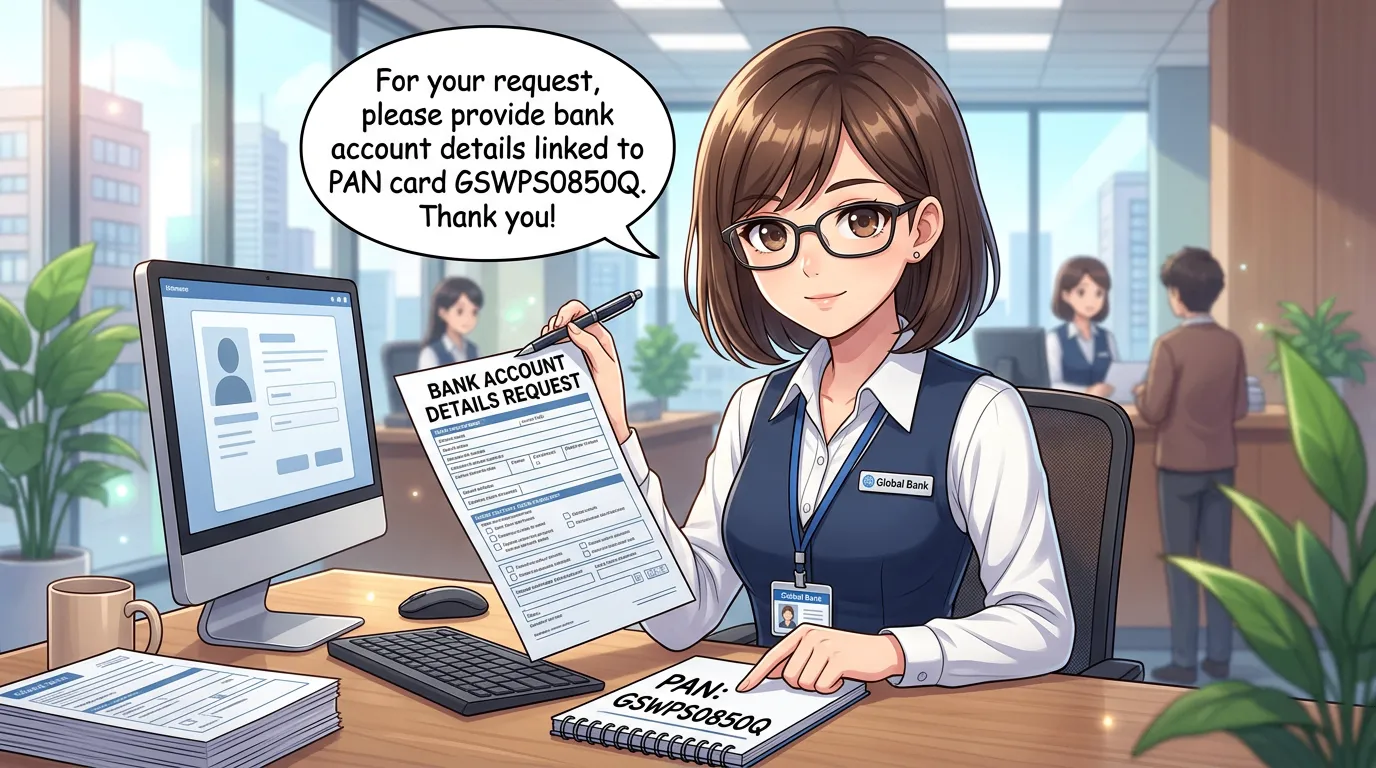
This Request for Bank Account Details case illustrates a significant oversight in the police inquiry process involving the PAN GSWPS0850Q. Instead of directing the inquiry to the appropriate authority, the request was erroneously sent to NSDL, which does not hold the relevant information required for an accurate investigation. This misdirection not only delayed the resolution of the case but also left crucial inquiries unresolved, hampering the efficiency of law enforcement efforts. As a result, the original request for bank account details remains unanswered, raising concerns about the protocols in place for handling sensitive financial information. Such mishaps underscore the necessity for better training and communication among various governmental departments to ensure that inquiries are directed correctly and in a timely manner, ultimately serving justice more effectively.
Key Takeaways
- The Request for Bank Account Details for PAN GSWPS0850Q was misdirected to NSDL instead of the Income Tax Department, causing significant delays.
- NSDL responded quickly but provided irrelevant information, confirming no demat account rather than addressing the bank account request.
- This incident highlights the breakdown in inter-departmental communication and the need for clear protocols in handling sensitive inquiries.
- The Income Tax Department has yet to respond properly to the request, undermining accountability and public trust.
- To avoid similar issues, it is crucial to ensure inquiries are sent to the correct department and follow up persistently.
🕵️ Analysis of Grievance PMOPG/E/2024/0184722: The Nexus of Police Inquiry, Income Tax, and Depository Records
This analysis examines a Request for Bank Account Details tied to PAN Card GSWPS0850Q, and asks a simple question: did the Income Tax (I-T) officer give an appropriate reply to the E-filing unit’s actions? The grievance raises this question in response to a police inquiry. So far, the answer looks doubtful.
The documentation reveals a crucial misdirection. The original Request for Bank Account Details went to several recipients. However, a Depository (NSDL) responded instead of the intended Income Tax E-filing Unit. As a result, this mix-up raises real questions about how such inquiries get handled. It also points to a breakdown in inter-departmental coordination. Therefore, it’s worth examining what caused this oversight, so similar failures don’t repeat.
🛑 The Core Issue: A Misdirected Request for Bank Account Details
The confusion centers on one thing: who the Request for Bank Account Details was meant for, versus who actually answered it. This kind of mix-up often happens when multiple stakeholders interpret a communication differently. As a result, the message can miss its intended recipient entirely, causing delays in action. Clarity matters here. It directly shapes how effective the request turns out to be. A clear understanding of how the parties relate to one another can prevent confusion. It also helps ensure information reaches the right people on time.
Whenever a police unit files a formal Request for Bank Account Details as part of a fraud probe, the recipient list matters just as much as the legal basis cited. A single email sent to the wrong department can stall an investigation for months. That’s true even when every other part of the process runs smoothly. And that appears to be exactly what happened here.
The Original Request for Bank Account Details
- Sender: RAMESH YADAV (so-katra.mi@up.gov.in), PS Kotwali Katra Dist- Mirzapur (Uttar Pradesh Police).
- Date: September 05, 2024.
- Subject/Intent: A Request for Bank Account Details of a fraudulent bank account tied to PAN Card No. GSWPS0850Q.
- Legal Basis Cited: Section 91 of the Code of Criminal Procedure, 1973 (CrPC), and Sections 69 and 69B of the Income Tax Act, 1961 (IT Act).
- Requesting:
- Linked Bank Account holder details (KYC and opening form).
- Contact number of the relevant Branch Managers.
- Other relevant details (usage logs, beneficiary information).
The Grievance Context
- Complainant: Yogi M. P. Singh.
- Grievance Filed: December 25, 2024, via CPGRAMS (Status: Under process).
- Concerns To: Central Board of Direct Taxes (Income Tax) >> Corruption/Malpractices related (VCs, employees) >> Inaction by Income Tax Department.
- Officer/Office Cited: ITO E Filing Unit 2 Director of IT Neeta Sharma, DGIT(Systems) CPC, E-filing.
The Response to the Request for Bank Account Details
- Responder: NSDL (National Securities Depository Limited) — Surveillance Department.
- Date of Email: September 05, 2024 (same day as the police request).
- Content: NSDL searched its records against the PAN GSWPS0850Q and found no Beneficial Owner (BO) account registered with any of its Depository Participants (DPs).
At first glance, this looks like a fast, efficient reply. NSDL responded the same day the request went out. However, speed means little if the response doesn’t answer the actual question. A Request for Bank Account Details cannot be satisfied by a depository confirming the absence of a demat account — the two categories of financial record simply don’t overlap.
🔍 Assessment: Was the Request for Bank Account Details Properly Answered?
The answer is no, based on the documents provided.
The grievance specifically names “Inaction by Income Tax Department.” It targets the ITO E Filing Unit 2 Director of IT Neeta Sharma and the DGIT(Systems) CPC, E-filing. However, the reply on record comes from NSDL, a securities depository, not an Income Tax authority. This misalignment raises real concerns about accountability. It also raises questions about the communication channels between taxpayers and the government departments responsible for tax regulation. It highlights a broader problem too: relying on responses from agencies outside a tax authority’s jurisdiction can leave taxpayers without real answers. For this reason, grievances need to reach the right authorities promptly, so the system keeps the public’s trust.
Key Reasons for the “No” Assessment:
- Wrong authority responded. The police sent the request to a list of recipients that included surveillancecell@nsdl.com — which is why NSDL replied. Meanwhile, the Income Tax Officer (ITO) and the DGIT(Systems) CPC, E-filing unit never provided a documented response. Since the grievance alleges inaction by the I-T Department, NSDL’s response does nothing to disprove that allegation.
- Wrong information provided. The original Request for Bank Account Details aimed to support an alleged money-laundering investigation. However, NSDL’s response only confirms the absence of a Beneficial Owner (BO) account — which relates to dematerialized securities holdings like shares and bonds, not bank accounts. This distinction matters:
- Bank accounts: held with commercial banks, regulated by the RBI. Banks and the Income Tax Department (ITD) typically hold this information via records such as the Annual Information Statement.
- BO/Demat accounts: held with Depositories (NSDL/CDSL) and Depository Participants (DPs), relating to securities investments. In short, NSDL’s reply is accurate within its own domain, but it fails to address the core police request for linked bank account details.
- Income Tax’s obligation under the IT Act/CrPC. The police inquiry explicitly cites Sections 69 and 69B of the IT Act and Section 91 of the CrPC. When the Income Tax Department receives a Request for Bank Account Details like this — especially one tied to a money-laundering or fraud investigation — the I-T officer must respond in one of three ways: acknowledge the request; search the department’s database (Annual Information Statement/TIS, ITRs, financial transaction data) and share any linked bank accounts; or state clearly that the unit doesn’t hold the requested information. None of these responses appear in the record. Given that the I-T E-filing Unit’s mandate covers processing returns and maintaining financial data linked to a PAN, it remains a relevant party for bank account information.
Why a Clear Request for Bank Account Details Matters
Cases like this one illustrate a wider pattern. When a Request for Bank Account Details gets routed to the wrong department, the delay rarely stays contained to paperwork. Investigations stall, complainants lose confidence in the system, and the officials who should answer for the delay often escape scrutiny simply because the record shows someone replied — even if that reply came from the wrong office entirely.
This case also shows how easy it is for departments to treat a technically prompt response as a satisfactory one. NSDL answered within hours. On paper, that looks like efficient public service. In practice, it let the actual target of the inquiry — the Income Tax E-filing Unit — go unanswered for months, while the grievance record shows a reply that never actually addresses the original ask. Any citizen filing a similar Request for Bank Account Details should watch for this exact pattern: a fast reply from an adjacent authority that quietly closes the loop on paper, without resolving the substance of the request.
📝 Conclusion and Next Steps for the Grievance
Where the Grievance Stands Now
The grievance currently sits “Under process” with Sh. Gopalan Gurusamy (DGIT Systems Bengaluru — Addl. charge). Rightly so. It identifies a genuine failure in the system.
What the complainant actually needs is direct, relevant communication from the Income Tax Department’s E-filing Unit. That reply should detail the bank accounts linked to PAN GSWPS0850Q. Or, it should formally explain why the unit can’t furnish the requested bank details and name the correct custodian instead. Until that happens, the original Request for Bank Account Details remains functionally unanswered, regardless of what the grievance record shows on paper.
NSDL’s response confirms one thing only: the PAN holder holds no securities via NSDL. But it sidesteps the real issue. The Income Tax Department still has a duty to answer the police’s query for bank account details, and its alleged inaction remains unaddressed. Therefore, based on the documented record, the concerned Income Tax Officer has not yet given a proper reply to this Request for Bank Account Details.
Practical Steps for a Similar Request for Bank Account Details
For complainants navigating a similar situation, three practical steps help keep a Request for Bank Account Details on track.
First, confirm which specific department holds the type of financial record being sought. Banking data and depository data sit with entirely different regulators. Conflating them invites exactly the kind of misdirected reply seen in this case.
Second, follow up in writing whenever a reply arrives from a department other than the one originally named in the request. Ask explicitly whether the intended recipient still owes a response.
Third, escalate through the grievance portal by name. Cite the specific officer and unit that failed to reply, rather than describing the case in general terms — vague escalations are easier for departments to close without genuine action.
Cases like PMOPG/E/2024/0184722 show why these steps matter. Without them, a legitimate Request for Bank Account Details can sit unanswered indefinitely, hidden behind a grievance status that reads as “resolved” in name only.e concerned Income Tax Officer has not provided a proper reply as documented in the grievance status.


Facing a similar challenge? Share the details in the box below, and our team of experts will do their best to help.