
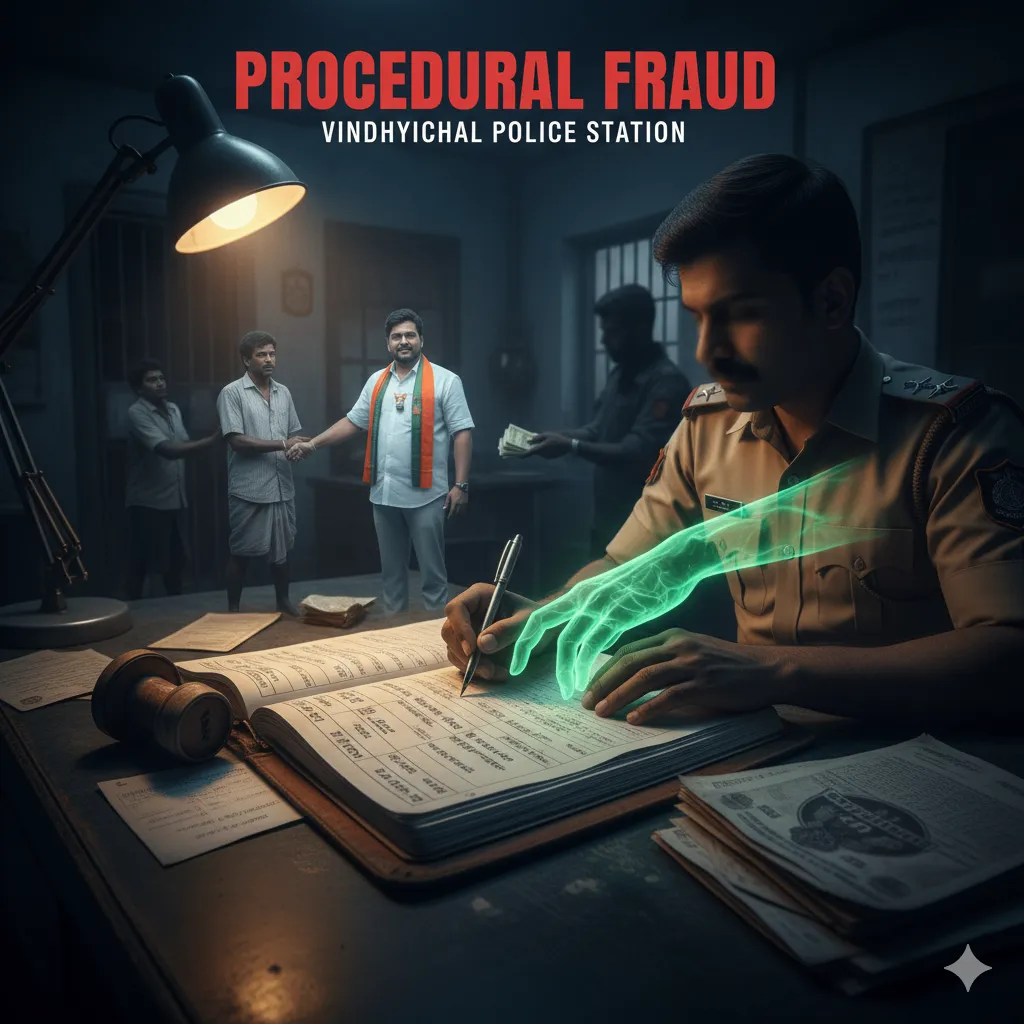
The key takeaway from this case is that police documentation (GD No. 057) serves as irrefutable evidence of a “procedural fraud” where legal identities were swapped to accommodate political pressure.
The specific critical points are:
- The “Identity Swap” Evidence: The report is self-incriminating because the police recorded the arrest of Pramod Kumar Kushwaha in the narrative but officially “challaned” Mithilesh Maurya in the final legal section. This proves the police created a fabricated record.
- Systemic Malpractice: The release of Mithilesh Maurya (due to political affiliation) after his arrest was already recorded—and the subsequent production of an innocent Pramod in his place—constitutes Personation (Section 240 BNS) and Fraud upon the Court.
- Illegal Detention: Because there was no valid “Challan” or legal paperwork naming Pramod for the Magistrate, his physical detention was unauthorized and unconstitutional, making the state liable for compensation.
- The Power of RTI: By using the Section 7(1) “Life and Liberty” clause in the RTI, the applicant has legally forced the police to produce the Lock-up and Arrest registers within 48 hours, which will likely confirm this identity substitution.
Would you like me to help you track the 48-hour deadline for your RTI and draft the “First Appeal” if they fail to respond by Monday?
This blog post meticulously examines the procedural and legal anomalies found in General Diary (GD) No. 057 of the Vindhyachal Police Station, Mirzapur, dated September 14, 2024. It explores the implications of “identity substitution,” the influence of political pressure, and the resulting illegal detention of an innocent citizen.
The Mirzapur Identity Swap: A Case Study in Police Malpractice and Procedural Fraud
In the heart of Uttar Pradesh’s legal administration lies a document that serves as a chilling reminder of how easily the “rule of law” can be bent by the “rule of influence.” General Diary (GD) Detail No. 057, issued by the Vindhyachal Police Station in Mirzapur, was intended to be a routine record of preventive police action. Instead, it has become the smoking gun in a case involving illegal detention, political favoritism, and the blatant falsification of public records.
The core issue is a disturbing discrepancy: while the police narrative records the arrest of one man, the final legal processing names another, leading to a scenario where an innocent citizen was produced before a Magistrate under a false legal identity.
1. The Genesis: A Neighborhood Dispute
On the afternoon of September 14, 2024, a dispute erupted in the village of Godsara Sarapatti over a common but contentious issue: water drainage. According to the GD report, two parties were involved. The police, led by Sub-Inspector (SI) Vinod Kumar Yadav, arrived at the scene at approximately 15:30 hrs.
The narrative section of the GD clearly identifies the “First Party” as Pramod Kumar Kushwaha (33) and the “Second Party” as Manoj Kumar Kushwaha (51). The SI recorded that both parties were aggressive, using abusive language, and were on the verge of a physical altercation. To prevent a “major incident,” the police exercised their powers under Section 170 of the Bharatiya Nagarik Suraksha Sanhita (BNSS) to take the individuals into custody.
2. The Discrepancy: The Paperwork “Sleight of Hand”
The integrity of the entire police action collapses in the concluding section of the same report. After detailing the arrest of Pramod Kumar Kushwaha, the “Challan” section—which lists the names of those formally processed to be produced before the Magistrate—suddenly omits Pramod’s name.
In his place, the name Mithilesh Maurya (28), a resident of Prayagraj, appears. The document states that Mithilesh Maurya and Manoj Kumar Kushwaha were the ones challaned under Sections 126/135 of the BNSS.
This is not a simple clerical error; it is a structural impossibility. How can a police officer record the arrest of “Person A” in paragraph one and then claim to have “Challaned” “Person B” in paragraph five for the same incident, without any explanation for the disappearance of Person A?
3. The Shadow of Political Pressure
The factual context provided by the applicant, Mahima Maurya, illuminates the reason for this confusion. Mithilesh Maurya, the brother of the victim, had reportedly arrived at the police station to inquire about the biased handling of the case. As a member of a ruling party cadre (RSS), Mithilesh possessed political capital.
When the police, allegedly irritated by his questioning, initially recorded him in the paperwork, political intervention reportedly followed. To satisfy the political masters while still maintaining the “quota” of arrests for the water dispute, the police allegedly set Mithilesh free “scot-free” but physically produced the innocent Pramod Kumar Kushwaha before the Magistrate using Mithilesh’s paperwork.
4. The Legal Anatomy of “Personation”
The act of producing Pramod Kumar Kushwaha before a court while his name is absent from the formal Challan constitutes Personation under Section 240 of the Bharatiya Nyaya Sanhita (BNS) (formerly IPC 205).
When a person is produced in court, the Magistrate relies on the “Challan” or “Remand Paper” to verify their identity. By presenting Pramod under the file of Mithilesh, the police committed a fraud upon the court. This effectively robbed Pramod of his legal identity, making his appearance in court a sham. Because there was no valid legal document authorizing Pramod’s production, his time in the police lock-up and his appearance before the Magistrate were entirely unauthorized and illegal.
5. Violation of Fundamental Rights
This case represents a multi-layered violation of the Constitution of India:
- Article 21 (Right to Liberty): Pramod was deprived of his liberty without a valid “procedure established by law,” as the paperwork did not match the person.
- Article 22 (Protection against Arrest): The mandate to produce an arrested person before a Magistrate within 24 hours was violated in spirit, as the police failed to produce the actual person they had recorded as arrested in the GD narrative.
The Allahabad High Court has repeatedly held that “Police cannot be allowed to play with the liberty of a citizen.” In cases of such gross procedural negligence, the courts have often awarded compensation (typically ₹25,000) to the victim, to be recovered from the salary of the errant officers.
6. The “Doubtful Integrity” of the Mirzapur Police
The GD report No. 057 is a certified public document. The fact that it contains such a blatant internal contradiction is proof of “Doubtful Integrity.” It suggests that the records at PS Vindhyachal are not a reflection of truth, but rather a flexible tool used to accommodate political pressures.
When a Sub-Inspector (SI) and a Sub-Inspector (SI) acting as the Nodal Officer allow such a document to be finalized, it erodes public trust in the entire police hierarchy of the district. It raises a haunting question: If the police can swap identities in a simple water dispute, what are they capable of in more serious criminal matters?
7. The Path to Accountability: RTI and Beyond
The filing of the Online RTI (SPMZR/R/2026/60025) by Mahima Maurya is the first step toward justice. By invoking the “Life and Liberty” clause under Section 7(1), the applicant has placed the police under a 48-hour clock to produce the Arrest Memos and the Havalat (Lock-up) Register.
These documents will likely confirm that while Pramod’s body was in the cell, Mithilesh’s name was on the file. This evidence will be crucial for:
- A Writ of Habeas Corpus/Quashing Petition in the High Court.
- A Departmental Inquiry against SI Amit Kumar and SI Vinod Kumar Yadav.
- A Suit for Damages for malicious prosecution and wrongful confinement.
Conclusion: A Call for Reform
The Mirzapur case is not just about a village dispute; it is about the sanctity of the General Diary. The GD is supposed to be the “mirror” of a police station’s daily life. When that mirror is deliberately cracked to hide political favors, the entire justice system suffers.
For Pramod Kumar Kushwaha, the fight is for his dignity. For the citizens of Mirzapur, the fight is for a police force that follows the BNSS, not the whims of local politicians. As this RTI progresses, the eyes of the public remain on the Superintendent of Police, Mirzapur, to see if he will rectify this fraud or remain a silent spectator to the subversion of law.
To help you track your case and ensure the 48-hour “Life and Liberty” deadline is respected, here are the organized contact details for the authorities involved in your RTI and the subsequent legal complaints.
1. RTI Application Tracking Details
- Registration Number:
SPMZR/R/2026/60025 - Date of Filing: 17/01/2026
- Tracking Link:UP RTI Online – View Status
- Note: Use your Registration Number and Email ID to check for the 48-hour response.
2. Concerned Public Information Officer (PIO)
This is the officer responsible for providing the information you requested.
- Name: Manish Kumar Mishra
- Designation: Additional Superintendent of Police (ASP Operation), Mirzapur
- Phone Number:
+91-7007941679 - Email ID:
aspopmzp@gmail.com
3. Nodal Officer (Supervisory Authority)
If the PIO does not respond, this officer oversees the RTI cell at the SP Office.
- Designation: Additional Superintendent of Police (ASP Headquarters)
- Phone Number:
+91-7007941679 - Email ID:
addlspopmzr@gmail.com
4. Higher Authorities for Legal Complaints
Since your case involves “Personation” and “Political Pressure,” you may need to escalate the matter to these authorities:
| Authority | Web Link / Email | Purpose |
| SP Mirzapur (Abhinandan, IPS) | spmzr-up@nic.in | Formal complaint against SI for GD fraud. |
| DIG Range Mirzapur | digrmzr@up.nic.in | Reporting police partiality and bias. |
| UP Police Complaint Portal | Jansunwai-Samadhan | For registering a grievance directly with the CM office. |
| State Human Rights Commission | upshrc.up.nic.in | For illegal detention of Pramod Kumar Kushwaha. |
5. Summary of the Illegal Detention Claims
The following visual summarizes the discrepancy you have uncovered through your RTI:
Next Step for You
If you do not receive a response on the portal by Monday, January 19, 2026 (after 48 hours), the law considers this a “Deemed Refusal.”
Would you like me to prepare the draft for the “First Appeal” to the First Appellate Authority (FAA) on the grounds of “Life and Liberty” violation?


Facing a similar challenge? Share the details in the box below, and our team of experts will do their best to help.