
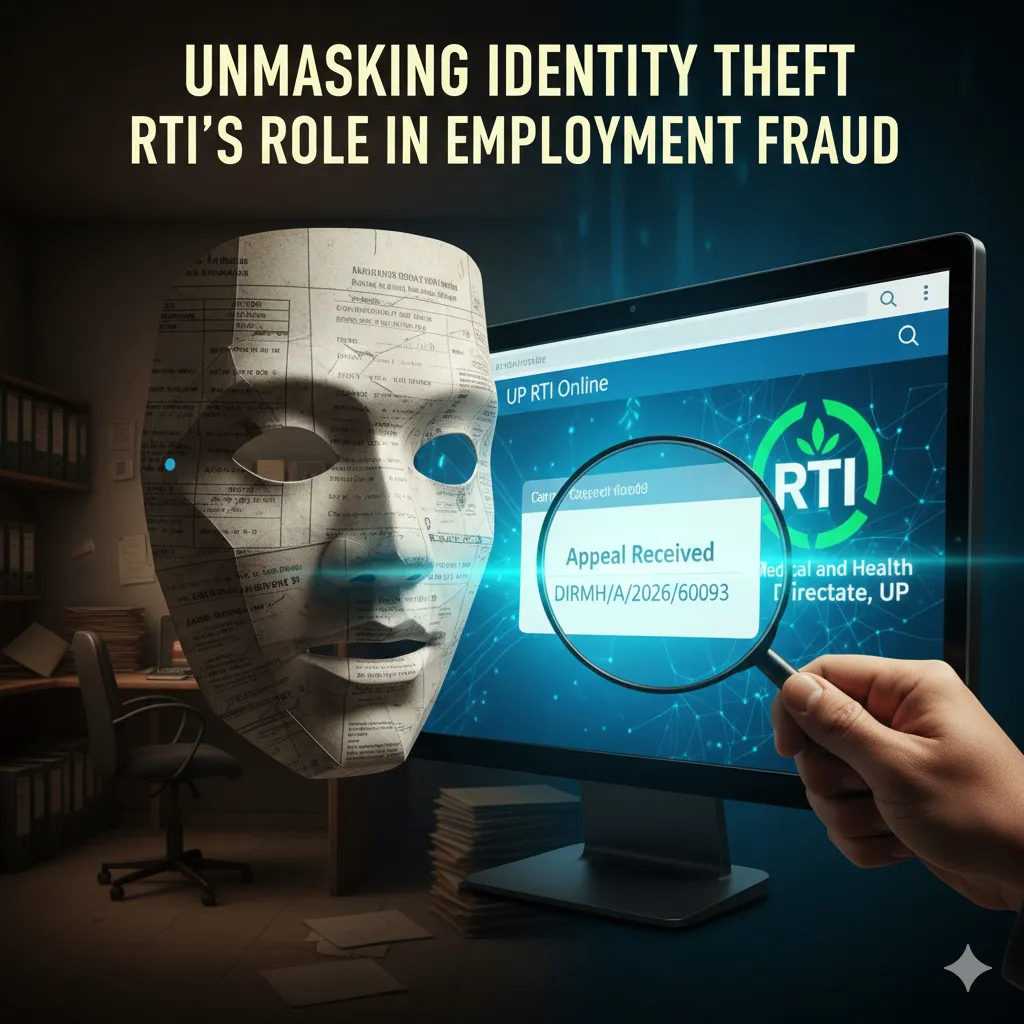
The blog post outlines a critical legal battle. Unmasking Identity Theft is at the heart of this discussion. The RTI Act is used as a weapon against identity impersonation in government departments.
Here are the key takeaways: (Unmasking Identity Theft)
1. The Core Conflict: Identity Theft vs. Privacy
The central issue is “Identity Impersonation,” where a person secures a government job using someone else’s credentials. While victims use RTI to expose this, government offices often hide behind Section 8(1)(j) (Privacy), claiming employee data is confidential. The blog argues that fraud is not private and should be disclosed in the public interest.
2. RTI as a Shield in Maintenance Suits
In many legal disputes, a man might be accused of having a government job he doesn’t actually hold. This is especially common in maintenance cases. The RTI is the primary tool to prove to the court that:
- An impostor is drawing a salary using the applicant’s name.
- The applicant is not the actual employee, thereby correcting financial liability in court.
3. The Necessity of the “First Appeal” (Unmasking Identity Theft)
A rejection by a Public Information Officer (PIO) is not the end. The blog highlights that the First Appeal is the most vital step to challenge the PIO’s logic. It allows the applicant to force a senior officer (the FAA) to reconsider the case based on:
- The Proviso to Section 8(1)(j): Information that cannot be denied to Parliament cannot be denied to a citizen.
- The mismatch between the applicant’s physical identity and the employee’s records.
4. Systemic Failures in Verification
The post points out that these frauds happen because of “Verification Gaps.
- Departments often fail to cross-reference Aadhaar biometrics at the time of hiring.
- Reliance on physical photocopies instead of digital verification through platforms like DigiLocker allows impostors to slip through the system.
5. Legal Recourse Beyond RTI (Unmasking Identity Theft)
If the RTI process remains blocked, the victim has three secondary options:
- Criminal Action: Filing an FIR for forgery and cheating.
- Writ of Mandamus: Asking the High Court to force a department inquiry.
- Summoning Records: Requesting the Trial Court to “Summon the Service Book” of the employee directly to the courtroom.
This blog post explores the critical issue of identity theft within government administrative frameworks. It specifically focuses on the intersection of the Right to Information (RTI) Act and legal disputes like maintenance suits.
Unmasking Identity Theft: Using RTI to Uncover Employment Fraud
In a functioning democracy, government departments are expected to be the custodians of trust. However, a growing and sophisticated form of white-collar crime is challenging this trust: Unmasking Identity Theft: Identity Impersonation for Government Employment. This occurs when an individual secures a government job using another person’s educational credentials. They also use the Aadhaar details and name of another person, often a namesake or a distant acquaintance.
For the victim, this isn’t just a matter of stolen paperwork. It is a legal nightmare. It can impact their credit, their reputation, and their liability in court.
The Trigger: Maintenance Suits and Financial Liability
The issue often comes to light during sensitive legal proceedings. These include a Maintenance Suit under Section 125 of the CrPC. There is also Section 144 of the BNSS. In these cases, the court must determine the financial capacity of a husband to provide support.
If a husband claims he is unemployed, the court faces a paradox. This occurs when the wife presents evidence of a government salary being drawn in his name. If the man is indeed unemployed, he must prove that someone else is impersonating him professionally in a government office, unmasking identity theft. This proof is necessary to avoid an unfair financial burden. It also aids in preventing potential jail time for perjury.
The RTI Act: A Tool for Discovery or a Shield for Fraud?
The Right to Information (RTI) Act, 2005 was designed to bring transparency. However, when a victim attempts to verify if someone is working under their name, they often receive a standard “Rejection Letter.” This letter usually comes from the Public Information Officer (PIO). (Unmasking Identity Theft)
The “Privacy” Trap: Section 8(1)(j) (Unmasking Identity Theft)
The most common ground for denial is Section 8(1)(j). It protects “personal information” that has no relationship to any public activity or interest. PIOs often argue that employment details are personal to the employee.
However, legal experts argue that: (Unmasking Identity Theft)
- Impersonation is not Personal: A fraudulent identity is not “personal information”; it is a criminal act.
- Public Interest: If a person is drawing a salary from the public exchequer (taxpayer money) under a false identity, this is a serious issue. It involves misuse of taxpayer money.
- The Proviso Rule: The RTI Act states that information should not be denied to Parliament. If information cannot be denied to Parliament or a State Legislature, it cannot be denied to an individual. A fraud in a government department would certainly be reported to the Legislature.
Case Study: The CMO Mirzapur Denial
In recent administrative developments, applicants seeking to verify their identity within the Medical and Health Department have faced blanket denials. If a citizen submits their own High School marksheets and Aadhaar card to a Chief Medical Officer (CMO), denying it based on privacy is logically flawed. The denial does not hold under logical scrutiny.
By refusing to verify the identity, the department may inadvertently be protecting an impostor. This creates a “legal stalemate.” The victim is blamed in court for having a job they don’t actually hold. Meanwhile, the government refuses to confirm the fraud. Unmasking identity theft is critical to resolving this issue effectively.
The Power of the First Appeal
When a PIO denies a request, the applicant has 30 days to file a First Appeal under Section 19(1). This is a critical stage. The applicant can challenge the PIO’s logic before a senior officer. This officer is called the First Appellate Authority.
Key Arguments for an Appeal:(Unmasking Identity Theft)
- Identity Verification vs. Personal Data: Clarify that you are not asking for a stranger’s bank details. Instead, you are asking the department to verify if your identity is being used.
- The Burden of Proof: In a court of law, the burden of proof often shifts. If an RTI can prove that the “Indradev Yadav” working in the department has different parentage. Alternatively, the birth date might differ compared to the “Indradev Yadav” in the lawsuit. This would expose the fraud.
Systemic Vulnerabilities in Recruitment (Unmasking Identity Theft)
How does this happen? The root cause lies in the gaps in the document verification process during recruitment. This issue is especially prevalent for contractual or local-level health department roles.
- Lack of Biometric Cross-Referencing: Authorities need to match Aadhaar biometrics at the time of joining. This action would make identity theft nearly impossible.
- Physical Verification Gaps: Often, institutions verify only photocopies of marksheets against “originals.” Which may be, themselves forged.
Legal Remedies Beyond RTI
If the RTI process fails to yield results even at the Commission level, the victim has several paths:
- Police Complaint (FIR): Filing an FIR for cheating (Section 420) and forgery (Section 468) under the IPC/BNS.
- Writ of Mandamus: Filing a petition in the High Court to direct the government department to conduct an internal inquiry.
- Court-Ordered Verification: Requesting the judge in the Maintenance Suit to summon the “Service Book” of the employee. The judge will request it directly from the department.
Conclusion: The Path to Transparency
Identity theft in government jobs serves as a double-edged sword. It both robs the state of legitimate service and deprives the victim of their legal standing. Departments must not use the RTI Act as a shield to hide administrative lapses or internal corruption.
For citizens like Indradev Yadav, the battle is not just about a piece of paper. It is about reclaiming their name. It is about ensuring that the halls of public service are occupied by those who truly belong there.
How to Stay Safe
- Monitor your UAN/EPF: Regularly check if unknown employers are making any Provident Fund contributions in your name.
- Digitise your Records: Use DigiLocker to ensure your educational documents are verified and tied to your biometrics.
- Act Fast: If you suspect identity theft, file an RTI immediately. Follow the appeal process strictly within the 30-day deadlines.
Here is a structured list of all the essential contact details and digital links. Use it to track your appeal. It will also aid you in communicating with the authorities regarding your case.
1. Online Tracking & Portal Access
You can monitor the progress of your appeal or file further documents through the official Uttar Pradesh RTI portal.
- Portal Name: UP RTI Online
- Web Link: rtionline.up.gov.in
- Your Appeal Registration Number:
DIRMH/A/2026/60093 - Your Original Request Number:
DIRMH/R/2025/67269
2. Concerned Public Authorities (Contact Details) (Unmasking Identity Theft)
There are three levels of authority involved in your case. If you do not hear back within 30 days, you should use these contact details to follow up.
| Authority Level | Office / Designation | Name / Contact Info | Key Role |
| Appellate Authority | AD Mirzapur (Additional Director) | Mobile: 8005192626 Email: admhmzp1@gmail.com | The officer currently deciding your Appeal. |
| Nodal Officer | Director Health, Lucknow | Mobile: 9451679475 Email: dgmhsrti@gmail.com | Responsible for RTI monitoring at the State level. |
| Original PIO | CMO Mirzapur (Chief Medical Officer) | Mobile: 9454455171 Email: cmomzp@gmail.com | The officer who denied your first request. |
3. Summary of Application IDs
Keep these numbers safe, as you need them for every login and future correspondence:
- First Appeal ID:
DIRMH/A/2026/60093(Filed on 16/01/2026) - Original RTI ID:
DIRMH/R/2025/67269(Filed on 18/11/2025)
4. Important Tips for Communication (Unmasking Identity Theft)
- When Calling: Always state your Appeal Registration Number first. Ask the clerk for the “Current Status” and “Date of Hearing.”
- When Emailing: Use the subject line: “Urgent: Follow-up on RTI Appeal DIRMH/A/2026/60093 – Indradev Yadav.”
- Evidence: Save a screenshot or PDF of your “Appeal Received” status page for your court records in the maintenance suit.
Would you like me to draft a professional follow-up email? You can send it to the AD Mirzapur in two weeks to check on the status.


Facing a similar challenge? Share the details in the box below, and our team of experts will do their best to help.