
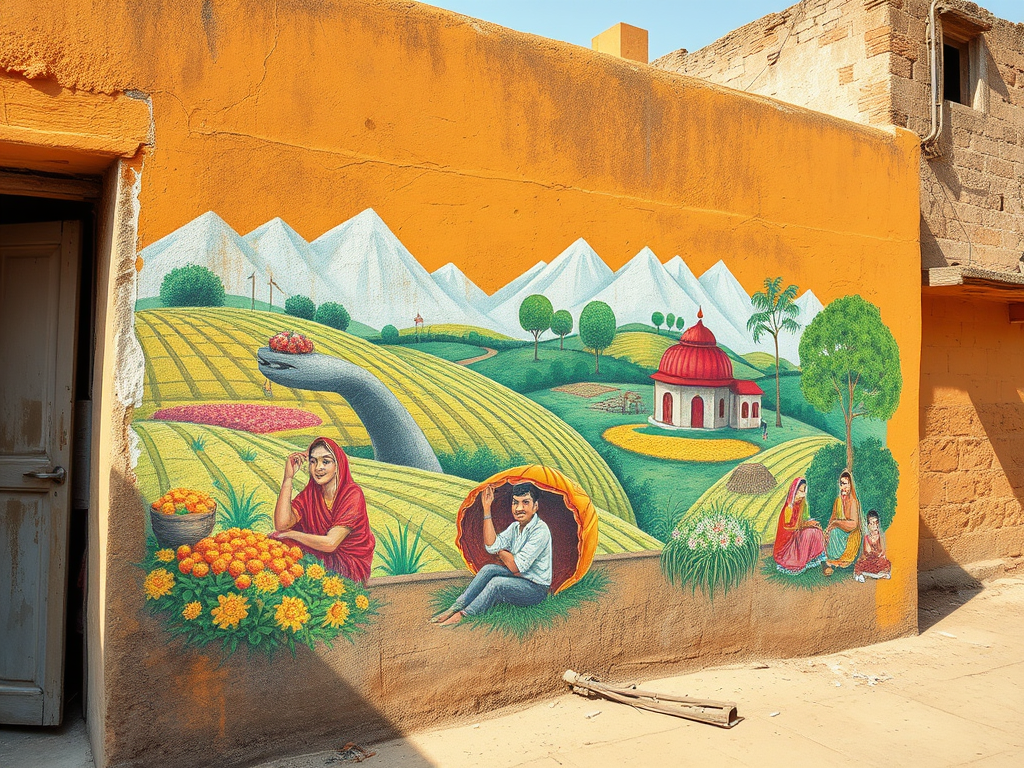
This blog post explores a crucial topic. It examines the intersection of the Right to Information (RTI) Act and rural transparency initiatives in Uttar Pradesh. It specifically focuses on the mandatory wall painting of developmental schemes on Panchayat buildings. The practice of Uttar Pradesh Wall Painting serves as a visual tool for spreading public information in rural areas.
Uttar Pradesh Wall Painting: The Fight for Accountability in Rural Uttar Pradesh
In the heart of rural India, information is often the most guarded currency. For decades, developmental funds entered village panchayats like shadows—rarely seen and even more rarely accounted for by the common citizen. However, a significant policy shift occurred in 2016. It aimed to change this situation. The policy transformed the walls of our villages into public ledgers. These walls are reminiscent of the vibrant Uttar Pradesh wall paintings. They now narrate essential information and engage the community.
Recent RTI filings show a growing movement of “Information Seekers.” For example, Devi Prasad Gupta’s filing regarding Village Panchayat Dhanwatiya in District Bhadohi highlights this trend. These seekers use the law to ensure these “walls of transparency” aren’t just empty promises.
The Mandate: Government Order No. 72/2016/2611
In October 2016, the Uttar Pradesh Government, through the Panchayati Raj Section-3, issued a landmark directive (Circular No. 2611/33-3-2016-14/2016). Special Secretary Sushil Kumar Maurya signed the order. It was clear. All developmental activities must be displayed through wall paintings on Panchayat buildings and schools.
The objective was simple: to bring governance out of the filing cabinets and into the public eye. The government aimed to create a permanent record. They planned to paint the details of budgets. They also included workers and project timelines on primary schools and Panchayat Bhawans. This was done through Uttar Pradesh Wall Painting. This record would be unerasable and any villager could read it.
The Administrative Hierarchy of the Scheme (Uttar Pradesh Wall Painting)
To ensure this wasn’t just another ignored circular, the government appointed a strict coordination committee at the district level.
- Chairman: District Magistrate (DM)
- Member: Chief Development Officer (CDO)
- Member: District Information Officer (DIO)
- Member Secretary: District Panchayat Raj Officer (DPRO)
At the grassroots level, the Block Development Officer (BDO) works closely with vendors. Gram Vikas Adhikari (VDO) ensures the paintings are actually executed.
Uttar Pradesh Wall Painting: An RTI Case Study from Bhadohi
Despite the clear administrative structure, many activists claim the scheme is being deliberately stalled. A recent RTI application (Registration No: DIRPR/R/2025/61913) filed against the Panchayati Raj Directorate paints a picture of frustration.
The applicant targets the Dhanwatiya Panchayat in the Bhadohi block. They raise a stinging allegation. The lack of wall paintings is not a result of negligence. It is a deliberate attempt to hide the siphoning of government funds.
Five Critical Points of Inquiry (Uttar Pradesh Wall Painting)
The RTI application demands specific, data-backed answers for the period spanning the last four years and the current year (2020–2025):
- Current Status: What is the actual status of wall paintings in Dhanwatiya?
- Locations: Which buildings (schools, Bhawans) did you paint?
- Financials: What exact amount did the public fund spend on these paintings?
- Verification: Where do the DPRO and Block staff submit the verification reports that confirm the work was done?
- Scheme Details: A breakdown of the developmental schemes listed in these paintings and the funds allocated to them.
Why “Wall Painting” Matters for Democracy (Uttar Pradesh Wall Painting)
You might wonder: In the age of digital India, why do we care about paint on a wall? The answer lies in accessibility. While many government portals (like e-GramSwaraj) provide data, the “Digital Divide” remains vast. A wall painting is:
- Permanent: It stays intact and users cannot easily “delete” or “glitch” it.
- Public: It requires no internet connection or smartphone to access.
- Accountable: A wall reports that officials spent ₹5 Lakhs on a road. It becomes clear that the road is full of potholes. Every passerby can see the discrepancy.
Uttar Pradesh Wall Painting: Corruption and Cryptic Governance
The RTI applicant in this case study notes a “cryptic approach” by local officials. Omitting wall paintings makes it easier for corrupt officials to over-invoice projects. They can also claim funds for “ghost” projects that never existed.
By avoiding the wall painting mandate, the Block Development Officer (BDO) and Village Development Officer (VDO) remove an essential tool. This affects social audits conducted by the rural population.
The Path Forward: Social Audits and Citizen Action
The Right to Information Act 2005 was designed to dismantle the “culture of secrecy.” As seen in the Bhadohi application, the law provides a 30-day window for the PIO to respond.
What can citizens do? (Uttar Pradesh Wall Painting)
- Check your Panchayat Bhawan: Look for paintings that show the last five years of work. If they are missing, your village is in violation of the 2016 Government Order.
- File an RTI: Follow the template used by seekers like Devi Prasad Gupta. Ask for the “Verification Reports”—these are the papers where an official signed off saying the painting exists.
- Demand a Social Audit: Use the information gained from the RTI to confront local officials during Gram Sabha meetings.
Conclusion
Transparency is not a gift from the government; it is a fundamental right of the taxpayer. The wall painting scheme in Uttar Pradesh is a brilliant tool for grassroots democracy. However, it only works if the citizens demand its implementation.
When the walls speak, corruption finds it much harder to hide.
It is a common yet frustrating hurdle in the RTI process. The Public Information Officer (PIO) and the First Appellate Authority (FAA) often remain silent. They may also refuse to act. When the DPRO Bhadohi (PIO) ignores your application, you have reached a critical stage. The Deputy Director of Panchayati Raj, Mirzapur (Appellate Authority) also fails to conduct a hearing. At this point, the law provides you with the power to escalate the matter to the state level.
Below is the structured roadmap to handle this non-compliance.
1. The Legal Standing: Deemed Refusal (Uttar Pradesh Wall Painting)
Under Section 7(2) of the RTI Act 2005, if the PIO does not decide on the request for information within 30 days, it is automatically deemed a “Refusal.” The PIO’s lack of decision results in this automatic refusal. If the First Appellate Authority (Deputy Director, Mirzapur) does not decide on your appeal within 30 days, it commits a breach of Section 19(1). This non-decision is a breach. You now have the right to bypass these local offices and approach the Commission directly.
2. Your Next Step: Second Appeal to the SIC
The district and divisional levels have not provided the information regarding the wall painting scheme. Therefore, you must file a Second Appeal under Section 19(3) to the Uttar Pradesh State Information Commission (UPSIC) in Lucknow.
Why file a Second Appeal? (Uttar Pradesh Wall Painting)
- Penalty Provisions: The Commission can fine the PIO (DPRO Bhadohi) for the delay. The fine is ₹250 per day and can go up to ₹25,000.
- Disciplinary Action: You can request the Commission to suggest disciplinary measures. These measures can be taken against the officers for willful negligence of a Government Order.
- Compulsion: The Commission’s order is binding, and they can compel the production of records regarding the wall painting funds.
3. How to Draft Your Complaint/Appeal to the SIC
When sending your documents to the State Information Commission, ensure you include the following:
| Document Type | Details to Include |
| Copy of Original RTI | The application filed on 30/07/2025 (Registration No: DIRPR/R/2025/61913). |
| Proof of Filing | The receipt or online acknowledgment from the RTI portal. |
| First Appeal Copy | The appeal you sent to the Deputy Director, Mirzapur. |
| Proof of Delivery | Speed Post tracking or digital timestamp showing the First Appeal was received. |
| Affidavit/Self-Declaration | A simple statement that you have not received any response to date. |
4. Addressing the Core Issue: Corruption Allegations
In your appeal to the State Information Commission, you should emphasize the non-response. It is linked to the Wall Painting Scheme (Order 2611/2016). State clearly that:
- The information is being suppressed to hide the misappropriation of funds in Village Panchayat Dhanwatiya.
- Uttar Pradesh Wall Painting
- The lack of wall paintings is a direct violation of the Agriculture Production Commissioner’s decision dated 08-09-2016.
- The DPRO and Deputy Director are shielding the Block Development Officer (BDO) from accountability.
5. Contacting the State Authorities Directly
While you wait for the SIC process, you can also escalate the administrative failure (not the RTI, but the failure to implement the painting scheme) to the higher-ups in Lucknow:
- Director, Panchayati Raj (Lucknow): Since the DPRO reports to the Director, a formal complaint can trigger an internal audit. This can occur if the wall painting order in Bhadohi is not implemented.
- CM Helpline (1076): Register a complaint stating that Government Order No. 72/2016 regarding wall paintings is being ignored in Block Bhadohi, and RTI queries regarding the same are being blocked.
Suggested Action Plan
- Wait for 45 days from the date you filed your First Appeal with the Mirzapur Deputy Director.
- On the 46th day, draft your Second Appeal to the UP State Information Commission.
- Send the appeal via Registered/Speed Post to:The Registrar, U.P. State Information Commission, 7/7A, RTI Bhawan, Vibhuti Khand, Gomti Nagar, Lucknow, Uttar Pradesh 226010.
When both the DPRO Bhadohi (PIO) fail to respond, they violate the RTI Act. Similarly, if the Deputy Director of Panchayati Raj, Mirzapur (First Appellate Authority) does not reply, it is a violation of the RTI Act. If they do not reply, they are violating the RTI Act. Your next move is to file a Second Appeal or Complaint to the UP State Information Commission (UPSIC) in Lucknow.
Below are the specific contact details, web links, and application IDs you need to escalate this.
1. Second Appeal / Complaint Escalation
Since you have already filed your RTI and First Appeal without success, you must now approach the State Information Commission.
- Official Website: upsic.up.gov.in
- Online Second Appeal Link: UPIC Online Appeal Portal
- Helpline (Technical/Portal): 0522-7118629
- Commission Email:
webmaster-upic@up.gov.in - Office Address: 7/7A, RTI Bhawan, Vibhuti Khand, Gomti Nagar, Lucknow, Uttar Pradesh – 226010.
2. Direct Contact Details for Bhadohi & Mirzapur
To put pressure on the defaulting officers, you can use these direct contact points for the Panchayati Raj Department:
| Office / Officer | Mobile / Phone | Email Address |
| DPRO Bhadohi (PIO) | 9450981727 | dprosr-up@nic.in |
| Dy. Director Mirzapur (FAA) | 9415139308 | amaprmi-up@nic.in |
| Directorate (Lucknow) | 0522-2322926 | up.panchayatiraj@gmail.com |
| Nodal Officer (Lucknow) | 9795140577 | up.panchayatiraj@gmail.com |
3. Key Identification Numbers for Your Case
You must use these numbers in all future correspondence with the State Information Commission to prove your case has already been filed:
- RTI Registration Number:
DIRPR/R/2025/61913 - Date of Filing: 30/07/2025
- Public Authority: Panchayati Raj Directorate (UP)
- Relevant Govt Order (Wall Painting): 72/2016/2611/33-3-2016-14/2016
4. How to Check Status Online
- Go to the UP RTI Portal: rtionline.up.gov.in
- Click on “View Status”.
- Enter your Registration Number (
DIRPR/R/2025/61913) and your Email ID (devipg1966@gmail.com). - This will show you if the DPRO has uploaded any hidden response or if the appeal has been officially forwarded.
Recommended Action (Uttar Pradesh Wall Painting)
If the Deputy Director in Mirzapur has not scheduled a hearing within 45 days of your First Appeal, take action. File a Complaint under Section 18 of the RTI Act to the State Information Commission. In your complaint, state that the DPRO and Deputy Director are willfully suppressing information regarding the wall painting funds. They are doing this to cover up corruption in Village Dhanwatiya.



Facing a similar challenge? Share the details in the box below, and our team of experts will do their best to help.