
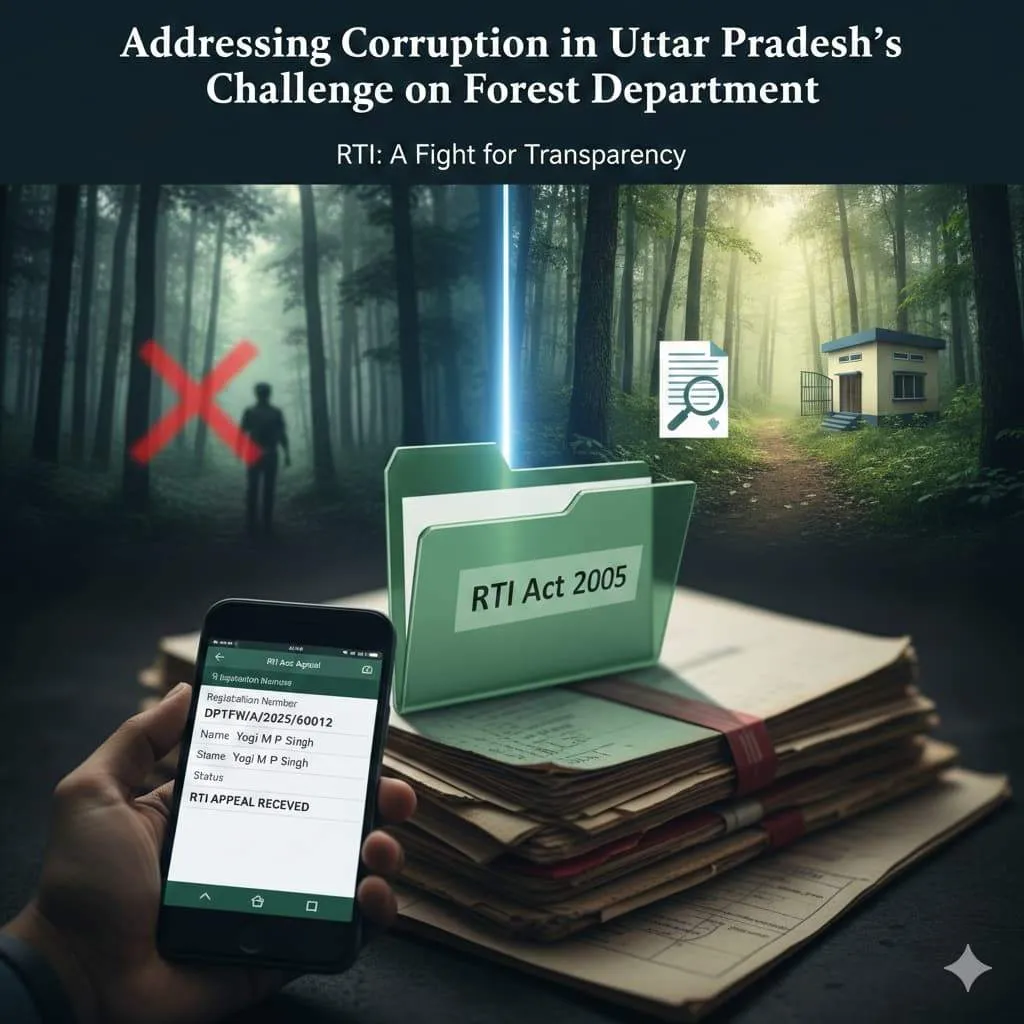
🌳 Battling Bureaucracy: Using RTI to Challenge Corruption in the Forest Department
The Right to Information (RTI) Act, 2005, stands as a powerful tool for promoting transparency and accountability in India’s public authorities. Its core mission is to empower citizens, shedding light on government operations and thereby acting as a crucial check against the pervasive problem of corruption. This blog post examines a specific case where an RTI appeal has been filed to address alleged malpractice and procedural violations within the Uttar Pradesh Forest and Wildlife Department, highlighting the persistent challenges faced by citizens in their pursuit of honest governance.
The Anatomy of an RTI Appeal Against Forest Department Anarchy
The appellant, Yogi M P Singh, filed an RTI application on February 12, 2025, seeking information regarding what he believes is a case of corruption in the Department of Forest. The subsequent delay and administrative handling of this request became the central Ground For Appeal to the First Appellate Authority (FAA).
1. The Core Allegation: Procedural Procrastination
The initial RTI application (Registration No. DPTFW/R/2025/60026) was received by the Public Authority on February 12, 2025. However, the record shows the status as REQUEST TRANSFERRED TO OTHER PIO only on March 20, 2025—a delay of over one month and one week.
- Violation of RTI Act, 2005: The appellant rightly points out that Sub-section 3 of Section 6 of the RTI Act mandates that a Public Information Officer (PIO) must transfer an application to the correct public authority, if necessary, within one week of its receipt. The substantial delay in this case is a clear violation of this statutory duty.
- The Implication of Delay: The appellant views this procrastination not as mere inefficiency, but as a deliberate attempt by the Forest Department to escape from the matter of corruption due to the sensitive nature of the information sought. Such bureaucratic stalling undermines the very spirit of the RTI Act.
2. The Root Cause of Corruption: Illegal Charge-Basis Posting
The corruption allegation that the department is allegedly attempting to obscure through delay concerns a specific posting in the Baki Range under the Gorakhpur Division.
- The Sensitive Post: Baki Range is described as a super sensitive area, connecting directly with the Nepal border, necessitating competent and authoritative leadership.
- The Irregular Appointment: Following the death of the incumbent Ranger, a Deputy Ranger, Mr. Jagdamba Pathak, was granted the charge of the Baki Range. The appellant argues that the posting of a Deputy Ranger to a Ranger’s role on a charge-basis is a corruption in itself, given the difference in rank and responsibility:
- Ranger: Holds overall authority, oversees the management of a forest area.
- Deputy Ranger: Lower-ranking, subordinate position, typically assisting the Ranger with specific tasks like patrolling and reporting.
- Violation of Policy: Crucially, this temporary, charge-based posting has allegedly been maintained for more than four years, which is cited as a violation of the new transfer policy of the government. The longevity of this irregular arrangement suggests a systemic failure or deliberate manipulation of rules, and the appellant asserts this is the root cause of the PIO’s reluctance to provide information.
The RTI Act as a Mechanism for Systemic Reform
The RTI Act was designed to be a potent deterrent against precisely this kind of alleged bureaucratic and financial impropriety.
1. Promoting Accountability and Transparency
The Act’s primary objective is to infuse transparency into public functioning, making it difficult for officials to act arbitrarily or engage in corrupt practices without fear of exposure. The mere filing of an RTI application can compel a public authority to review its internal processes and documentation.
2. The Power of Public Scrutiny
By seeking details on the posting of the Deputy Ranger to the Baki Range, the appellant is exercising public scrutiny over departmental HR decisions and adherence to transfer policies. If proven, the prolonged, irregular posting could signify a wider system of favouritism or illegal monetary transactions associated with lucrative or sensitive positions.
3. Recourse Through Appeal
When the initial RTI process fails—whether through denial of information, provision of incomplete/false information, or, as in this case, a violation of the mandated timeline for response or transfer—the Act provides for a First Appeal (to the FAA, Gaurav Verma) and a subsequent Second Appeal to the Information Commission. This appellate structure ensures that non-compliant officials face disciplinary action, thereby reinforcing the PIO’s obligations.
The Path Forward: Relief Sought
The appellant’s prayer to the FAA is two-fold and highly specific:
- Direct the PIO to provide information at the earliest: The fundamental relief is to immediately receive the information that was originally sought, compelling the department to address the corruption issue instead of avoiding it.
- Start disciplinary proceedings: This is the critical step for systemic change. The appellant demands action against the PIO (Sushil Kumar, Section Officer) and the Public Authority for violating Sub-section 3 of Section 6 of the RTI Act, and for the perceived attempt to shield corrupt practices.
The successful resolution of this appeal is crucial. If a public authority is allowed to flagrantly violate the transfer timeline provisions under Section 6(3) with impunity, it severely cripples the RTI mechanism, especially when confronting matters of deep-seated corruption. The current situation in the Forest Department, as described by the appellant, reflects the constant battle where the noble goal of transparency is often hindered by the “main hurdle… corruption which is rampant in our public offices.”
The outcome of this First Appeal will be a significant indicator of whether the accountability mechanisms intended by the RTI Act can truly overcome procedural anarchy and vested interests in sensitive departments like the Forest and Wildlife Department.
Would you like me to research the specific responsibilities of a Ranger versus a Deputy Ranger to further elaborate on the seriousness of the irregular posting?


Facing a similar challenge? Share the details in the box below, and our team of experts will do their best to help.