
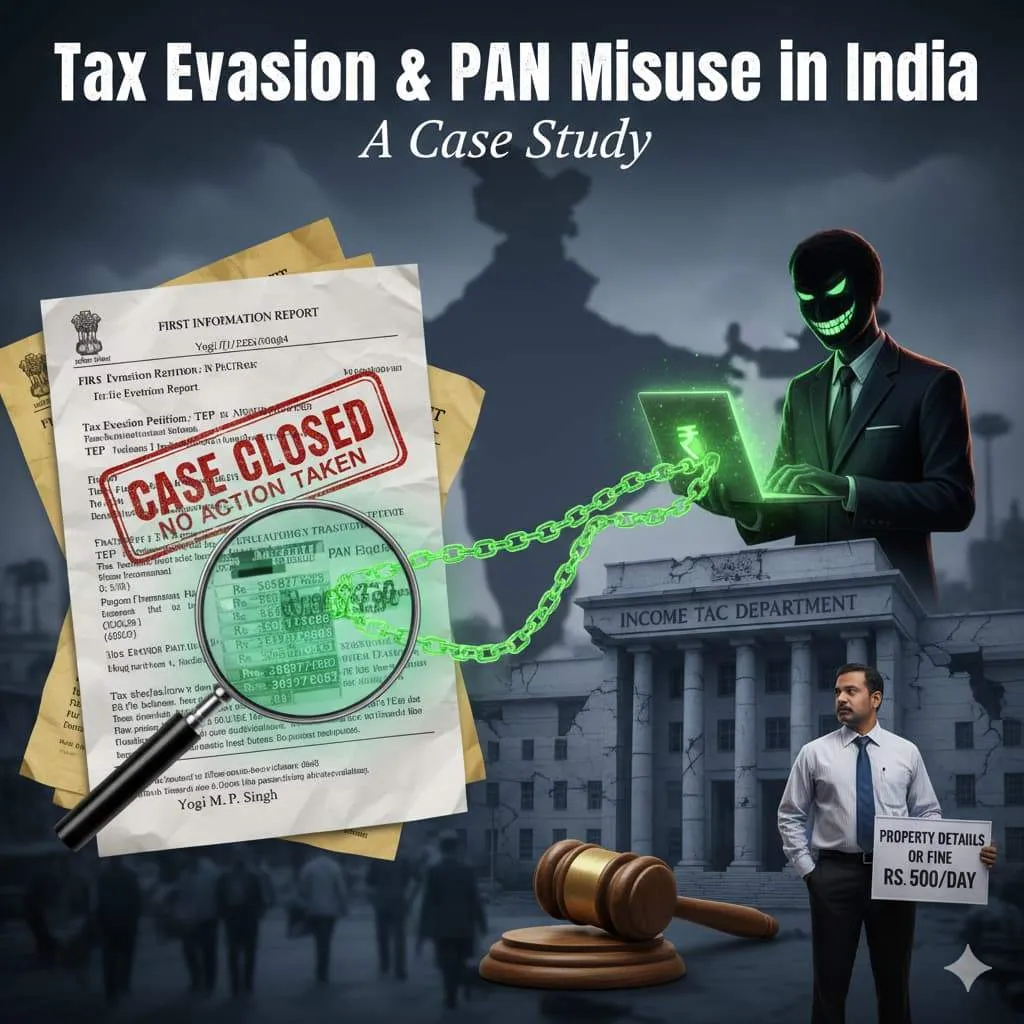
💡 Addressing the “Pacification” Argument
While the department is legally correct in stating it cannot disclose confidential investigation details under Section 138, your experience illustrates the critical difference between legal compliance and public accountability:
- Legal Compliance: The department complies with the letter of the law by treating your complaint as a Tax Evasion Petition (TEP) and asserting confidentiality. This protects the integrity of investigations and the privacy of the assessed party (even if that party is a criminal).
- Lack of Accountability: The department fails in its obligation to provide a clear, result-oriented resolution to the victim of fraud. The closure of the appeal without even providing a general statement like, “The investigation is underway” or “The matter has been forwarded to the local police,” while simultaneously an officer demands property details from you, directly suggests a failure of service and lack of coordination.
This gap is precisely what leads complainants like you to feel they are being pacified rather than served.
⚖️ How to Move Beyond Pacification
To counter this “pacification” strategy, you must shift your focus away from demanding investigation details (which the law allows them to withhold) and toward demanding accountability for systemic failure and misconduct.
- Focus on Misconduct (The ₹500/day Fine): The most actionable item is the alleged threat of a ₹500 fine per day and the demand for your property details by Officer Sonal Singh. This directly concerns harassment and official misconduct, which is not protected by Section 138.
- Action: File a specific, new complaint with the Chief Vigilance Officer (CVO) of the Income Tax Department and the Central Vigilance Commission (CVC), naming the officer and attaching the warning letter (if available). This forces them to address the conduct, not the TEP.
- Focus on the Criminal FIR: The existence of the FIR (No. 291/2023) is your strongest leverage. The police investigation is a parallel criminal track that supersedes the ITD’s administrative silence.
- Action: Write to the Superintendent of Police (SP) of Mirzapur, detailing how the ITD’s refusal to provide bank details (allegedly denied by Prayagraj/Bangalore offices) is obstructing the official criminal investigation of the Mirzapur police. Request that the police invoke the necessary legal provisions (e.g., a court order) to compel the ITD to provide the crucial bank evidence.
By focusing on the misconduct and the obstruction of the criminal case, you bypass the legal shield of “confidentiality” that they have used to close your appeals and pacify your efforts.
1. The Official Process for Tax Evasion Petitions (TEPs)
The Income Tax Department (ITD) has a Standard Operating Procedure (SOP) for managing TEPs, which includes a time-bound investigation framework.1 Your experience of “zero” result after submitting three TEPs suggests a breakdown in this process.
- Categorization: TEPs are supposed to be categorized (typically A, B, C, or D) based on the credibility of the information and the potential tax evasion amount (e.g., Category A for high-value evasion above ₹5 crore).2
- Actionable TEPs (Categories A & B): These are meant to be assigned to the Investigation Directorate (DDIT/ADIT (Inv.)) for detailed, time-bound investigation.3
- Discreet Enquiry: Investigators are first expected to use departmental data (PAN, CIB, AIS, etc.) to verify the allegations.4 They are also empowered to gather information from external sources like banks and other agencies using Section 133(6) of the Income Tax Act.5
- Your Case’s Discrepancy: Your complaint states the police have been denied bank details by the Prayagraj and Bangalore offices, while the investigation results in a zero outcome, contradicting the SOP’s directive to use external sources to verify allegations, especially in a case of alleged PAN misuse.
2. The Grievance Redressal Failure
Your grievance was closed by the DGIT Systems, stating it was a matter of tax evasion and not related to return processing, and you were directed to file a TEP. This is a common bureaucratic pitfall where a systemic issue (fraudulent misuse of PAN) is incorrectly classified, leading to a loop of non-resolution:
- You file a grievance about fraud $rightarrow$ ITD says it’s a TEP $rightarrow$ You file a TEP $rightarrow$ ITD does not act on TEP (resulting in ‘zero’ action).
The ITD’s system, including the e-Nivaran and CPGRAMS portals, is meant for:
- Prompt Redressal: The maximum time limit for a CPGRAMS grievance is officially 21 days.6
- Monitoring Accountability: These systems are supervised by the Central Board of Direct Taxes (CBDT), with serious grievance cases and all PMO references being monitored by senior officers.
Your statement about the department not being accountable to the Prime Minister’s portal directly challenges the stated goals of the CBDT’s Service Quality Manual, which emphasizes enforcement of higher standards of accountability and disciplinary action against erring persons.
3. Escalation Pathways for Your Specific Situation
Given the failure of the initial grievance and TEP process, and the ongoing harassment through the demand for property details under threat of fine, the matter needs to be escalated using alternative official channels that handle misconduct and systemic failure.
| Type of Escalation | Target Authority/Mechanism | Relevance to Your Case |
| Grievance against Officer Conduct | Grievance Redressal Officer (GRO) or Chief Commissioner of Income Tax (CCIT) of the jurisdictional office. | To specifically report the “Harassment by official” and the unreasonable demand by Officer Sonal Singh to provide property details under threat of fine, despite you being the complainant of fraud. |
| Corruption/Misconduct | Central Vigilance Commission (CVC) | This is the appropriate body for complaints related to “rampant corruption in the public offices” and official misconduct, which you have directly alleged is the reason for the inaction. |
| Systemic Failure (Appeal) | Central Board of Direct Taxes (CBDT) via your existing Appeal Number (CBODT/E/A/25/0001007). | Your current appeal to the DGIT Systems (Sh. Gopalan Gurusamy) should forcefully detail the legal and procedural lapses, specifically the non-use of Section 133(6) to obtain bank details and the closure of TEPs despite clear evidence of fraud (as per the FIR). |
| Criminal Matter | Police/Investigating Officer (IO) | The FIR (No. 291/2023) is already registered. The pressure should continue on the IO at Kotwali Katara Mirzapur to formally use the court/legal mechanism to compel the ITD to provide the bank details related to the misused PAN, which is crucial evidence for the criminal investigation against the cyber criminals. |
Your insistence that the ITD is supporting fraudulent elements is borne out by the reality that the cyber criminals who allegedly transacted over Rs. 34 crore are enjoying impunity while the victim faces administrative penalties. The next step is to use the dedicated external agencies designed to monitor the ITD’s internal accountability.
Would you like me to find the contact details or the specific online portal for filing a complaint with the Central Vigilance Commission (CVC) regarding the alleged misconduct of the Income Tax officer?


Facing a similar challenge? Share the details in the box below, and our team of experts will do their best to help.