
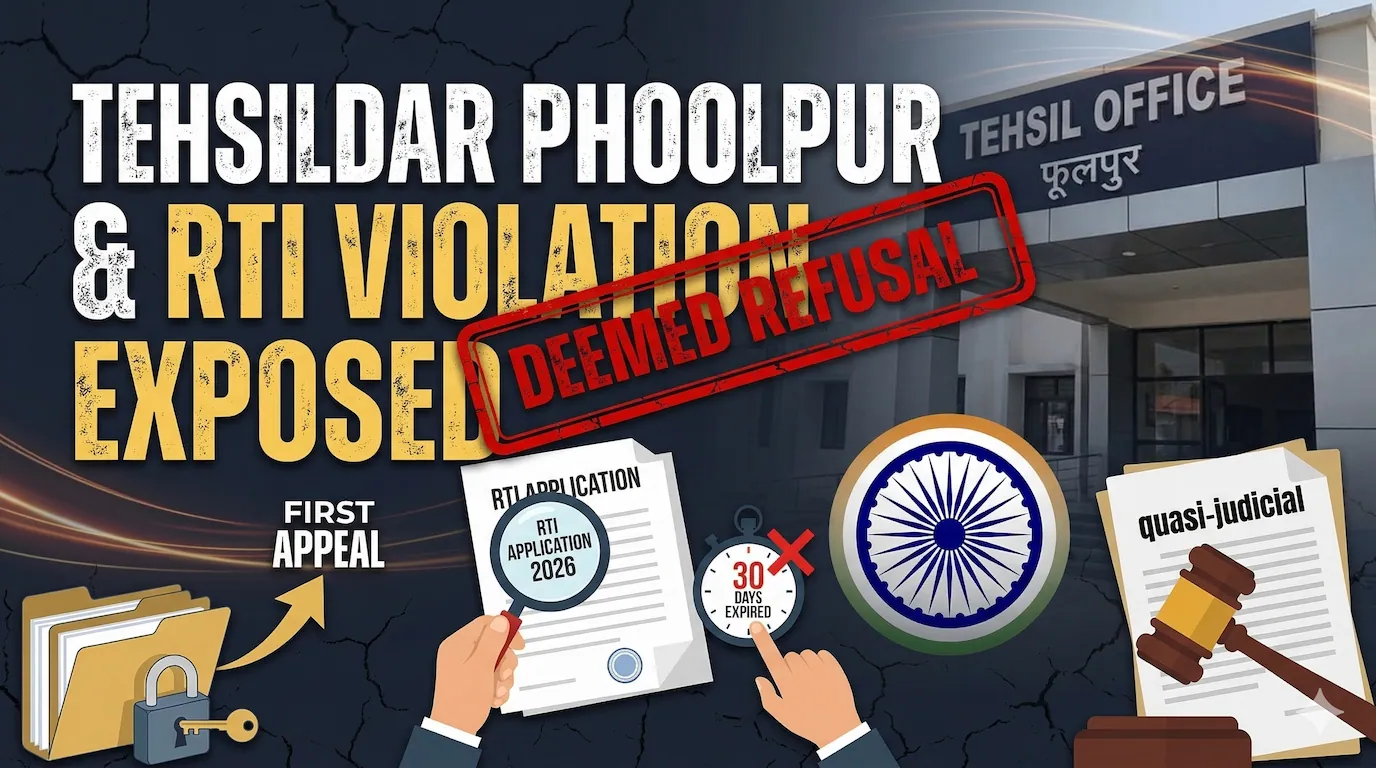
Here are the key takeaways regarding the legal struggle against the RTI Violation by the Tehsildar Phoolpur: (Tehsildar Phoolpur & RTI Violation)
1. The Core Legal Violation
The primary issue is a “Deemed Refusal.” Under the RTI Act, the Tehsildar Phoolpur was legally obligated to respond within 30 days. The office ignored the request for over 60 days. This action is a direct RTI Violation. It forced the citizen to escalate the matter.
2. Critical Data Withheld (Tehsildar Phoolpur & RTI Violation)
The information being suppressed is vital for land rights and transparency:
- Certified Site Maps (Nazri Naksha): Essential for verifying the boundaries of Araji Number 283.
- Official Accountability: Data on which specific officials (SDM, Tehsildar, and Lekhpal) visited the site and when.
- Physical Records: Measurement data showing exactly how much area is covered by permanent structures.
3. Escalation to the First Appellate Authority (FAA)
By filing Appeal No. DMOPR/A/2026/60082, the responsibility has shifted to the SDM Phulpur. The FAA now has a 30-day window (extendable to 45 days) to pass a quasi-judicial order. Their role is to determine if the Tehsildar Phoolpur obstructed the law.
4. Financial Penalty and Free Information (Tehsildar Phoolpur & RTI Violation)
Because a deadline was missed, Section 7(6) of the RTI Act now applies. The appellant is no longer required to pay any photocopying or certification fees. The government must provide all requested documents free of cost as a penalty for the delay.
5. The “Paper Tiger” Syndrome
The post highlights a systemic lack of fear among revenue officials. Local officials often treat the RTI Act as an optional suggestion. This happens when the State Information Commission does not actively impose the ₹250-per-day penalty under Section 20.
6. Future Recourse (Tehsildar Phoolpur & RTI Violation)
If the SDM Phulpur does not provide relief within 45 days, you must file a Second Appeal. This appeal is to the State Information Commission in Lucknow. It is the final step. This is the only stage where a personal penalty can be docked from the salary of the responsible officer.
The Crisis of Accountability: Addressing the RTI Violation by Tehsildar Phoolpur
The Right to Information (RTI) Act of 2005 promised a new era for India. It aimed to replace colonial secrecy with modern transparency. However, the gap between law and reality remains wide. Recent developments in Phulpur Tehsil, Prayagraj, highlight this struggle.
A citizen, such as Yogi M P Singh, filing a First Appeal (Registration No: DMOPR/A/2026/60082) indicates system failure. This action shows that the system has broken down. The Tehsildar Phoolpur ignored a basic request for two months. This silence is a clear RTI Violation that signals a deeper rot in local administration.
1. The Core Dispute: Araji Number 283 (Tehsildar Phoolpur & RTI Violation)
The battle centers on land in Village Saraijeet Rai. The appellant seeks specific data: certified site maps (Nazri Naksha), inspection reports, and measurement records for Araji Number 283.
In the revenue department, land records maintain social order. A Lekhpal’s field report determines the legality of property. By withholding these files, the office of the Tehsildar Phoolpur obstructs justice. They prevent the citizen from verifying state actions.
2. The Trap of “Deemed Refusal” (Tehsildar Phoolpur & RTI Violation)
Section 7(1) of the RTI Act gives the PIO 30 days to act. If they fail, the law calls it a “Deemed Refusal.” The Phulpur application reached the office on January 5, 2026. By February, the Tehsildar Phoolpur had already committed a blatant RTI Violation.
This silence is often a tactic. Officials hope the applicant will lose interest. They use time as a weapon to protect the status quo. In this case, 60 days passed without a single word. This neglect forces the citizen into a cycle of appeals.
3. Demanding Transparency for Officials
The appeal demands the posting details and attendance logs of specific staff. This includes the SDM, the Tehsildar Phoolpur, and Lekhpal Rafiq Ahmad.
Public records should identify who handled a case. Knowing who visited a site is vital for three reasons:
- Accountability: It identifies the officer responsible for a specific report.
- Integrity: It checks if officials made unauthorized visits.
- Verification: It proves whether claimed field inspections actually happened.
Transparency in personnel prevents the “anonymous” exercise of power. When officials know their movements are public, they act with more caution.
4. The Authority of the SDM Phulpur
The First Appeal moves the case to the First Appellate Authority (FAA). In this instance, the SDM Phulpur holds that role. The FAA is more than a manager; the law views them as a quasi-judicial body.
The SDM must now decide: will they protect the Tehsildar Phoolpur or the law? A strong FAA order does two things. First, it forces the release of documents. Second, it penalizes the RTI Violation. Under Section 7(6), the government must now provide all information free of cost. The PIO lost the right to charge fees when they missed the 30-day deadline.
5. A Mockery of the Rule of Law
The appellant’s statement is blunt. He claims the PIO made a “mockery” of the RTI Act. This frustration is common across Uttar Pradesh.
The crisis stems from a lack of fear. Officials ignore requests because the State Information Commission rarely imposes fines. Section 20 allows for a penalty of ₹250 per day. Yet, backlogs in Lucknow mean few officials ever pay for an RTI Violation. Without a financial sting, the law remains a “paper tiger.” The Tehsildar Phoolpur ignores the citizen because there are no immediate consequences.
6. How to Fix the Broken Machinery
Individual appeals are necessary, but they aren’t enough. We need systemic changes:
- Digital Public Access: The state should upload all Nazri Nakshas to the Bhulekh portal. This removes the chance for a Tehsildar Phoolpur to withhold data.
- Automated Red Flags: The RTI portal should automatically flag overdue requests. This should trigger an immediate inquiry by the District Magistrate.
- Cultural Shift: Revenue officials must stop seeing RTI users as “troublemakers.” They are stakeholders in a democracy.
7. The Road Ahead for Prayagraj
The SDM Phulpur has 30 days to resolve this appeal. If they fail, the case moves to the State Information Commission.
This case serves as a litmus test for the Prayagraj District Magistrate. Will the administration uphold its duty? Or will it continue to hide the RTI Violation committed by the Tehsildar Phoolpur? The information for Araji Number 283 is not a gift; it is a legal right.
Conclusion
The fight for a site map represents the fight for democracy. When a state refuses to answer its people, it breaks the social contract. Transparency is not a favor. It is a debt the government owes to every citizen. Yogi M P Singh’s appeal is a reminder that the “second independence” requires constant vigilance against every RTI Violation.
Next Steps for the Appellant:
Check the portal every week. If the SDM does not issue a hearing notice by April 1, 2026, send a formal reminder. Keep the Speed Post receipt of the appeal as proof for the Commission.
We have reviewed your filings and consulted the official RTI portal of Uttar Pradesh. Here are the consolidated contact and digital details for the public authorities involved in your case.
1. Primary Case Identification (Tehsildar Phoolpur & RTI Violation)
- Original RTI ID:
DMOPR/R/2026/60018(Filed: 05/01/2026) - First Appeal ID:
DMOPR/A/2026/60082(Filed: 05/03/2026)
2. Public Authority Contact Directory
| Office / Designation | Name of Officer | Mobile Number | Email Address |
| First Appellate Authority (FAA) | SDM Phulpur | 9454417816 | sdmphul.ah-up@gov.in |
| Public Information Officer (PIO) | Tahsildar Phulpur | 9454417824 | (Linked to SDM Email) |
| Nodal Officer (Prayagraj) | Vinita Singh (ADM FR) | 8840843880 | admfr.ah-up@gov.in |
| Lekhpal (Concerned) | Rafiq Ahmad | Field Level | N/A |
3. Web Links for Tracking & Filing (Tehsildar Phoolpur & RTI Violation)
- UP RTI Online Portal:rtionline.up.gov.in
- Use this to check the daily status of your appeal using your Registration Number.
- District Prayagraj Official Website:prayagraj.nic.in
- Use this to find updated “Telephone Directory” links if officer assignments change.
- UP State Information Commission (UPSIC):upsic.gov.in
- This will be required if the SDM does not provide a resolution within 45 days.
4. Summary of Legal Action Points (Tehsildar Phoolpur & RTI Violation)
- Next Deadline: April 4, 2026 (30 days from Appeal filing).
- Strategy: If you do not receive a hearing notice by the end of March, send a formal reminder. Contact the Nodal Officer (ADM FR) via the email provided above.
- Evidence: Ensure you have saved the PDF receipt of your appeal from the online portal.
Would you like me to draft a professional email to the ADM (Nodal Officer)? It would bring this “Deemed Refusal” by the Tehsildar Phoolpur to their immediate attention.


Facing a similar challenge? Share the details in the box below, and our team of experts will do their best to help.