
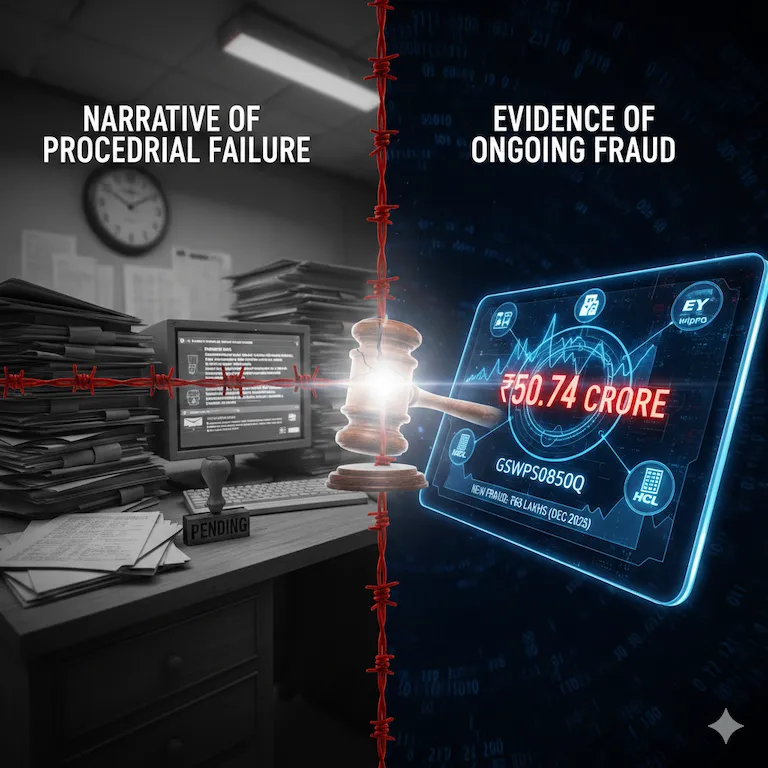
Here are the key takeaways from the blog post regarding the ongoing ₹50 Crore financial fraud case:
- To begin with, the Narrative of Procedural Failure is often illustrated by Massive Financial Exposure
- The total fraudulent turnover, including GST and business receipts, has escalated to a staggering ₹50,74,66,731.
- Furthermore, a single assessment year (2023-24) witnessed a fraudulent GST turnover of ₹16.32 Crore.
- In addition, identity theft was used to link 13 bank accounts and secure fraudulent loans totaling ₹16 Crore.
- Moving on, Systemic Corporate HRA Scam (Narrative of Procedural Failure)
- Major corporations such as EY, Wipro, and HCL are involved as “shell payers” in an organized HRA scam.
- As of late, 24 new fraudulent rent entries were detected on December 13, 2025. These entries total ₹66,07,741. This proves the syndicate is still active.
- Hundreds of employees are claiming rent payments to the victim for properties he does not own.
- Despite this evidence, Critical Investigative Failures (Narrative of Procedural Failure)
- Specifically, the JIMS portal has identified suspects in Bangalore (Mahesh Pratap Singh) and Assam (Naziruddin Barbhuiya). However, no physical arrests have been made.
- Moreover, the Cyber Cell has failed to retrieve IP Addresses and Device IDs from digital wallet providers like DBS Bank.
- Worse yet, the PIO violated Section 7(1) of the RTI Act. They provided a delayed response. This delay constitutes a Deemed Refusal.
- Finally, The Legal Battle at the State Commission (Narrative of Procedural Failure)
- A critical hearing is scheduled for March 12, 2026, before the Uttar Pradesh Information Commission in Room S-1.
- The victim has filed a formal Knowledge of Facts (KOF) under Diary Number D-190220260002 to place fresh evidence on record.
- Consequently, relief sought includes the formation of a Special Investigation Team (SIT). Alternatively, an Economic Offences Wing (EOW) inquiry is requested. This is due to the multi-state nature of the crime.
Identity Theft and Systematic Financial Fraud: The ₹50 Crore Battle of Yogi M.P. Singh (Narrative of Procedural Failure)
In an era where digital footprints are more valuable than gold, the story of Yogi M.P. Singh from Mirzapur, Uttar Pradesh, serves as a chilling manifesto of the vulnerabilities within our financial and investigative systems. Initially, what began as a case of identity theft has escalated into a sophisticated ₹50.74 Crore financial syndicate, involving hundreds of corporate employees, ghost bank accounts, and a multi-state network of perpetrators. This disturbing narrative highlights procedural failures at various levels, as authorities struggled to keep pace with the rapidly evolving tactics of fraudsters, allowing the syndicate to thrive undetected for far too long.
This blog post deconstructs the core issues of this ongoing battle. It highlights the investigative lapses. It also reveals the scale of corporate misuse. Moreover, it discusses the legal fight currently unfolding before the Uttar Pradesh Information Commission.
⚖️1. The Genesis: Identity Theft as a Tool for Massive Fraud
The core of this crisis lies in the unauthorized use of Mr. Singh’s Permanent Account Number (PAN: GSWPS0850Q). Criminal elements hijacked his financial identity to create a parallel universe of transactions: (Narrative of Procedural Failure)
- The GST Syndicate: A massive fraudulent GST turnover of ₹21.95 Crore was generated, specifically with a single assessment year (2023-24) seeing transactions worth ₹16.32 Crore.
- Loan Fraud: Furthermore, initial police reports indicated that his identity was used to link 13 bank accounts. This identity was also used to show a fraudulent loan of ₹16 Crore. Despite this, the applicant had only one legitimate account.
- Multi-State Footprint: Crucially, the fraud isn’t localized. It spans from Bangalore, Karnataka to Silchar, Assam. The operation uses digital wallets and shell bank accounts to move money.
+2
2. The Corporate HRA Scam: Wipro, HCL, and EY in the Spotlight (Narrative of Procedural Failure)
One of the most organized segments of this fraud is a systemic House Rent Allowance (HRA) scam. Specifically, hundreds of employees from top-tier corporations are claiming rent payments to Mr. Singh for properties he does not own and money he has never received.
The Details of the 24 Recent Fraudulent Elements 📉
As recently as December 13, 2025, fresh fraudulent entries appeared in Mr. Singh’s Taxpayer Information Summary (TIS). In fact, a total of 24 new rent entries amounting to ₹66,07,741 were discovered. This clearly shows that the syndicate remains active. This is despite police intervention.
Key corporate misuses identified include: (Narrative of Procedural Failure)
- For instance, EY Global Delivery Services: Reported fraudulent rent of ₹8,57,178 (TSN: 133240057123353).
\+2 - Similarly, TIAA Global Capabilities: Claimed rent of ₹6,20,818 (TSN: 133240014161128).
\+2 - In addition, Wipro Limited: Reported fraudulent rent of ₹3,02,576 (TSN: 133240001333428).
\+1 - Finally, HCL Technologies: Multiple entries for various employees totaling over ₹3.9 Lakhs.
\
3. Investigatory Inertia: Why the Police are Failing (Narrative of Procedural Failure)
Suspects have been identified and there is a trail of digital evidence. However, the investigation by the Mirzapur Police has been criticized as a “narrative of procedural delays.
Failure to Arrest Identified Suspects 🚔🚫
The JIMS (Joint Interoperable Monitoring System) portal successfully identified specific suspects:
- For example, Mahesh Pratap Singh in Bangalore, Karnataka.
\+1 - Similarly, Naziruddin Barbhuiya in Assam. However, the police have failed to dispatch teams for physical arrests. This has allowed the perpetrators to continue exploiting the victim’s identity.
+2
Technical and Administrative Negligence 💻❌(Narrative of Procedural Failure)
- Cyber Cell Failures: Furthermore, the investigation has failed to retrieve IP Addresses. It also failed to retrieve Device IDs from digital wallet providers like DBS Bank (Accounts ending in 2484 and 5183).
- RTI Violations: Moreover, the Public Information Officer (PIO) violated Section 7(1) of the RTI Act. They provided a response to a recent query on February 18, 2026. This response was well beyond the mandatory 30-day limit. Consequently, this delay constitutes a “Deemed Refusal” and highlights an attempt to shield the investigative process from scrutiny.
4. The Legal Battle: UP Information Commission Hearing
The fight for accountability has now reached the Uttar Pradesh Information Commission (UPIC). Specifically, under Appeal No. S01/A/0061/2024, the Commission has scheduled a critical hearing for March 12, 2026, in Room S-1. (Narrative of Procedural Failure)
In the meantime, Mr. Singh has filed a formal Knowledge of Facts (KOF) under Diary Number D-190220260002. This action places the evidentiary table of the 24 new fraudulent elements on the official record. 🏛️ His prayers to the Commission are clear:
- First, Direct the Police to summon Nodal Officers from the 24 corporate entities.
- Second, Order immediate arrest teams for suspects in Bangalore and Assam.
- Furthermore, Recommend an SIT or EOW Inquiry due to the complex, multi-state nature of the ₹50 Crore crime.
- Finally, Freeze digital wallets and bank accounts linked to the fraud.
5. Conclusion: A System on Trial (Narrative of Procedural Failure)
The case of Yogi M.P. Singh is not just about one man’s financial ruin. Furthermore, it concerns the reliability of the Taxpayer Information Summary (TIS). It also reflects on the integrity of corporate HR verification processes and the efficiency of the Cyber Police. 🛡️
Specifically, criminals can misuse a PAN to generate ₹50 Crore in turnover. Meanwhile, the police spend years “sending emails.” The system itself is on trial. Therefore, the hearing on March 12, 2026, will be a pivotal moment for justice. ⚖️🎯
In order to ensure your formal objection is properly supported, you need the official contact details. Your upcoming hearing is on March 12, 2026. Therefore consequently, here are the official contact details for the key public authorities involved in your case.
1. Uttar Pradesh Information Commission (UPIC) 🏛️ (Narrative of Procedural Failure)
The Commission handles your second appeal and oversight of the RTI process.
- Case Reference: Appeal No. S01/A/0061/2024 | Diary No. D-190220260002.
- Web Portal: https://upsic.up.gov.in/.
- Hearing Room: S-1 (State Chief Information Commissioner Dr. Raj Kumar Vishwakarma).
- Email for Submissions: hearingcourts1.upic@up.gov.in or webmaster-upic@up.gov.in.
- Address: 7/7 A, RTI Bhavan, Vibhuti Khand, Gomti Nagar, Lucknow, UP – 226010.
- Contact Number: 0522-2724930.
2. Superintendent of Police (SP) Mirzapur 👮♂️(Narrative of Procedural Failure)
Responsible for the investigation of FIR No. 291/2023.
- SP Name: Smt. Aparna Rajat Kaushik (IPS).
- Email: spmzr-up@nic.in.
- Official Web Link: https://mirzapur.nic.in/police/.
- CUG / Mobile Number: 9454400299.
- Office Landline: 05442-252578.
3. Public Information Officer (PIO) – ASP Operation 📂
The officer who issued the contested RTI response.
- PIO Name: Shri Manish Kumar Mishra (Addl. SP).
- Email: asp-op.mi@up.gov.in.
- Mobile Number: 9454401105.
- RTI Application ID: SPMZR/R/2026/60009.
4. State Cyber Crime Cell / Police Headquarters 📡(Narrative of Procedural Failure)
Crucial for tracing IP addresses and Device IDs from digital banks.
- Headquarters Email: sp-cyber.lu@up.gov.in or asp-cyber.lu@up.gov.in.
- Phone Number: 0522-2390538.
- Nodal Officer Contact: 9454400581.
Summary of Key Application IDs 🔢 (Narrative of Procedural Failure)
| Document Type | Reference ID |
| UPIC Appeal ID | S01/A/0061/2024 |
| UPIC Diary No. | D-190220260002 |
| RTI Registration | SPMZR/R/2026/60009 |
| Police FIR No. | 291/2023 (Kotwali Katra) |
First Appeal Details 📝 (Narrative of Procedural Failure)
- Appeal Registration Number: SPMZR/A/2026/60010
- Date of Filing: 19-02-2026
- Appellate Authority (FAA): Somen Verma, SSP Mirzapur
- Contact Number: 9473567333
- Email ID: spmzr-up[at]nic[dot]in
Relationship Between the Two Proceedings ⚖️
It is important to keep these two tracks distinct but related in your strategy:
- The First Appeal (SPMZR/A/2026/60010): This is a new legal challenge. It addresses the PIO’s “illegal” denial of information. This includes the call logs requested on Jan 7, 2026. 📞🚫
- The Second Appeal (S01/A/0061/2024): This is the ongoing case at the State Information Commission in Lucknow regarding the massive ₹50.74 Crore fraud. 🏛️💰+1
Why the First Appeal ID is Critical Now 🔑 (Narrative of Procedural Failure)
The fact that you had to file this First Appeal is evidence of “Procedural Failure.” During your Commission hearing on March 12th, mention this new Appeal ID (SPMZR/A/2026/60010). It will show that the police are still withholding evidence of their alleged contact attempts. 🛑🕵️♂️


Facing a similar challenge? Share the details in the box below, and our team of experts will do their best to help.