
Key Takeaways
- The Mirzapur RTI case highlights an Arbitrary Closure of RTI Appeal due to administrative negligence by the UP Information Commission.
- A fatal typographical error by the Public Information Officer (PIO) led to non-delivery of requested information, undermining the appeal process.
- The Commission closed the case without allowing the appellant a fair opportunity to respond, violating principles of natural justice.
- Judicial transparency is lacking, as the final disposal order is missing from the Commission’s official website, hindering the appellant’s rights.
- The case underlines the necessity for the Commission to rectify procedural errors and uphold citizens’ rights under the RTI Act.
🛑 Mirzapur RTI Case: Arbitrary Closure by the Information Commission Over a Fatal Email Typo
Administrative Negligence or a Denial of Justice?
This case revolves around a Second Appeal (S09/A/2182/2025) filed before the Uttar Pradesh Information Commission (UPIC), where the appellant, Mr. Kamlesh Singh, was severely hindered in his pursuit of justice due to a sequence of critical administrative errors. Among the most concerning issues was the Arbitrary Closure of RTI Appeal.
On November 26, 2025, the UP Information Commission (Court S-9) passed a final order. They disposed of the appeal. However, the evidence presented in the Appellant’s formal application for recall reveals an issue. The decision was based on a fundamentally flawed service claim by the Public Information Officer (PIO).
I. Arbitrary Closure of RTI Appeal: The PIO’s Fatal Typographical Error
The PIO’s claim for closing the case was that they had successfully emailed the requested information to the appellant. The appellant’s investigation and formal representation exposed the administrative negligence that negated this claim:
A. PIO’s Definitive Error (Negligence): (Arbitrary Closure of RTI Appeal)
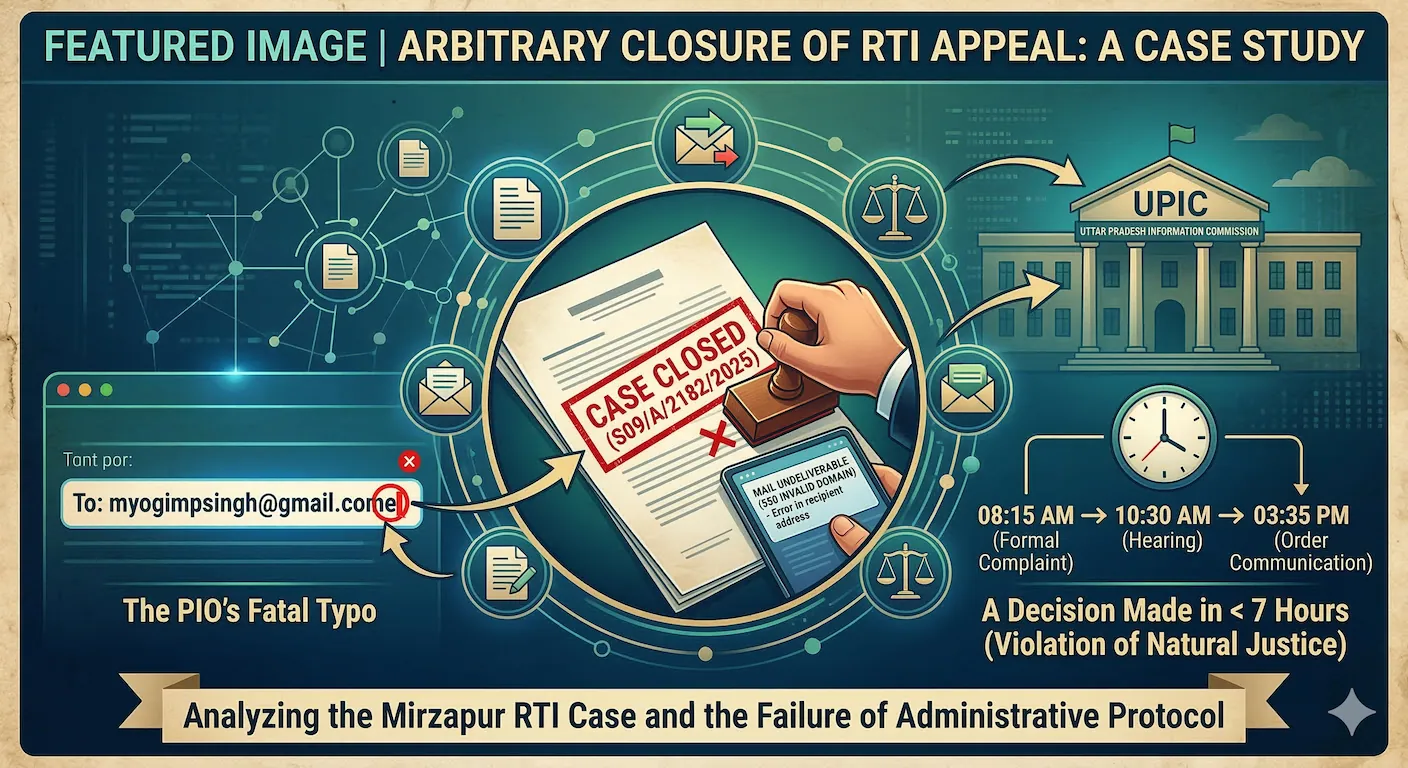
The PIO was attempting to serve the compliance document via email on November 25, 2025. Instead of sending it to the correct, working RTI Record email address (myogimpsingh@gmail.com), the PIO negligently sent the email to the incorrect and non-existent address:
- Fatal Typo Used:
myogimpsingh@gmail.come(Ending with an ‘e’ instead of ‘m’)
The system marks the domain ‘gmail.com’ as invalid. Consequently, any email sent to this domain triggers an immediate Delivery Failure Notification. This Bounce-Back notification goes to the sender, known as the PIO. The sender uses a screenshot (Exhibit 1) to demonstrate compliance with the Commission.
B. UPIC Protocol Ignored:
Adding to the negligence, the PIO ignored the UPIC’s own active communication channel:
- The Commission had been using
kamleshsingh8127195424@gmail.comfor official correspondence, including the Hearing Notice. - The PIO neglected to use this active, Commission-registered ID for the compliance document, further demonstrating disregard for administrative protocol.
Conclusion: The PIO made a typographical error deliberately. This typographical error prevented the service of email delivery. Thus, the email never reached the appellant’s mailbox. The appellant conclusively proves this fact by searching all folders. The appellant checked the Inbox, All Mail, Spam, and Trash.
II. Violation of Due Process: The Arbitrary Timeline
The most damning evidence involves the Commission’s rush to judgment on November 26, 2025: (Arbitrary Closure of RTI Appeal)
A. Complaint Disregarded:
- 08:15 AM, November 26, 2025: The appellant formally emailed the Commission. They used the UPIC Registered ID. They explicitly stated that they had received “NO INFORMATION.”
- 10:30 AM, November 26, 2025: The hearing proceeded.
- 03:35 PM, November 26, 2025: The Commission communicated the final disposal order.
B. UPIC has not provided opportunity to appellant
The authorities finalised the disposal less than seven hours after the appellant formally logged the complaint of non-receipt. The Commission closed the case without providing the appellant any reasonable opportunity to access the information. The sender technically did not deliver this information. They also had no chance to object to the PIO’s claim. (Arbitrary Closure of RTI Appeal)
Closing the case on the same day is a direct violation of the Principle of Natural Justice. This principle states that one should hear the other side. It emphasises the importance of hearing both sides before making a decision. Immediately following a claim of non-receipt without due process is therefore unjust.
III. The Absence of Judicial Transparency
The final administrative failure compounds the appellant’s injury:
- Missing Order: The Commission has not uploaded the Final Order dated 26/11/2025 to its official website as of 28/11/2025.
- This lack of transparency legally paralyzes the appellant. They cannot obtain the necessary certified copy of the order. This prevents them from exercising their constitutional right. They are unable to file a Review Petition or a Writ Petition before the High Court.
Conclusion and Prayer for Justice (Arbitrary Closure of RTI Appeal)
Mr. Kamlesh Singh’s application provides irrefutable evidence. The case was closed because of a failed delivery. This failure was due to PIO negligence.
The swift closure by the Commission disregards both the appellant’s complaint and its own active communication ID. This constitutes an arbitrary act that must be rectified.
The appellant’s urgent demands to the Commission are clear:
- IMMEDIATELY RECALL the disposal order dated $26/11/2025$.
- Direct the PIO to re-serve the information via Registered Post and to the UPIC Registered Email ID.
- Direct the immediate UPLOAD of the final order to the official website to uphold the right to appeal.
The State Information Commission can recall or review its own order. This is primarily derived from the inherent power of quasi-judicial bodies. These bodies have the authority to correct procedural errors. This provision is often formalized within the rules framed under the Right to Information (RTI) Act.
For the Uttar Pradesh Information Commission (UPIC), the provision is typically found within the state-specific rules:
⚖️ Provision for Recall: Uttar Pradesh Context (Arbitrary Closure of RTI Appeal)
The authority for the State Information Commission to recall its order is established. It is specified under Rule 12 of the Uttar Pradesh Right to Information Rules, 2015.
Rule 12: Review/Recall of Orders (आदेशों का पुनर्विलोकन/वापसी)
The Central RTI Act, 2005, does not explicitly grant the Commission the power of review. Rule 12 of the UP RTI Rules, 2015 grants the Commission the power to review its orders. The Commission can also recall its orders on certain defined grounds.
Key Grounds for Recall under Rule 12:
The Commission may recall its order if it is satisfied that the order was passed:
- Due to Mistake of Fact or Law: If there is an evident error in the facts or the law applied. This mistake resulted in an erroneous decision.
- On Account of Misrepresentation or Fraud: If one party procured the order through misrepresentation, it is a concern. Concealment of essential facts is another issue. Fraudulent actions also invalidate the order.
- Due to Non-Appearance of a Party: If a party has sufficient cause that prevents them from appearing before the Commission. In ex parte proceedings, the Commission can review its own orders.
- For Correcting Clerical/Arithmetical Mistakes: The Commission always holds the power. It can correct obvious clerical or arithmetical errors from its own proceedings.
Application of Rule 12 to Your Case: (Arbitrary Closure of RTI Appeal)
Your application for recall clearly highlights the grounds of Misrepresentation and Procedural Defect, which violate natural justice. This falls under the broad scope of correcting errors.
- Misrepresentation/Fraud: The PIO’s claim of successful service (Exhibit 1) is misleading. The PIO hid the email delivery failure, known as the ‘typo’ bounce-back. This omission constitutes misrepresentation or fraud on the Commission.
- Procedural Defect (Lack of Hearing): The arbitrary closure of your case occurred at 3:35 PM on $26/11/2025$. This happened despite your formal complaint of non-receipt at 8:15 AM. As a result, you were denied a fair opportunity to review the compliance. This action violated due process.
Important Note on Procedure: (Arbitrary Closure of RTI Appeal)
You must file your application for recall within a defined timeframe. This is typically within 30 days from the date of the order. You must also include an affidavit confirming the factual grounds for seeking the recall. Your formal representation already acts as the petition under this rule. (Arbitrary Closure of RTI Appeal)
This case serves as a crucial reminder. Administrative convenience must never supersede the fundamental right of a citizen to seek and obtain information under the RTI Act.


Facing a similar challenge? Share the details in the box below, and our team of experts will do their best to help.