
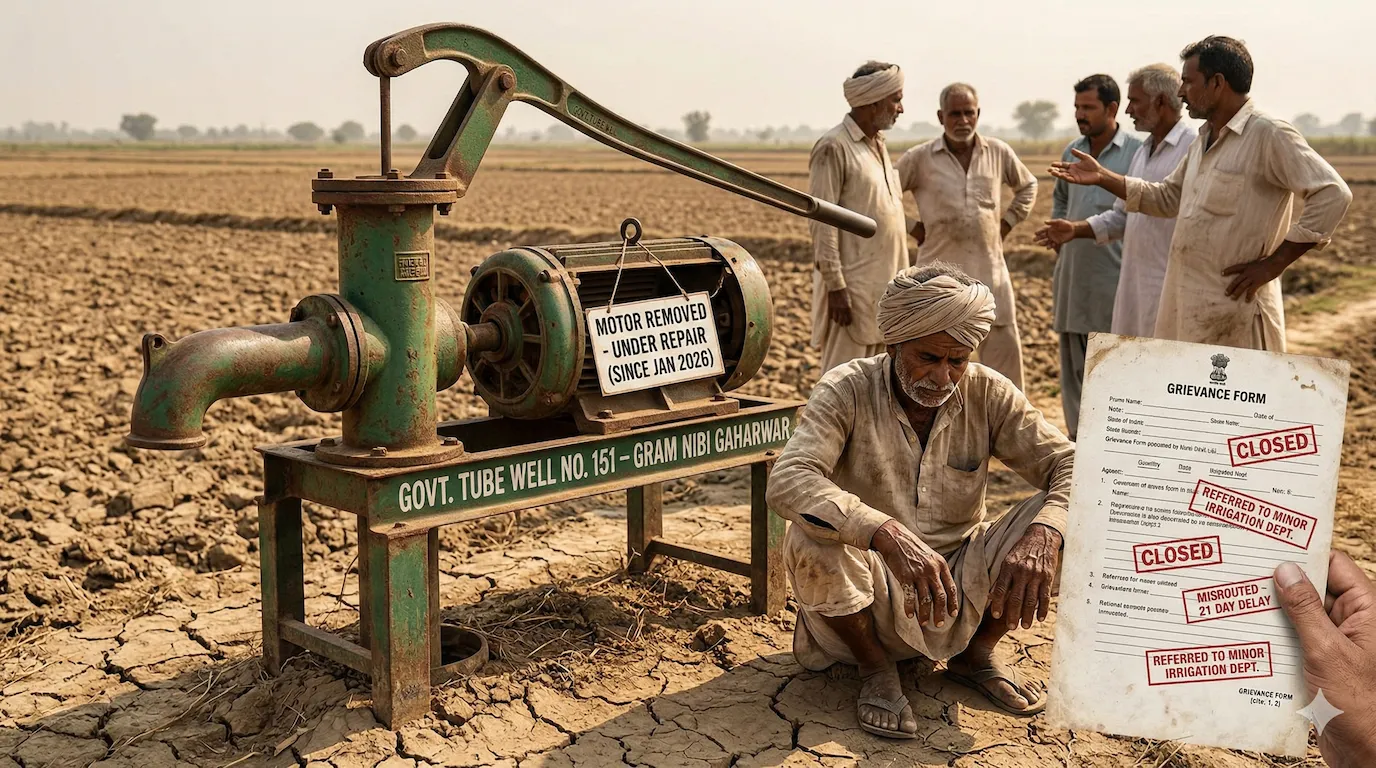
Here are the key takeaways from the analysis of the grievance disposal process. One central finding is that Bureaucratic Latency Paralyses Agriculture, significantly impacting timely resolutions.
- Explicit Misrouting: The complainant addressed the grievance to the Minor Irrigation Department in the initial filing. This was done on January 29, 2026. Despite this, the system misdirected the grievance to U.P. Jal Nigam (Rural).
- Critical Time Loss: The Jal Nigam office held the urgent application for 21 days. Then, it formally declared it lacked jurisdiction on February 19, 2026.
- Procedural vs. Physical Closure: The authorities marked the case as “Closed” on February 25, 2026. This decision was based solely on the act of forwarding a letter to the correct department. They did not confirm the actual repair of the tube well.
- Agricultural Impact: The month-long administrative delay directly coincided with the peak wheat sowing season. This prevented “Paleva” (pre-sowing irrigation). It threatened the livelihoods of dozens of farming families in Gram Nibi Gaharwar.
- Staff Accountability Gap: The grievance highlights a total lack of communication from field-level staff. This includes a Junior Engineer who provided no timeline. A mechanic also kept his phone switched off while the tube well motor remained at a workshop.
- Administrative Harassment: The complainant officially rated the disposal as “Harassment by official.” They noted that bureaucratic “evasive styles” are ineffective. Paperwork transfers do not solve the physical reality of a broken government asset.
High Cost of Red Tape: How Bureaucratic Latency Paralyses Agriculture?
A silent crisis unfolds in the heart of Uttar Pradesh. It does not arise from a lack of resources. Instead, it stems from the friction of a slow-moving administrative machine. The case of Grievance Registration Number GOVUP/E/2026/0012142 highlights the failure of “digital governance. It fails to protect the very citizens it aims to aid when departments work in isolated silos.
The Crisis at Ground Zero: Nibi Gaharwar
For the farmers of Village Nibi Gaharwar in Block Chhanbey, timing is everything. We are currently in the peak season for wheat sowing, a period where every hour carries immense weight. The primary source of life for these fields—Government Tube Well No. 151—has remained broken for weeks.For the farmers of Village Nibi Gaharwar in Block Chhanbey, timing is everything. We are currently in the peak season for wheat sowing, a period where every hour carries immense weight. The primary source of life for these fields—Government Tube Well No. 151—has remained broken for weeks. Bureaucratic latency paralyses agriculture. Farmers are left in limbo as they await the necessary repairs. This ensures their livelihoods are not compromised.
Without ‘Paleva’ (pre-sowing irrigation), farmers cannot prepare the soil or sow their seeds. For dozens of families, this technical fault represents an impending financial catastrophe.
The Anatomy of a Systemic Failure (Bureaucratic Latency Paralyses Agriculture)
When Yogi M. P. Singh filed a formal grievance on January 29, 2026, he provided clear, urgent, and properly addressed instructions. The headline explicitly directed the matter to the Executive Engineer, Mechanical Division (Minor Irrigation Department).
However, a masterclass in bureaucratic “ping-pong” followed:
1. The Misrouting Oversight
The grievance description was clearly labeled. However, the IGRS system or the initial intake officer routed the complaint to the U.P. Jal Nigam (Rural). This initial error set the stage for a month-long delay while the farmers watched their sowing window vanish. (Bureaucratic Latency Paralyses Agriculture)
2. The 21-Day Holding Pattern
The Jal Nigam (Rural) office in Mirzapur received the complaint on January 29. Rather than immediately flagging the jurisdictional error, the department held the application for three weeks. On February 19, 2026, the Executive Engineer finally issued a formal letter (Pattrak No. 1677) stating that the Minor Irrigation Department actually holds responsibility for the case.
3. The “Closed” Status Illusion (Bureaucratic Latency Paralyses Agriculture)
By February 25, 2026, the system marked the case as “Closed”. In the world of administrative metrics, this looks like a resolution. In reality, the “disposal” merely consisted of a letter sent to the District Magistrate and the Minor Irrigation Department. The tube well remained broken, the motor stayed in the workshop, and the farmers remained without water.
The Human Element: Staff Apathy and Misconduct
Beyond the digital paperwork, the grievance highlights a troubling lack of responsiveness from field-level officials: (Bureaucratic Latency Paralyses Agriculture)
- The Motor Mystery: The department uprooted the motor for Tube Well No. 151 and took it to the Mirzapur Workshop days before the complaint, yet officials provided no timeline for its return.
- Communication Blackout: The concerned mechanic kept his phone switched off, and the Junior Engineer (JE) ignored the farmers’ direct pleas.
- Evasive Style: This “evasive style” of working creates a culture of resentment. It makes citizens feel that the very officials paid to serve them are instead harassing them.
The Core Issues: Why Digital Portals Aren’t Enough (Bureaucratic Latency Paralyses Agriculture)
This case exposes three fundamental flaws in the current grievance redressal framework:
A. Lack of Real-Time Triage
When a grievance contains the words “Urgent,” “Tube Well,” and “Sowing Season,” the system should trigger an immediate manual review. Allowing an urgent irrigation complaint to sit in the wrong department’s inbox for 21 days represents a failure of logic.
B. Paperwork vs. Physical Resolution
Authorities should only mark a grievance “Closed” when they physically resolve the issue—meaning the water is flowing. Closing a case because an official “forwarded a report” allows departments to meet their internal quotas. However, the actual problem persists on the ground. (Bureaucratic Latency Paralyses Agriculture)
C. Jurisdictional Silos (Bureaucratic Latency Paralyses Agriculture)
The distinction between Jal Nigam (Rural) and Minor Irrigation is clear to the government. To a farmer, both represent “the water department”. One department could not simply call and alert the other immediately. They chose to wait 21 days to send a formal letter. This shows a total lack of inter-departmental synergy.
Conclusion: A Call for Accountability (Bureaucratic Latency Paralyses Agriculture)
The complainant’s feedback sums up the frustration clearly. If the farmers lose everything, what is the outcome of the repair? Justice delayed is, in this case, a crop denied.
The government must move beyond the “Attached File” culture. The District Magistrate and the Chief Minister’s Secretariat must investigate. They should find out why the system wasted a month on a simple jurisdictional transfer. Meanwhile, the livelihood of a village hung in the balance.
The goal is not to close a ticket; the goal is to irrigate a field.
Based on the documents provided, here are the contact and identification details for the public authorities and the specific case file:
Case Identification Details (Bureaucratic Latency Paralyses Agriculture)
- Grievance Registration Number: GOVUP/E/2026/0012142
- Related Reference Numbers: 40019922026664, 40019922026783
- IGRS Disposal Number: 60000260024475
- Internal Letter Number (Pattrak): 1677 / District Visitor / 1551
Public Authority Contact Information (Bureaucratic Latency Paralyses Agriculture)
| Authority / Office | Contact Detail |
| Shri Arvind Mohan (Joint Secretary) | Email: arvind.12574[at]gov[dot]in |
| Chief Minister Secretariat (Lucknow) | Phone: 0522-2226350 |
| U.P. Jal Nigam (Rural) (Mirzapur) | Phone: 05442-245381 |
| District Magistrate Office (Mirzapur) | Addressed in Letter: Collectorate, Mirzapur |
| Minor Irrigation Department (Mirzapur) | Office: Executive Officer, Mechanical Division |
Web Link and Digital Access (Bureaucratic Latency Paralyses Agriculture)
While the specific direct link to this case is private to the complainant, the public authorities manage grievances through the following portal:
- Jansunwai (IGRS) Portal:jansunwai.up.nic.in
- You can use this portal to “Track Complaint” or “Send Reminder” using Registration Number GOVUP/E/2026/0012142.
Complainant Information (For Verification)
- Name: Yogi M. P. Singh
- Mobile Number: 7379105911
- Address: Sureka Puram Colony, Rewa Road, Mirzapur
Would you like me to assist you? I can help draft a formal email to Shri Arvind Mohan at the Chief Minister’s Secretariat. It will help escalate this delay. (Bureaucratic Latency Paralyses Agriculture)


Facing a similar challenge? Share the details in the box below, and our team of experts will do their best to help.