
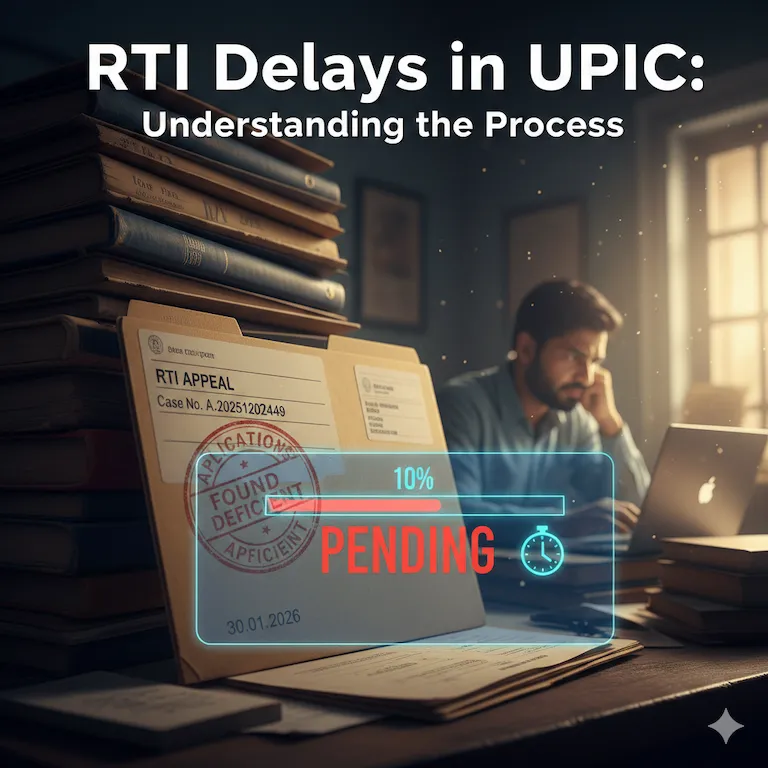
These are the key takeaways from the blog post. Firstly, it discusses the hurdles in the RTI process. Additionally, it highlights the specific delays at the Uttar Pradesh Information Commission. Furthermore, this article explores the issue of RTI delays in UPIC and explains why it has become a concern for information seekers.
1. The Procedural “Deficiency” Hurdle (RTI Delays in UPIC)
- Appeals often enter a state of limbo when marked with the status Applications found deficient.
- While meant to ensure documents meet Form 14 standards, this status is frequently used as a bureaucratic delay tactic.
- Research Officers may hold these files for over a month without informing the appellant of the specific error.
2. Failure of Communication
- By law, only the Registrar can issue a Facilitation Memo to help a citizen fix their appeal.
- When the Commission fails to send this memo, the citizen cannot move the case forward, effectively denying them justice.
3. Challenges with High-Level Offices (RTI Delays in UPIC)
- RTI requests involving the Chief Ministers Office (CMO) face unique resistance. There are evasive replies. Additionally, requests are transferred to avoid answering specific points.
- Appellate Authorities often issue proforma orders—pre-written, “rubber-stamp” decisions that ignore the actual facts of the case.
4. The Impact of Systemic Delays
- The legal 30-day response mandate is rarely met, with national backlogs exceeding 4 lakh cases.
- Justice is often denied because information loses its relevance and value by the time a hearing occurs.
5. Strategies for Accountability (RTI Delays in UPIC)
- Citizens can fight procrastination by filing a new RTI application against the Information Commission itself.
- Demanding internal documents like the Daily Progress Report or File Movement Register forces the Commission to explain why a file has stalled.
6. Necessary Reforms (RTI Delays in UPIC)
- The system requires automated transparency; therefore, the portal shows the exact reason for a deficiency the moment it is flagged.
- There must be strict staff deadlines and consequences for officers who hold files without issuing the mandatory notifications.
The Administrative Labyrinth: RTI Delays in UPIC
The RTI Act of 2005 intended to empower citizens; consequently, it aimed to make the state accountable to the people. This law gave every Indian the right to question authority. However, the current reality in Uttar Pradesh shows a different picture. Unfortunately, many appellants face a dead-end when seeking data from the Chief Ministers Office. Moreover, they often get stuck at the Uttar Pradesh Information Commission, with RTI Delays in UPIC causing frustration and uncertainty. Instead of clarity, they find, regrettably, a complex web of procedural delays.
The Deficiency Trap: A Procedural Obstacle
Appellants frequently see a status labeled Applications found deficient. Officially, this status serves as a compliance check; therefore, it ensures that documents follow the standards of Form 14. Additionally, the commission uses this process to verify signatures and dates. Notably, RTI Delays in UPIC often stem from these procedural obstacles and unclear requirements.
In practice, this status acts as a bottleneck. Research Officers hold cases for over a month; moreover, they rarely tell the appellant what is actually wrong. Consequently, this lack of communication leaves citizens confused. Under the CATS-UPSIC system, officers must forward these files to the Registrar. Unfortunately, only the Registrar can issue a Facilitation Memo. This memo is, in fact, the only way a citizen learns how to fix the appeal. Without it, the appeal stays in limbo; thus, the case remains open but motionless.
The CMO and the Accountability Gap
Transparency is vital when an RTI involves the Chief Ministers Office. Appellants want to know how the state monitors grievances. They question why junior staff like Lekhpals report on senior officers. These questions target the heart of administrative discipline, especially considering the impact of UPIC RTI Delays on accountability.
Three core issues define this struggle:
- Evasive Replies: PIOs transfer applications to avoid answering specific points.
- Proforma Orders: Appellate Authorities issue rubber-stamp decisions without checking the facts.
- Hidden Information: Officials hide data that might expose administrative flaws.
- Ignoring Public Interest: High-level offices often overlook the urgency of citizen requests.
The Time Trap: Denying Justice through Delay
Time destroys the impact of the RTI Act; consequently, information loses its value as months pass. The law mandates a response within 30 days; however, citizens often wait over a year for a second appeal hearing. Moreover, national backlogs now exceed 4 lakh cases. As a result, RTI delays in UPIC can crucially undermine public trust in timely access to information.
This delay hurts common people. Specifically, a farmer needs information quickly to resolve land issues. Moreover, long waits allow corruption to stay hidden. Consequently, when the system stalls, the corrupt gain an advantage. Ultimately, justice delayed is truly justice denied in the world of RTI.
Breaking the Silence: Using New RTIs (RTI Delays in UPIC)
Citizens can fight back when the Commission causes the delay. You can file an RTI against the Information Commission itself. Demand the Daily Progress Report of your file. This forces the Commission to explain its own inaction. You can ask for names of officers responsible for your file. Furthermore, addressing RTI Delays in UPIC through new applications is an important step toward greater transparency.
These RTIs target the Public Information Officer of the Commission. Consequently, this creates a legal record of their failure. Moreover, it proves they did not issue a Facilitation Memo on time. As a result, it turns the law back on those meant to uphold it. Ultimately, this strategy helps break the wall of silence.
Conclusion: The Path to Reform (RTI Delays in UPIC)
A strong law requires strong institutions to work. The Uttar Pradesh Information Commission must change. It should:
- Automate Transparency: The portal must show the exact deficiency reason immediately.
- Add Judicial Expertise: The commission needs members who understand legal procedures.
- Set Staff Deadlines: Officers must face consequences for holding files without cause.
- Enhance Public Outreach: Citizens need clearer guides on avoiding technical errors.
Transparency is a two-way street. Therefore, the Commission must be as open as the offices it monitors. Without internal reform, the RTI Act will inevitably lose its power. Consequently, we must demand a system that works for the people. It should not work against them. Moreover, this is especially crucial in tackling the persistent RTI delays in UPIC.
The records and the RTI you just filed have been reviewed. Here are the specific application IDs. Contact details and web links for the public authorities involved are also included.
1. Uttar Pradesh State Information Commission (UPIC)
This is the authority currently processing your Second Appeal; furthermore, they are also handling your new RTI regarding the delay.
- Second Appeal ID: A-20251202449
- New RTI Registration Number: UPICM/R/2026/60103
- Web Link: https://upsic.up.gov.in
- Public Information Officer (PIO): Mumtaz Ahmad (Administrative Officer)
- Mobile: 9151804317
- Email: jansu-section.upic@up.gov.in
- Nodal Officer: * Telephone: 9415021746
- General Commission Email: webmaster-upic@up.gov.in
2. Chief Minister Office (CMO), Uttar Pradesh (RTI Delays in UPIC)
This is the department that originally handled your grievance and the initial RTI.
- RTI Application No: DOCMO/R/2025/61124
- Original Grievance ID: GOVUP/E/2025/0096028
- Public Information Officer (PIO): Vinod Sharma (Section Officer, Section-III)
- Mobile: 9454412736
- Email: vsls32165@gmail.com
- First Appellate Authority (FAA): Anjna Tripathi (Under Secretary)
- Mobile: 9454411282
- Email: anjna.11282@gov.in
- Nodal Officer: Sanjay Chaturvedi
- Mobile: 9454410972
- Email: sanjay.10972@gov.in
Summary Table for Quick Reference (RTI Delays in UPIC)
| Authority | Role | Name | Phone/Mobile | |
| UPIC | PIO (Current RTI) | Mumtaz Ahmad | 9151804317 | jansu-section.upic@up.gov.in |
| UPIC | Nodal Officer | — | 9415021746 | — |
| CMO | PIO (Original) | Vinod Sharma | 9454412736 | vsls32165@gmail.com |
| CMO | FAA | Anjna Tripathi | 9454411282 | anjna.11282@gov.in |
| CMO | Nodal Officer | Sanjay Chaturvedi | 9454410972 | sanjay.10972@gov.in |
Would you like me to help you draft a follow-up email to the UPIC Nodal Officer? We can check the status of your second appeal.


Facing a similar challenge? Share the details in the box below, and our team of experts will do their best to help.