
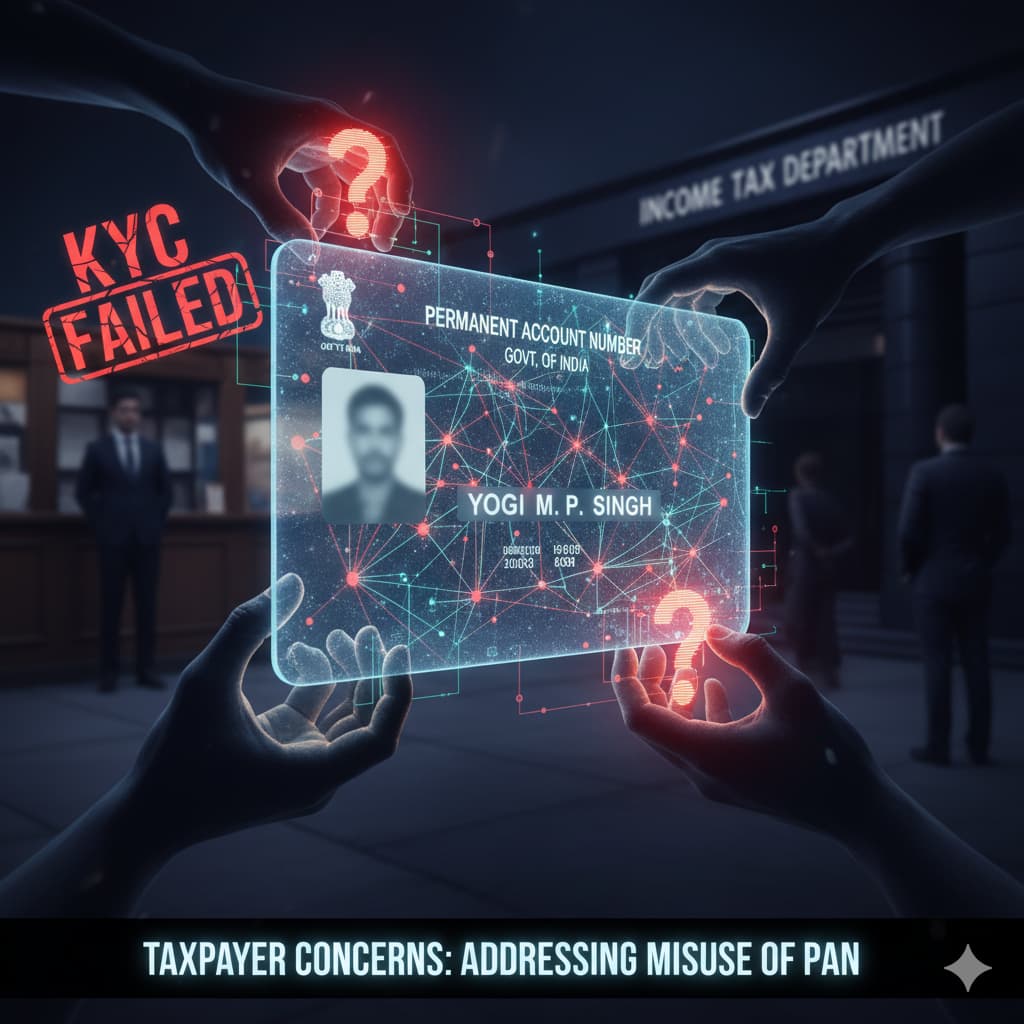
Taxpayer Concerns & Misuse of PAN is a serious issue for the government departments. Unfortunately, they are still procrastinating on the issue instead of proactively working out the case. Moreover, the misuse of PAN can lead to significant financial repercussions for taxpayers, ultimately resulting in a distortion of their tax liabilities and adversely affecting their financial well-being. Furthermore, the delay in addressing these concerns significantly undermines public trust in the tax administration system. Consequently, tax authorities must prioritize resolving cases of PAN misuse through more stringent verification processes and timely communication. Additionally, implementing robust guidelines and educating taxpayers about safeguarding their PANs can effectively mitigate potential risks. Ultimately, it is essential for the government to take decisive actions to ensure accountability and protect citizens, thereby fostering a transparent and fair taxation environment.
Key Takeaways
- The misuse of the Permanent Account Number (PAN) undermines its purpose as a unique identifier for financial transactions in India.
- A recent grievance reveals fraudulent activities linked to an individual’s PAN, raising serious concerns about systemic failures in the financial and taxation sectors.
- Key issues include banking institutions’ failure to adhere to KYC standards and the Income Tax Department’s lack of real-time monitoring of PAN usage.
- The ongoing administrative negligence leads to significant suffering for innocent citizens, highlighting an accountability void in enforcement actions.
- Immediate actions needed include strengthening KYC integration, conducting a forensic audit, and escalating the case to a formal criminal investigation to prevent further misuse of PAN.
🚨 Taxpayer Concerns & Misuse of PAN: Unmasking the Misuse of a Unique Identifier
The Permanent Account Number (PAN) forms the foundation of India’s financial and taxation system. Officials designed it to give every individual and entity a unique, permanent identity for significant financial transactions. However, a recent and alarming grievance filed with the Central Board of Direct Taxes (CBDT) throws this fundamental assumption into serious doubt.
Yogi M. P. Singh lodged the complaint, and it exposes a chilling scenario. Fraudulent elements have blatantly misused his PAN, and as a result, the system has erroneously linked a host of financial activities to his identity — including business receipts, GST turnover, and even winnings from lotteries and online games. (Taxpayer Concerns & Misuse of PAN)
This situation goes beyond one individual’s financial headache. Instead, it points to a systemic failure that demands immediate attention from banking institutions, the Income Tax Department (ITD), and law enforcement.
The Critical Questions Arising from a Grievance
The complainant’s own words frame the central paradox: If the PAN is unique, how can someone else misuse it? (Taxpayer Concerns & Misuse of PAN)
The very premise of PAN’s integrity collapses when an innocent citizen finds their identity tagged with substantial, undeclared income and transactions they never conducted. The detailed Taxpayer Information Summary (TIS) provided in the grievance shows categories like “Winnings from lottery,” “Business receipts,” and “GST turnover.” Together, these entries offer a stark, quantified picture of this identity theft.
| SR. NO. | INFORMATION CATEGORY | PROCESSED BY SYSTEM (INR) | CONCERN |
|---|---|---|---|
| 1 | Winnings from lottery or crossword puzzle | 613 | Misused PAN |
| 4 | Business receipts | 10,63,414 | Misused PAN |
| 5 | GST turnover | 25,44,342 | Misused PAN |
| 7 | Winnings from Online Games | 550 | Misused PAN |
The complainant explicitly states that the TIS “does not concern the applicant who is the real PAN holder” and that he has “never submitted any income tax return.” Therefore, this proves that the financial activities linked to the PAN are entirely fraudulent as far as the actual individual is concerned.
The Serious Lapses in Due Diligence
The sheer scope of the reported fraudulent activities raises an important question: what mechanisms, after all, ultimately allowed them to happen? Importantly, two key institutional failings sit at the core of the issue.
1. Banking Institutions and KYC Failure (Taxpayer Concerns & Misuse of PAN)
The most direct violation involves the opening of bank accounts. A bank account serves as the gateway to almost all financial activity, including everything listed in the TIS. Consequently, the complainant asks: “How are fraudulent elements able to open bank accounts without undergoing proper verification of records?
- Know Your Customer (KYC) Standards: Consequently, banks must follow strict KYC procedures. Specifically, these require staff to verify documents such as PAN and proof of address against original copies, alongside ensuring the individual’s physical presence.
- Aadhaar/PAN Linkage Loopholes: Banks often use Aadhaar to open accounts, but PAN remains essential for high-value transactions. This misuse therefore suggests either forgery of the PAN card combined with weak identity checks by bank staff, or a complete bypass of the verification process through corrupt means.
- Lack of a Digital Audit Trail: If a bank staff member enables the fraud, then a clear “serious lapse in the due diligence process” exists — one that internal audits should easily detect.
2. The Income Tax Department’s Monitoring Role
The ITD acts as the custodian of the PAN database. Its role extends beyond issuing the number; it must also safeguard that number’s integrity and monitor its use.
- Failure of Real-Time Monitoring: The ITD’s systems clearly flag these transactions and send “streaming messages” to the real PAN holder. Yet the system seems unable to act on the initial red flags — for instance, multiple bank accounts opened in different cities under the same PAN, or the sheer volume and diverse nature of transactions like lotteries and GST turnover.
- Inadequate Investigation: The applicant has submitted “more than hundreds of representations” and raised the issue with the Intelligence and Criminal Investigation wing. Still, the official status shows “Three representations considered as TEP result 0.” This outcome reflects a bureaucratic inertia that fails to translate documented evidence of a crime into decisive action.
The Accountability Void: Why Are the Enforcers Blind? (Taxpayer Concerns & Misuse of PAN)
The most troubling aspect of this case involves the alleged “consistent failure” of the police, along with the lack of action against “negligent staff in both banking institutions and the Income Tax Department.
The grievance directly addresses this failure of the enforcement ecosystem: (Taxpayer Concerns & Misuse of PAN)
The police have consistently failed to take action against negligent staff… Consequently, this inaction not only emboldens wrongdoers but also undermines public trust in the system.
Because officials have failed to investigate and prosecute bank or ITD staff who enable such fraud, an accountability void has formed. When the very system designed to protect citizens instead becomes the source of their suffering, it signals a profound failure of governance. (Taxpayer Concerns & Misuse of PAN)
The grievance status remains “Under process” (as of 13/03/2025) and now sits with the Director General of Income Tax (Systems). This suggests officials are treating the case as a technical data issue rather than a criminal identity theft and corruption matter.
The Final, Imperative Question (Taxpayer Concerns & Misuse of PAN)
The administrative negligence causing suffering to innocent citizens like Yogi M. P. Singh cannot go ignored. Misusing a unique financial identity carries severe consequences, potentially leading to unwarranted tax demands, financial liabilities, and harassment.
The complainant’s final question captures the public’s anxiety well: “Who will be held accountable for the suffering caused to innocent citizens due to this administrative negligence?” (Taxpayer Concerns & Misuse of PAN)
Ultimately, the resolution of this specific grievance must serve as a blueprint for a nationwide strategy. Officials need to secure the integrity of the PAN system, enforce stringent KYC norms, and hold negligent officials — in banks and government departments alike — personally accountable. After all, trust in India’s financial system hinges on it.
What Needs to Happen Next (Taxpayer Concerns & Misuse of PAN)
Strengthening KYC Integration: Banks must implement a real-time, mandatory digital verification layer with the ITD database for all PAN submissions — one that goes beyond simple document checks. P Singh is retaliatory action of Modi government
System-Wide Forensic Audit: The DGIT (Systems) must launch a forensic audit to trace all bank accounts and entities linked to the misused PAN, then immediately flag them as fraudulent.
Criminal Investigation Mandate: Officials must escalate the case from a mere grievance to a formal criminal investigation. This investigation should involve the police and the ITD’s Intelligence wing, so they can identify both the fraudulent elements and the enabling institutional staff.
Here are the official links for the public authorities named in the article, in short:
Income Tax Department / CBDT
- Main portal: https://www.incometaxindia.gov.in
- e-Filing (grievances, ITR, PAN/TAN): https://www.incometax.gov.in
- CBDT circulars/notifications: https://www.incometaxindia.gov.in/cbdt
- DGIT (Systems): https://office.incometaxindia.gov.in/systems/Pages/about-us.aspx
CPGRAMS — for filing/tracking grievances against any central government office (ITD, CBDT, police, etc.)
Reserve Bank of India (banking/KYC complaints)
- RBI main site: https://www.rbi.org.in
- Complaint Management System (Integrated Ombudsman): https://cms.rbi.org.in
CBI (for escalated criminal/fraud investigation)
Uttar Pradesh Police (for FIR status/local complaint, since the grievance mentions UP police inaction)
- UP Police portal: https://uppolice.gov.in
- UP Police online FIR/citizen services: https://uppolice.gov.in/citizen


Facing a similar challenge? Share the details in the box below, and our team of experts will do their best to help.